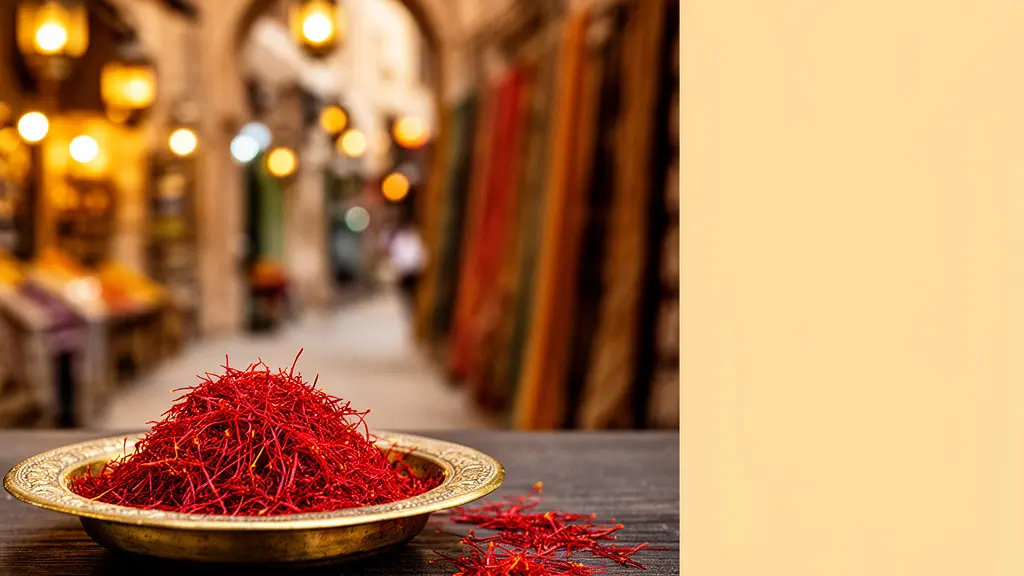
Authentication failure in saffron purchases stems from relying on visual color alone rather than chemical and morphological verification.
- Real Super Negin exhibits trumpet-shaped stigmas with crocin levels above 220 (ISO 3632) and completely absent yellow styles.
- The cold water test remains the most reliable field assay: genuine threads release yellow pigment gradually, while synthetic dyes bleed instantly.
- Metric arbitrage using the Tola system and repackaged Iranian “Spanish” saffron constitute the primary economic fraud vectors in Dubai souks.
Recommendation: Perform the cold water and baking soda tests on sample threads before negotiating price or accepting packaging.
The Spice Souk of Dubai presents a sensory paradox: abundant displays of crimson “red gold” coexist with endemic adulteration that confounds even experienced buyers. Tourists seeking authentic Crocus sativus stigmas encounter what professional graders term “saffron-adjacent material”—turmeric-dyed corn silk, safflower petals, or exhausted Iranian threads rehydrated with vegetable glycerin and honey. The platitude suggests evaluating “vibrant color” and “strong aroma,” yet modern fraud employs erythrosine dyes and paraffin coatings that mimic premium morphology while lacking chemical potency.
The scientific reality demands microscopic scrutiny of stigma architecture and quantitative assessment of crocin concentration. This guide adopts the methodology of an ISO 3632 laboratory inspector, adapted for field conditions in hot climates. You will learn to distinguish Super Negin from Sargol based on fracture patterns, to deploy the cold water test as a chromatographic assay, and to recognize the re-export economics that relabel Iranian produce as Spanish. We will examine hygroscopic degradation mechanisms in Dubai’s humidity and the metric arbitrage of the Tola versus Gram systems.
The objective transcends avoiding fake threads; it involves understanding the material science of saffron authentication. By applying these protocols, you transform from a vulnerable tourist into an informed purchaser capable of assessing chemical potency through observable physical constants and provenance verification.
The following sections provide a systematic framework for authentication, beginning with morphological grading and progressing through chemical assays, provenance verification, and preservation science. We conclude with parallel authentication methods for other luxury goods commonly sought in Dubai, ensuring comprehensive consumer protection.
Table of Contents: Scientific Authentication of Saffron and Luxury Goods in Dubai
- Why Is Super Negin Saffron More Expensive Than Sargol?
- The Cold Water Test: How to Check Saffron Purity in 30 Seconds?
- Persian or Spanish Saffron: Which Is Better for Rice Dishes?
- The Packaging Mistake That Dries Out Your Saffron in a Month
- Gram vs Tola: How to Calculate the Price per Gram Correctly?
- The Turmeric Mistake: How to Spot Artificially Colored Spices?
- The Shopping Mistake of Buying “Local” Pearls That Are Actually Imported
- Dates or Chocolate: What Is the Appropriate Gift When Visiting an Emirati Home?
Why Is Super Negin Saffron More Expensive Than Sargol?
Morphological grading of saffron stigmas follows strict ISO 3632 standards that classify threads based on fracture patterns, apical symmetry, and the absence of the yellow style. Super Negin represents exclusively the distal portion of the stigma, harvested before dehydration and symmetrically trimmed to eliminate all non-pigmented tissue. These threads exhibit a characteristic trumpet-shaped flaring at the tip, with cellular structures that retain higher concentrations of glandular trichomes.
The chemical differentiation proves equally critical. Super Negin typically demonstrates crocin concentrations—the water-soluble carotenoid responsible for color potency—ranging between 220 and 260 on the ISO color scale, whereas Sargol threads generally register 220 to 250. This variance stems from harvest timing and cellular integrity; Super Negin stigmas undergo separation before drying, preserving volatile compounds, while Sargol may include distal fragments from post-drying processing.
The following table delineates the technical distinctions between these premium grades:
| Attribute | Super Negin | Sargol |
|---|---|---|
| Thread length | Longer, thicker, unbroken | Shorter, may contain broken tips |
| Yellow/white style | Completely absent | Completely absent |
| Visual appeal | Symmetrically cut, aesthetically premium | Irregular, fragmented appearance |
| Crocin (color) ISO 3632 | 220–260+ | 220–250 |
| Separation timing | Separated before drying (fresh flower) | Separated after drying |
| Price tier | Highest (luxury/gift market) | High (professional/culinary use) |
| Best use | Luxury gifting, premium restaurants, visual presentation | Cooking, tea, extracts where appearance is secondary |
Visual inspection under magnification reveals further distinctions. The image below illustrates the trumpet-shaped termination that defines premium quality, showing the flared stigma tip against the uniform crimson filament.

For culinary applications, Super Negin serves luxury presentation where thread appearance matters, while Sargol suffices for extraction-based cooking. However, for authentication purposes, recognizing these morphological constants prevents accepting broken, recomposed fragments sold as premium grade.
The Cold Water Test: How to Check Saffron Purity in 30 Seconds?
The cold water test operates on the principle of differential solubility: authentic saffron contains crocin, a water-soluble carotenoid that releases gradually into solution, whereas synthetic adulterants employ oil-based or alcohol-based dyes that exhibit immediate bleeding. This assay requires no laboratory equipment yet provides chromatographic-level specificity when interpreted correctly.
To execute the protocol, place two to three threads in a glass of cold water. Genuine stigmas release a golden-yellow hue over ten to fifteen minutes while retaining their structural integrity and red coloration. Conversely, samples treated with erythrosine or tartrazine bleed red dye instantly, indicating artificial coloration. Research indicates that 20–30% of commercial saffron is adulterated globally, with regulatory disparities ranging from 3.5% in EU markets to 60% in unregulated regions, underscoring the necessity of field testing.
Secondary confirmation methods include the oil and paper rub test: rubbing threads between clean white paper should leave no greasy residue, whereas paraffin-coated fakes deposit oily stains. The baking soda test involves mixing baking soda with water to create an alkaline environment; authentic saffron turns the solution yellow-orange, while artificial dyes produce red or cloudy discoloration. Finally, the thread integrity rub assesses cellular structure: after soaking, genuine threads remain intact when rubbed between fingers, whereas dyed corn silk or paper fibers disintegrate into mush.
Persian or Spanish Saffron: Which Is Better for Rice Dishes?
The provenance question reveals complex geopolitical economics rather than simple agricultural terroir. Iran produces approximately 90% of global saffron, yet much of this volume reaches international markets through re-export channels that obscure its origin. According to Mohammad-Hassan Didehvar of the Iran-Spain Joint Chamber of Commerce, Iranian saffron constitutes the primary supply for Spanish export markets, where bulk purchases undergo repackaging and redistribution as “Spanish” produce.
This provenance laundering extends to Dubai, which functions as a critical logistics hub. The UAE imported 67.12 tonnes of Iranian saffron during the most recent Persian calendar year, followed by China and Spain, indicating that threads purchased in Dubai may traverse complex intermediary routes before reaching retail displays.
Chemically, Persian and Spanish saffron derive from identical Crocus sativus cultivars, yet processing methodologies create distinct chromatic profiles. Persian saffron typically exhibits deeper golden-amber color release due to traditional dehydration methods that preserve higher safranal content, while Spanish variations often display brighter, quicker-releasing yellow tones. The image below illustrates this chromatic divergence in rice preparation.
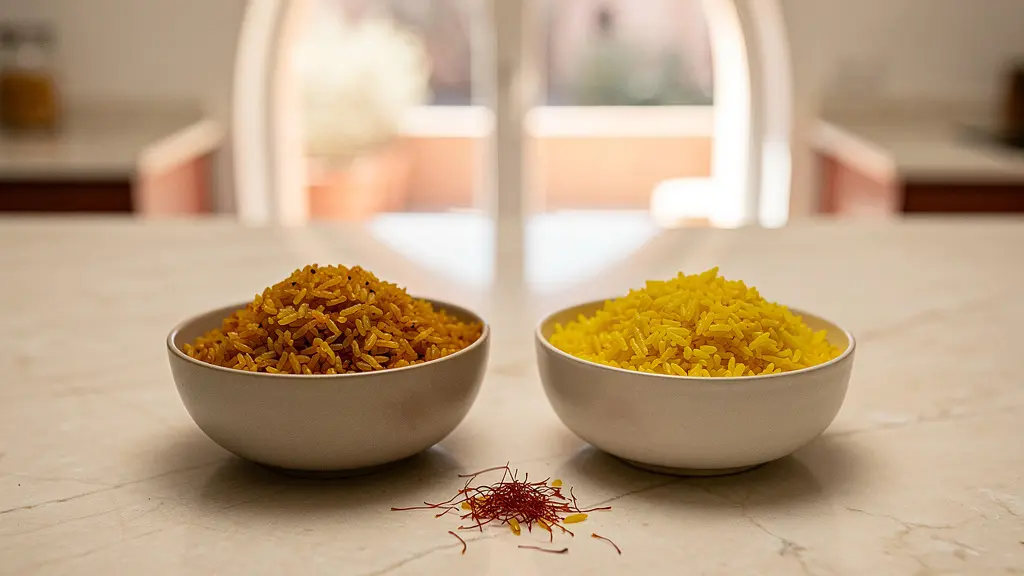
For rice dishes specifically, Persian saffron provides superior aroma retention and color stability during the extended cooking process, though the distinction matters less than ensuring you purchase authentic threads rather than repackaged commodity grades marked up through false geographic indication.
The Packaging Mistake That Dries Out Your Saffron in a Month
Saffron exhibits extreme hygroscopic sensitivity and photodegradation tendencies. The crocin and safranal compounds that constitute its value degrade exponentially when exposed to oxygen, moisture, or light—particularly problematic in Dubai’s high-humidity, high-UV climate. With market prices reaching 30 Euros per gram and 43% of samples showing adulteration, improper storage constitutes economic forfeiture.
The primary error involves purchasing pre-ground powder, which oxidizes immediately and invites undetectable adulteration with turmeric, paprika, or rice flour. Secondary errors include accepting decorative velvet or wooden souvenir boxes that permit oxygen diffusion, or transparent glass containers that accelerate photochemical degradation of crocin molecules.
Storage Protocol for Hot Climates: Dubai Saffron Preservation
- Never buy pre-ground saffron powder — once ground, saffron oxidizes immediately and is highly susceptible to adulteration with turmeric, paprika, or rice flour.
- Avoid decorative velvet or wooden souvenir boxes for long-term storage — they are rarely airtight and allow moisture and oxygen to degrade the saffron’s volatile compounds.
- Use opaque, airtight metal tins (like traditional Persian Khatam tins) rather than glass jars — glass exposes saffron to light, which accelerates crocin degradation, especially problematic in Dubai’s intense sunlight.
- Keep saffron whole as threads until the moment of cooking — grinding releases safranal and crocin into the air, meaning pre-ground saffron loses potency exponentially faster.
- When transporting saffron home from Dubai, wrap the tin in a cloth bag inside your carry-on to avoid condensation damage from cargo hold temperature fluctuations.
Proper storage protocols ensure that the volatile compounds you paid for remain intact until extraction.
Gram vs Tola: How to Calculate the Price per Gram Correctly?
The Dubai Spice Souk operates on multiple metric systems simultaneously, creating arbitrage opportunities for vendors familiar with tourist confusion. While the international standard uses grams, many traders employ the Mesghal (4.6 grams) or the Tola (11.664 grams, often rounded to 12 by vendors). This metrological ambiguity enables silent margin extraction: calculating prices based on 12-gram Tolas while dispensing 11-gram quantities.
The following conversion table clarifies these weight relationships and associated tourist vulnerabilities:
| Unit | Equivalent in Grams | Common Usage Context | Tourist Pitfall |
|---|---|---|---|
| 1 Gram | 1 g | International standard, used in retail packaging | Compare price per gram across vendors for fair pricing |
| 1 Mesghal (مثقال) | 4.6 g | Traditional Persian unit, common in Dubai Spice Souk among Iranian traders | Tourists may confuse Mesghal price with gram price, paying ~4.6x more than expected per gram |
| 1 Tola | 11.664 g (often rounded to 11.7 g) | Indian subcontinent unit, used in Dubai’s gold and spice trade | Vendors may calculate price based on 12 g but dispense only 11 g, silently increasing margins |
| 1 Ounce | 28.35 g | Western/Imperial system, rarely used in Dubai souks | Conversion errors between metric and imperial can lead to overpaying |
Retail prices in Dubai typically range from AED 25–50 per gram (approximately $7–$14 USD), with Super Negin commanding the highest tier. Always verify the digital scale display and confirm the unit of measurement before negotiating. Carry a calculator to derive price-per-gram equivalencies in real time, refusing transactions that refuse metric transparency.
The Turmeric Mistake: How to Spot Artificially Colored Spices?
Adulteration taxonomy extends beyond saffron to include species substitution and dye application. Safflower (Carthamus tinctorius), marketed as “kasubha” or “Philippine saffron” in Dubai souks, presents flat, ribbon-like petals lacking the trumpet morphology of true stigma. According to Food Fraud Advisors, safflower lacks crocin, picrocrocin, and safranal entirely, functioning solely as a colorant without aromatic or flavor compounds.
Common adulterants include dyed corn fibers, calendula stigmas, pomegranate fibers, and silk threads treated with Sudan dyes or tartrazine. These materials mimic crimson coloration but fail morphological and chemical assays.
Three rapid field tests identify these substitutions:
- Shape Inspection: Authentic threads display trumpet-shaped flaring at one end; dyed corn silk remains uniformly cylindrical without apical expansion.
- Taste Test: Genuine saffron exhibits distinct bitterness from picrocrocin with floral notes; artificial dyes taste metallic or absent.
- Tissue Rub: Spitting the thread onto white paper and rubbing should yield yellow staining (crocin); red staining indicates synthetic dyes.
Turmeric powder represents another vector, sometimes mixed with saffron powder or used to color inferior threads. The baking soda test distinguishes these: turmeric produces an immediate red-brown reaction in alkaline solution, while authentic saffron maintains yellow-orange chromatics.
The Shopping Mistake of Buying “Local” Pearls That Are Actually Imported
The authentication protocols applied to saffron extend to other luxury goods in Dubai, particularly natural pearls. The Emirates markets “Gulf pearls” extensively, yet authentic natural saltwater pearls from the Arabian Gulf constitute less than 0.01% of inventory. Most offerings consist of freshwater cultured pearls imported from China, chemically coated to simulate nacre depth.
Natural Gulf pearls form without human intervention in Pinctada radiata oysters, exhibiting slightly gritty surface textures when rubbed against dental enamel—a function of natural calcium carbonate crystalline structure. Freshwater imports feel smooth or waxy, often revealing glass or plastic substrates beneath thin coatings.
Authentication requires three verification steps: the tooth test for surface texture, laboratory certification from accredited institutes such as Danat (Bahrain) or GIA, and price reality assessment. Authentic natural Gulf pearls command hundreds to tens of thousands of dollars per pearl; strands under $100 indicate freshwater cultured origin. Unlike saffron, pearl authentication relies heavily on documentation, as visual inspection alone cannot distinguish high-quality cultured from natural specimens without magnification.
Key Takeaways
- Always verify saffron morphology (trumpet-shaped tips) and perform the cold water test before purchasing.
- Store saffron in opaque, airtight metal tins away from light to prevent crocin degradation.
- Calculate prices per gram to avoid Tola/Mesghal metric arbitrage scams.
Dates or Chocolate: What Is the Appropriate Gift When Visiting an Emirati Home?
After securing authentic saffron, navigating cultural gifting protocols completes the visitor’s preparation. Emirati hospitality traditions emphasize dates as the preferred offering, carrying religious and social significance that chocolate—perceived as a Western, casual alternative—cannot match.
Ajwa dates from Madinah hold particular religious weight, while Medjool varieties convey luxury through size and texture. Modern Dubai confectioners offer hybrid luxury: dates stuffed with pecans, almonds, or candied orange peel, bridging traditional ingredients with contemporary presentation. Chocolate remains acceptable among younger demographics but signals less cultural familiarity; combining premium chocolates with high-grade dates provides a safe, respectful compromise.
Critical etiquette involves the “tray return” custom: when receiving gifts on serving dishes, return the dish later containing a homemade item or secondary gift. Returning empty dishes breaches protocol and severs the reciprocity cycle central to Emirati social bonding.
Understanding these cultural dimensions ensures that your purchases—whether saffron for personal use or gifts for hosts—demonstrate the respect and awareness that characterize sophisticated global travelers.
Evaluate your vendor using these scientific authentication protocols before completing any high-value purchase in Dubai’s markets.
Frequently Asked Questions About Buying Saffron in Dubai
text
What is the average retail saffron price per gram in Dubai?
Retail prices in Dubai typically range from AED 25–50 per gram (approximately $7–$14 USD), depending on grade. Super Negin commands the highest prices, while Pushal is more affordable.
Is saffron cheaper in Dubai than in Western countries?
Generally yes. Dubai’s proximity to Iran (the world’s largest producer) and its robust trading infrastructure mean competitive pricing, especially for bulk purchases.
How can I verify that the vendor is weighing saffron correctly?
Always ask to see the digital scale reading clearly. Confirm the unit of measurement (grams vs Tola vs Mesghal) before agreeing on price. One Tola equals 11.664 grams — not 12. Carry a small reference weight or use your phone to convert units in real time.
What type of dates should I bring when visiting an Emirati home?
Ajwa dates from Madinah carry deep religious significance and are highly respected. Medjool dates convey luxury due to their large size and soft texture. For a modern touch, luxury stuffed dates (filled with nuts or candied fruit) from premium Dubai confectioners are an excellent choice.
Is it appropriate to bring chocolate instead of dates?
Chocolate is acceptable, especially among younger Emiratis, but it is viewed as a more casual, Western-style gift. Dates remain the traditional and more culturally respectful choice. A combination of both — premium chocolates alongside high-quality dates — is a safe and appreciated option.
What is the “tray return” etiquette in Emirati culture?
If you are gifted dates or sweets on a serving dish, Emirati custom encourages you to return the dish later — ideally with a homemade item or another gift. This creates a cycle of reciprocity and strengthens the social bond. Never return the dish empty.