In summary:
- Fuel planning requires calculating a 1.5x to 2.0x consumption multiplier; standard vehicle range is irrelevant.
- Tyre deflation is a trade-off: increased traction comes with a critical risk of catastrophic failure if speed limits are ignored.
- Satellite communication is not just an emergency backup; it is a primary logistical tool for navigation, weather tracking, and convoy coordination.
- Success is not determined by the gear you have, but by the rigour of your pre-expedition calculations and risk mitigation protocols.
The Rub’ al Khali does not forgive. Out here, silence is absolute, and the scale is so vast it recalibrates the human mind. You are planning to cross it under your own power. This assumes a level of competence and seriousness that surpasses casual tourism. You’ve already been told to carry extra fuel, water, and to lower your tyre pressure. That is baseline, elementary advice.
This is not another checklist. This is a manual on the physics of desert survival and the unforgiving logic of expedition failure. We will not tell you *what* to bring, but *how* to calculate your needs. We will not list gear, but dissect the strategic trade-offs that separate a successful traverse from a feature on the evening news. The common mistakes are not born from a lack of equipment, but from a failure to respect the desert’s mathematics—the exponential increase in fuel consumption in soft sand, the thermal limits of a deflated tyre, the precise angle of a recovery board.
This guide is structured as an expedition briefing. We will dissect vehicle preparation, navigation and communication protocols, and survival strategies not as individual topics, but as interconnected systems. Each section addresses a critical question that, if answered incorrectly, can lead to catastrophic failure. Pay attention. Your survival depends on it.
This article provides a comprehensive briefing on the essential preparations for a self-drive expedition into the Empty Quarter. Below is a summary of the critical command decisions and technical knowledge we will cover.
Summary: A Commander’s Guide to Self-Drive Expedition Preparedness
- Why Is Satellite Communication Essential in the Empty Quarter?
- How to Use Maxtrax Boards When Stuck in Soft Sand?
- Liwa Crescent or Tal Moreeb: Which Route Is Better for Intermediate Drivers?
- The Fuel Mistake That Leaves Drivers Stranded 50km from a Station
- Bowl or Ridge: Where Should You Pitch Your Tent to Avoid Wind?
- Why Was Water Sourcing the Single Most Important Skill for Bedouins?
- Why Do Drivers Deflate Tyres Before Entering the Desert?
- Is Dune Bashing Safe for Children and Seniors?
Why Is Satellite Communication Essential in the Empty Quarter?
In the Empty Quarter, satellite communication is not an emergency accessory; it is a primary logistical tool. The absence of cellular service is total and absolute. Assuming a satellite phone is only for a life-or-death call is a strategic error. Its primary function is proactive, not reactive. It is for confirming you have reached a pre-determined waypoint with your support network, receiving critical weather updates on inbound sandstorms, or coordinating a complex recovery with another vehicle that is out of visual or VHF radio range. It transforms an unfolding problem into a managed logistical event.
The 1,000-mile walking expedition of Alastair Humphreys and Leon McCarron is a case in point. Even on a minimalist trek, their satellite devices were crucial for coordinating with support vehicles and even arranging rescue for mechanical failures in the remote reaches of Oman. Communication redundancy is the core principle. A capable expedition employs a three-tier system: VHF/GMRS radios for immediate intra-convoy talk, a satellite messenger (like an inReach or SPOT) for non-urgent “All OK” pings to manage expectations back home, and a satellite phone reserved for complex, voice-required coordination or true emergencies. Neglecting this system is not a calculated risk; it is an irresponsible oversight.
How to Use Maxtrax Boards When Stuck in Soft Sand?
Recovery boards are not magic wands; they are tools that require precise technique. Incorrect use wastes energy, damages equipment, and deepens the problem. The most common error is panicked, aggressive application. A successful recovery is a slow, methodical process that begins with a calm diagnosis of the situation. Are you simply bogged down, or is the vehicle’s chassis resting on the sand (high-centered)? The latter requires a different approach, often involving a high-lift jack to lift the vehicle before boards can be effective.
The `Wabar Meteor Crater Expedition` provided a stark example of the power of technique. The team was able to reduce their average recovery time from a fatiguing 45 minutes to under 10 minutes per incident simply by standardizing their procedure. The key was a systematic approach: clearing sand from both in front of *and behind* all four tyres, positioning the boards at the correct shallow angle to act as a ramp, and applying minimal, steady throttle in a low-range gear to allow the tyre treads to grip the board’s nodules without spinning and melting them.
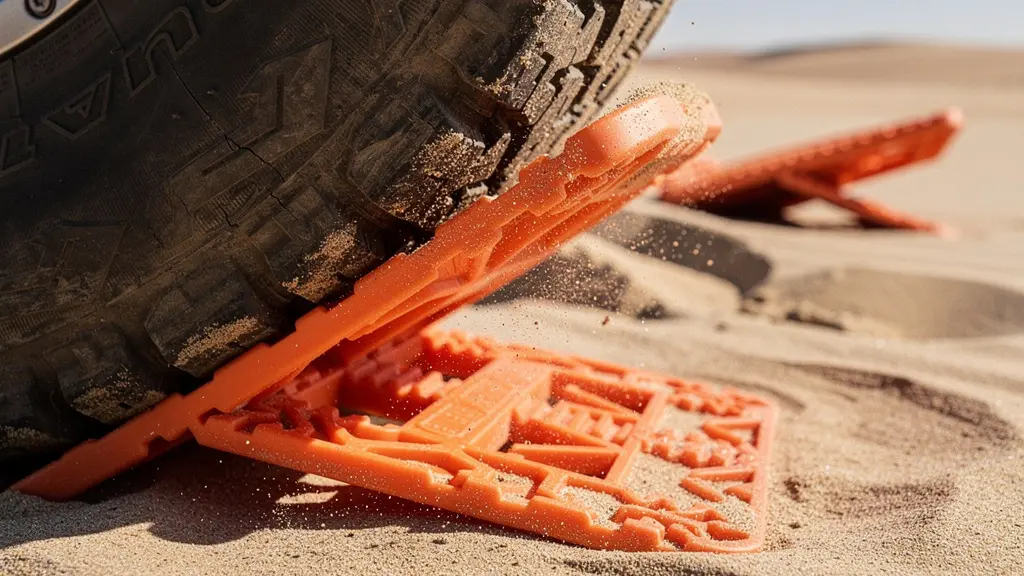
As the image demonstrates, the goal is to create a seamless ramp for the tyre to climb. The board must be wedged firmly, ensuring the tyre tread engages with the board’s knobs. Attaching bright tethers to the boards before you begin is a non-negotiable step; they will be violently ejected during a successful recovery and can be lost instantly in deep sand.
Your Action Plan: The S.A.P.E. Recovery Method
- Diagnose the situation: Check if the vehicle is high-centered by looking underneath. This dictates whether lifting is required before traction.
- Clear sand strategically: Remove sand from behind AND in front of all four tires to create a clear path, not just in the driving direction.
- Angle boards correctly: Position Maxtrax at a downward angle to create a gradual ramp, ensuring the knobs engage with tire treads.
- Secure with tethers: Attach bright-colored rope to boards to prevent losing them when they shoot out during recovery.
- Engage gradually: Use low-range first gear with minimal throttle input, allowing tires to grip the boards without spinning.
Liwa Crescent or Tal Moreeb: Which Route Is Better for Intermediate Drivers?
The choice between the Liwa Crescent and the area around Tal Moreeb is a classic expedition leader’s decision. It is not a question of which is “better,” but a strategic trade-off between technical challenge and bail-out potential. An intermediate driver’s skill can be quickly overwhelmed not by a single difficult dune, but by the cumulative fatigue of continuous, complex terrain far from any support. The primary consideration for a convoy with mixed skill levels must be the “weakest link” principle. The route is planned for the least experienced driver and the least capable vehicle.
The Tal Moreeb area features some of the world’s tallest dunes, with highly technical bowl systems and frequent, sharp slip faces. It is a playground for experts, but for an intermediate team, it can be a trap. The distance to a paved road can exceed 100km from its deepest points. The Liwa Crescent, while still challenging, offers a more forgiving environment. The dunes are generally smaller, and “escape routes” to pavement are more accessible, typically within 50km. This dramatically changes the risk calculus in the event of a mechanical failure or medical issue.
The following table breaks down the technical differences. It is not a scorecard, but a risk assessment tool. For an intermediate leader, the “Bail-Out Distance” is the most important metric on this chart.
| Factor | Liwa Crescent | Tal Moreeb Area |
|---|---|---|
| Average Dune Height | 50-80 meters | Up to 300 meters (Tal Moreeb itself) |
| Slip Face Frequency | Moderate (every 2-3km) | High (continuous challenging sections) |
| Technical Bowls | 5-8 major bowls | 15+ complex bowl systems |
| Safe Camping Spots | Every 10-15km | Limited (20-30km apart) |
The Fuel Mistake That Leaves Drivers Stranded 50km from a Station
The single most common catastrophic failure in desert expeditions is miscalculating fuel. Drivers accustomed to on-road consumption figures apply linear thinking to a non-linear environment. Driving in soft sand, with low tyre pressures and in low-range gears, can easily double your fuel consumption. Your vehicle’s 800km highway range is suddenly a 400km desert range, or less. This is not a possibility; it is a mathematical certainty. A critical finding from experienced desert drivers is that you must calculate your fuel needs at 1.5 to 2.0x normal consumption.
To ignore this multiplier is to plan for failure. If your planned route is 300km between fuel stops, you do not need 300km of fuel. You need a minimum of 600km of on-road equivalent range. This means carrying significant reserves in high-quality jerry cans, properly secured. There is no such thing as “too much” fuel in the Empty Quarter; there is only “not enough.” Running out of fuel 50km from a station is not an inconvenience; it is a life-threatening emergency that puts your entire party, and any potential rescuers, at risk.
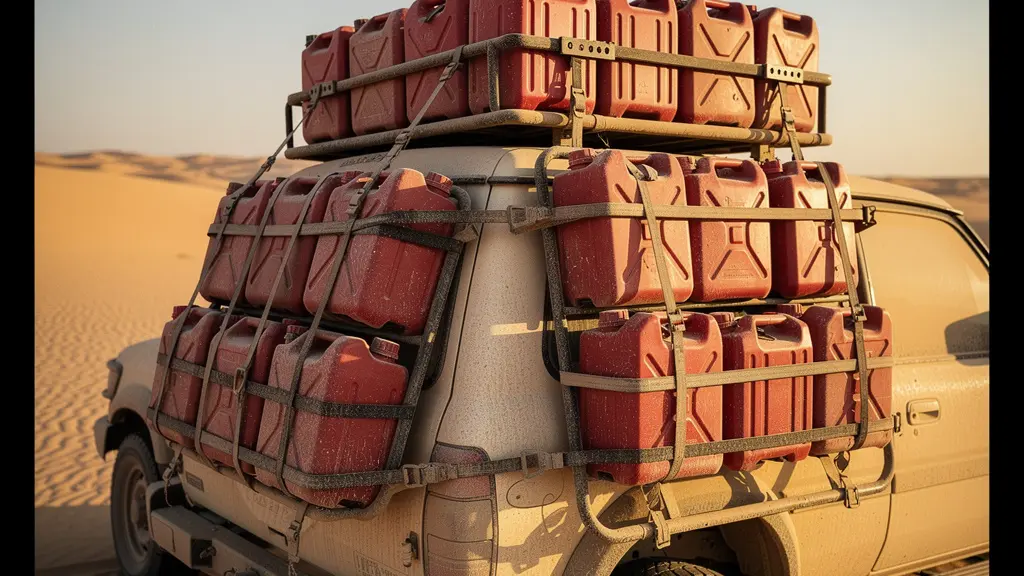
The image above is not a depiction of excessive preparation; it is the visual representation of a correct fuel calculation. Each can represents a buffer against the physical reality of soft sand travel. Your fuel plan must be a core, non-negotiable part of your expedition strategy, documented and checked before departure.
Bowl or Ridge: Where Should You Pitch Your Tent to Avoid Wind?
Campsite selection in the desert is a science of microclimates and fluid dynamics. The wrong choice doesn’t just lead to a poor night’s sleep; it can mean a significant drop in temperature or a battle against wind-blasted sand. The two most common mistakes are camping on the very top of a ridge or at the very bottom of a deep bowl. Both choices seem intuitive but are wrong for specific physical reasons.
A dune crest is subject to the Venturi effect, where wind is forced to accelerate as it passes over the peak, increasing its speed by up to 50%. It is the windiest, most exposed position possible. Conversely, the bottom of a deep bowl becomes a “cold sink” at night. Cold, dense air flows down the dune faces and pools at the bottom, creating temperatures that can be 5-10°C colder than the surrounding terrain. It can also be deceptively soft, risking a vehicle becoming bogged overnight. The `Wabar Crater` expedition team documented this exact phenomenon, noting the significant temperature differential was a major factor in team comfort and rest.
The optimal location is the “leeward sweet spot.” Here is the protocol:
- Avoid ridge tops and bowl bottoms completely.
- The ideal spot is approximately one-third of the way down the leeward (protected) side of a large dune system. This provides maximum shelter from the prevailing wind without placing you in the cold air sink.
- Read the sand: Small ripples on the surface always point downwind. The sharp, steep side of a dune is the slip face, indicating the prevailing wind direction. Camp on the other side.
- Before stopping, test the ground firmness. A flat, seemingly perfect area can be dangerously soft.
Why Was Water Sourcing the Single Most Important Skill for Bedouins?
Understanding the Bedouin relationship with water is to understand the core logic of the desert. For them, water was not a commodity; it was the organising principle of life, dictating routes, social structure, and survival itself. Their skill was not just finding water, but a deep, systemic knowledge of the desert’s “water map”—a mental database of wells, seasonal seeps, and landscape indicators passed down through generations. As the citation from the Adventures of Lil Nicki team notes, the desert’s climate is not static: “Ancient camel caravans used to traverse the Rub al Khali as part of the Frankincense trade but thanks to desertification traders had to alter their route away from here by 300 AD.” This demonstrates that survival depended on adapting to the changing availability of resources.
Ancient camel caravans used to traverse the Rub al Khali as part of the Frankincense trade but thanks to desertification traders had to alter their route away from here by 300 AD.
– Adventures of Lil Nicki Expedition Team, Oman Tour: To The Empty Quarter & Dhofar
Modern expeditions apply these ancient principles with modern technology. We carry our water—a minimum of 4-5 liters per person per day—but the Bedouin wisdom lies in resource planning. Like the Bedouins who memorized well locations, modern tour operators maintain GPS-logged networks of emergency water points at settlements and oil installations. The Bedouin practice of reading animal tracks and vegetation translates to our monitoring of team hydration, vehicle cooling systems, and satellite weather data. The ancient social protocols around water sharing are now formal pre-expedition agreements: water is a communal resource, with clear protocols for redistribution if one vehicle’s supply is compromised.
Why Do Drivers Deflate Tyres Before Entering the Desert?
Deflating tyres is the single most important action a driver takes before entering sand. The principle is simple physics: lowering the pressure dramatically increases the tyre’s footprint, the area of contact with the sand. This distributes the vehicle’s weight over a larger surface, allowing it to “float” on top of the sand rather than digging in. A fully inflated tyre is designed to cut through water on a paved road; in the desert, this same design makes it an anchor, digging itself into a hole.
The correct pressure is not one-size-fits-all; it is a function of vehicle weight and sand condition. However, professional desert driving guides recommend tire pressures between 14-18 PSI for most vehicles, with 12 PSI for extreme soft sand. This is a 50-70% reduction from normal road pressure. However, this benefit comes with two critical, often overlooked dangers. First, heat buildup: driving over 40 km/h with deeply deflated tyres generates immense internal friction and heat, which can cause a catastrophic blowout. Second, de-beading: the low pressure means the tyre bead is held less securely to the wheel rim. A sharp turn can unseat the tyre completely, an event that requires specialized equipment and significant effort to repair in the field.
An expedition leader must manage this trade-off constantly, balancing the need for traction against the risk of tyre failure. This table provides a starting point for pressure settings.
| Vehicle Weight | Hard-packed Sand | Soft Sand | Extreme Soft/Dunes |
|---|---|---|---|
| Light (under 2000kg) | 20-22 PSI | 15-18 PSI | 12-14 PSI |
| Medium (2000-2500kg) | 22-25 PSI | 16-20 PSI | 14-16 PSI |
| Heavy (over 2500kg) | 25-28 PSI | 18-22 PSI | 15-18 PSI |
| Maximum Safe Speed | 60 km/h | 40 km/h | 30 km/h |
Key takeaways
- The 2x Rule: Your on-road fuel range is irrelevant. Calculate all desert legs using a 2x consumption factor as a non-negotiable minimum.
- Pressure vs. Integrity: Tyre pressure below 18 PSI grants traction but creates a hard speed limit of 40 km/h. Exceeding this risks catastrophic heat-induced tyre failure.
- Comms are Logistics, Not Panic: Satellite devices are for proactive coordination of waypoints, weather, and convoy status. Relying on them only for emergencies is a sign of poor planning.
Is Dune Bashing Safe for Children and Seniors?
The term “dune bashing” is a recreational one, implying aggressive, high-speed driving for thrills. For a serious expedition, this is the wrong mindset and the wrong vocabulary. The correct question is: “Can technical dune driving be conducted safely with passengers of varying ages and physical conditions?” The answer is yes, but only if passenger safety and comfort are elevated to the primary mission objective, superseding speed or “excitement.”
Professional operators like Glory Tours Salalah, who run family-friendly overnight trips, demonstrate how this is done. It is not about avoiding dunes, but about navigating them with a specific, methodical technique. This involves maintaining speeds below 40km/h, using smooth and deliberate throttle/steering inputs to minimize jarring impacts, and enforcing a strict protocol of regular breaks. Their strategy includes mandatory hydration stops every 30 minutes and pre-trip briefings on motion sickness prevention. The installation of secure grab handles for all passengers and the removal of all loose items from the cabin are not suggestions, but mandatory safety requirements.
For any expedition including children or seniors, a pre-trip medical consultation is essential. The leader must establish a clear, non-embarrassing communication system for passengers to signal discomfort. The plan must account for more frequent stops for stretching and comfort assessment. Ultimately, the driver’s objective shifts from conquering the terrain to providing a stable, secure platform for their passengers. An expedition with a perfect safety record is a far greater mark of skill than one that boasts of thrilling, high-risk maneuvers.
The Empty Quarter is the ultimate test of preparation, foresight, and disciplined execution. Your expedition’s success or failure is decided long before the first tyre touches the sand. Begin your logistical planning, your calculations, and your risk assessments now; there is no substitute for rigorous preparation.