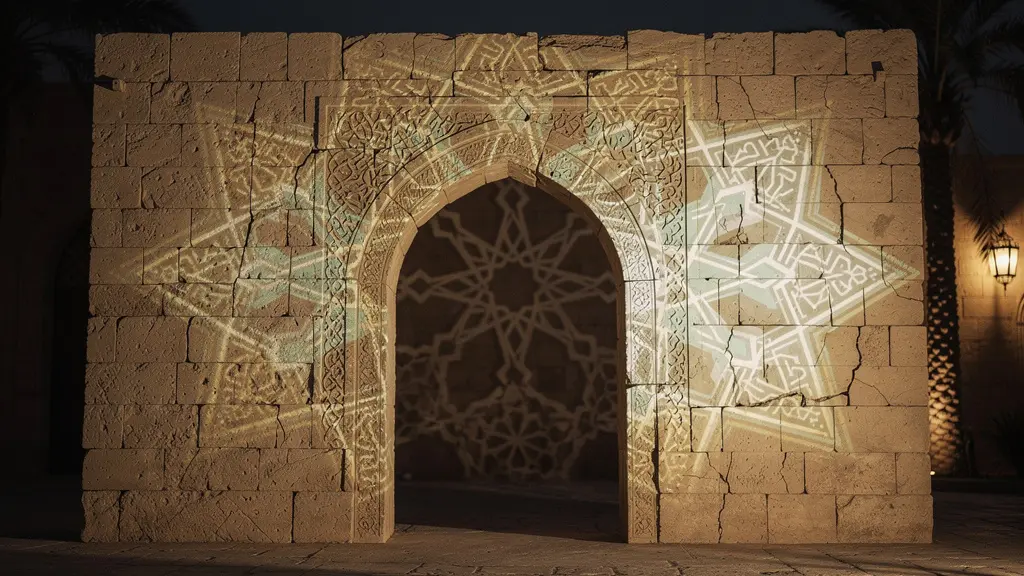
Modern projection mapping does not simply decorate heritage sites; it mathematically decodes their architectural DNA.
- Projections are narrative tools that visualize invisible histories, such as the pre-oil pearling economy.
- Technical precision, involving LiDAR scanning and audio synchronization, is required to respect the sanctity of historic geometry.
Recommendation: When visiting these festivals, prioritize locations where static illumination and dynamic mapping coexist to appreciate the contrast between preservation and interpretation.
Standing before a centuries-old fort in the UAE, one expects the silence of stone and the weight of history. Yet, when night falls during festivals like those in Sharjah, these static façades erupt into fluid motion. The intricate mathematics of traditional arabesque patterns are no longer confined to plaster and wood; they are dismantled and reassembled by photons in real-time. This fusion creates a unique tension between the permanence of heritage and the ephemeral nature of digital light.
While many observers see only a spectacular light show, the reality is a complex dialogue between ancient geometry and cutting-edge calibration. It is not merely about making old buildings look new; it is about revealing layers of narrative—from the harsh realities of the pearling trade to the rapid acceleration of urban life—that are usually invisible to the naked eye. The technology acts less as a paint brush and more as an x-ray, exposing the cultural soul of the architecture.
However, achieving this synthesis requires more than just powerful projectors. It demands a sophisticated understanding of spatial mapping, a respect for the structural integrity of the site, and a careful navigational approach by the viewer to truly grasp the audio-visual synchronization. By shifting our perspective from passive observation to analytical appreciation, we can uncover the hidden mechanics that allow lasers to interact so seamlessly with traditional designs.
For those who appreciate the visual spectacle, the following video offers a glimpse into the type of immersive projection mapping discussed here, illustrating the scale and precision involved.
text
To navigate the complexities of this digital art form, we have structured this analysis into key thematic clusters. The following table of contents guides you through the historical narratives, technical challenges, and artistic contexts of heritage projection mapping.
Table of Contents: A Journey Through Light and Stone
- Why Do the Projections Often Tell the Story of the Sea and Pearls?
- Who Are the Global Artists Behind the Sharjah Projections?
- Static Illumination or Video Mapping: Which Style Suits Historic Forts Better?
- The Laser Mistake That Can Damage Your Camera Sensor
- Where to Stand to Hear the Synchronized Music Score Clearly?
- Why Do Artists Need 3D Scans of Buildings Before Creating the Light Show?
- Why Does So Much Contemporary UAE Art Focus on Rapid Urbanization?
- Navigating the UAE Art Scene: Where to Find Emerging Local Artists?
Why Do the Projections Often Tell the Story of the Sea and Pearls?
In the context of UAE heritage festivals, the recurring visual motifs of rolling waves, oysters, and divers are not arbitrary aesthetic choices. They are deliberate acts of narrative restoration. Before the discovery of oil, the region’s economy and social structure were almost entirely dependent on the sea. The grueling months spent at sea defined the rhythm of life, the music, and the collective memory of the emirates. Digital art allows curators to flood arid desert forts with virtual water, visually reconnecting the architecture to its maritime origins.
This storytelling is grounded in economic reality. Historical data indicates that in the 19th century, pearl diving contributed to as much as 95% of the region’s income. By projecting these images onto government buildings or defensive fortifications, artists acknowledge that the modern skyline was essentially built on the foundation of the pearl trade. The projection mapping transforms the building into a canvas for oral history, translating the legacy of the tawawish (pearl merchants) into a language of light that resonates with a modern audience.
Who Are the Global Artists Behind the Sharjah Projections?
A common misconception is that a single artist sits behind a laptop controlling the lights for an entire festival. In reality, festivals like the Sharjah Light Festival function as a global curatorial ecosystem. The complexity of mapping irregular heritage surfaces requires interdisciplinary teams that blend coding, illustration, and architectural engineering. It is rarely a solo endeavor; it is a convergence of specialized studios from around the world, often collaborating with local historians to ensure cultural accuracy.
These international collaborations bring a variety of stylistic interpretations to Islamic geometry. A French studio might approach an arabesque pattern with a focus on mathematical fractals, while a Japanese team might interpret the same lines through a lens of minimalism and flow. This diversity ensures that the heritage sites are not just preserved but reinterpreted. The global nature of the artists turns local landmarks into international stages, where the universal language of geometry bridges cultural divides.
Static Illumination or Video Mapping: Which Style Suits Historic Forts Better?
There is a distinct tension in heritage lighting between “revelation” and “transformation.” Static illumination uses warm, fixed lights to accentuate the existing texture of stone and the rhythm of crenellations, respecting the building’s original dignity. In contrast, video mapping treats the façade as a screen, often obscuring the physical material beneath a layer of digital paint. The image below illustrates a balanced approach where the architecture breathes through the light.

As seen in the visual above, the most successful installations often employ a hybrid strategy. The light respects the architectural lines rather than ignoring them. Case studies from festivals have shown that while high-tempo video mapping works for storytelling on natural surfaces like mountains, sacred or deeply historic sites often benefit from the restraint of static imagery. This approach avoids trivializing the monument, allowing the gravity of the structure to anchor the ethereal quality of the light.
The Laser Mistake That Can Damage Your Camera Sensor
For art lovers and photographers, capturing the interplay of laser and stone is a priority, but it carries a significant, often overlooked risk. Modern projection shows frequently utilize high-intensity lasers which, unlike standard bulb projectors, emit collimated beams of energy. If one of these beams strikes a camera sensor directly, even for a fraction of a second, it can burn dead pixels into the sensor, permanently ruining the equipment. This damage is physical and irreversible.
The danger is statistically significant when compared to human eye safety standards. While strict regulations protect the audience’s vision—industry notes cite only eight documented eye injuries out of 109,000,000 people viewing continuous-wave laser shows—camera sensors are far more sensitive and have no biological blink reflex. The lens acts as a magnifying glass, concentrating the laser’s energy onto the delicate silicon wafer.
Checklist for Sensor Safety: Protecting Your Gear
- Points of contact: Identify where laser sources are positioned relative to your shooting angle.
- Collecte: Inventory your lens caps and ensure they are on when not shooting.
- Cohérence: Avoid using zoom lenses to “hunt” for beams; keep focal lengths moderate.
- Mémorabilité/émotion: Prioritize shooting the diffuse light on the wall, never the beam source itself.
- Plan d’intégration: Use “Live View” cautiously, as it exposes the sensor continuously.
Where to Stand to Hear the Synchronized Music Score Clearly?
In large-scale outdoor projection mapping, light travels instantly, but sound drags behind. This physical discrepancy creates a synchronization gap for the audience. If you stand too far back, the visual impact of a digital drumbeat on a tower wall will occur noticeably before you hear the sound, breaking the immersion. The “sweet spot” is not just about the best view; it is about the intersection of visual alignment and audio latency.
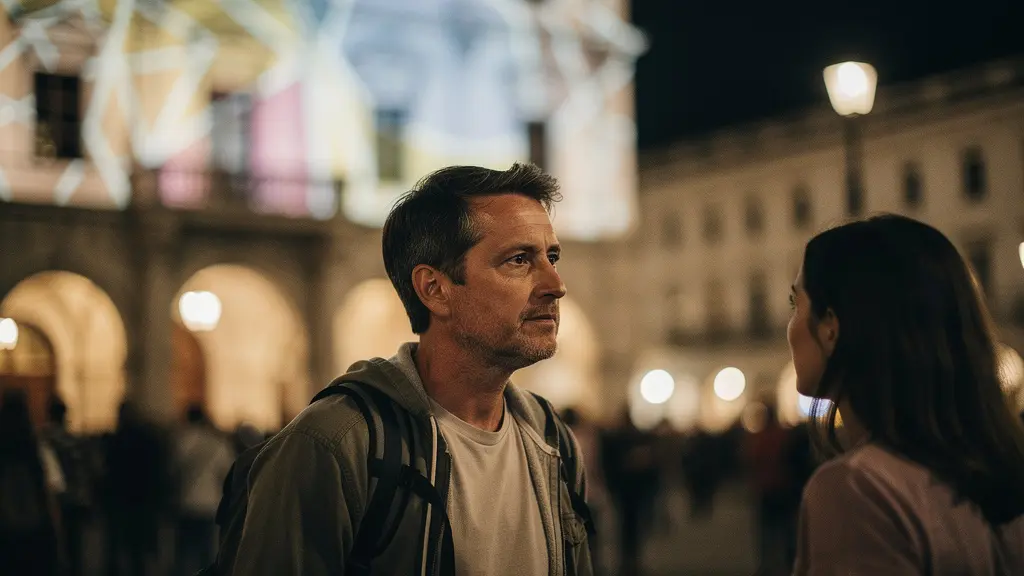
As the image suggests, positioning is key. Audio engineers calibrate delay towers to specific zones. A practical rule of thumb involves the physics of sound: sound travels at approximately 343 meters per second. Therefore, a distance of 100 meters results in a delay of roughly 0.292 seconds. While this seems negligible, in a rhythmically tight show based on geometric precision, a third of a second is enough to make the audio feel “loose.” Standing near the Front of House (FOH) mixing booth usually guarantees the sync the director intended.
Why Do Artists Need 3D Scans of Buildings Before Creating the Light Show?
You cannot project a complex geometric pattern onto a rugged fort wall without a digital blueprint. The surfaces of heritage sites are imperfect, filled with weathering, cracks, and architectural quirks. To ensure the digital light “sticks” to the physical stone, artists use LiDAR technology (Light Detection and Ranging) to create a point-cloud model of the building. This scan is accurate to the millimeter, allowing the creation of a “digital twin.”
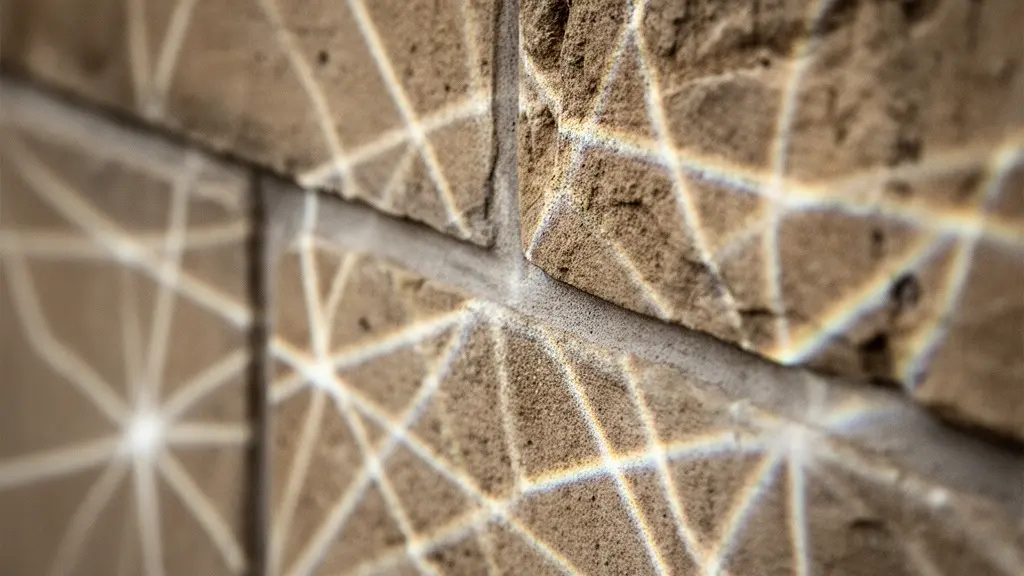
This digital twin allows the content to be designed remotely. As shown above, the light can be programmed to trace specific mortar lines or highlight particular stones. Without this scan, a straight line projected from a standard lens would distort and break over the uneven surface. The scan allows for “warping,” where the image is deliberately distorted in the software so that it appears perfect when projected onto the irregular reality.
As Eirik Svensen notes in a recent analysis of projection workflows:
The ability to simulate our projection in advance and make real-time adjustments was critical,
– Eirik Svensen, Disguise case study
Why Does So Much Contemporary UAE Art Focus on Rapid Urbanization?
The fixation on technology in UAE art is a direct reflection of the nation’s lived experience. The transition from a quiet coastal economy to a hyper-modern global hub happened within a single lifetime. Contemporary artists use projection mapping and digital installations to process this velocity of change. The juxtaposition of lasers (the future) on mud-brick forts (the past) is a visual metaphor for the country’s identity.
The demographic reality underscores this artistic focus. With an urban population of 87.8%, the UAE is one of the most urbanized nations on earth. This density creates a specific type of nostalgia—not for a distant past, but for a landscape that is disappearing and reappearing in new forms daily. Digital art, which is inherently transient and rewritable, becomes the perfect medium to express the fluidity of memory in a rapidly developing society.
Key Takeaways
- Projection mapping restores lost narratives like pearl diving using light.
- Camera sensors are highly vulnerable to laser damage; use lens caps.
- The best audio-visual sync is found near the FOH mixing booth.
Navigating the UAE Art Scene: Where to Find Emerging Local Artists?
While major festivals showcase international talent, the heart of the local art scene beats in more intimate districts. Events like the Sikka Art & Design Festival have become crucial incubators for Emirati and UAE-based artists. Located in the historic Al Fahidi neighborhood, Sikka allows artists to take over traditional houses, transforming domestic spaces into immersive installations. This setting offers a more personal, experimental interaction with heritage than the grand scale of projection mapping on forts.
The scale of public interest in these local narratives is growing efficiently. In 2023, the Sikka Art & Design Festival attracted more than 120,000 visitors, proving that there is a hunger for art that speaks directly to the region’s unique cultural fusion. For the art lover, these festivals are the entry point to discovering voices that will likely define the future of Islamic digital art.
Plan your visit during the winter art season to experience this synthesis of light and history firsthand.