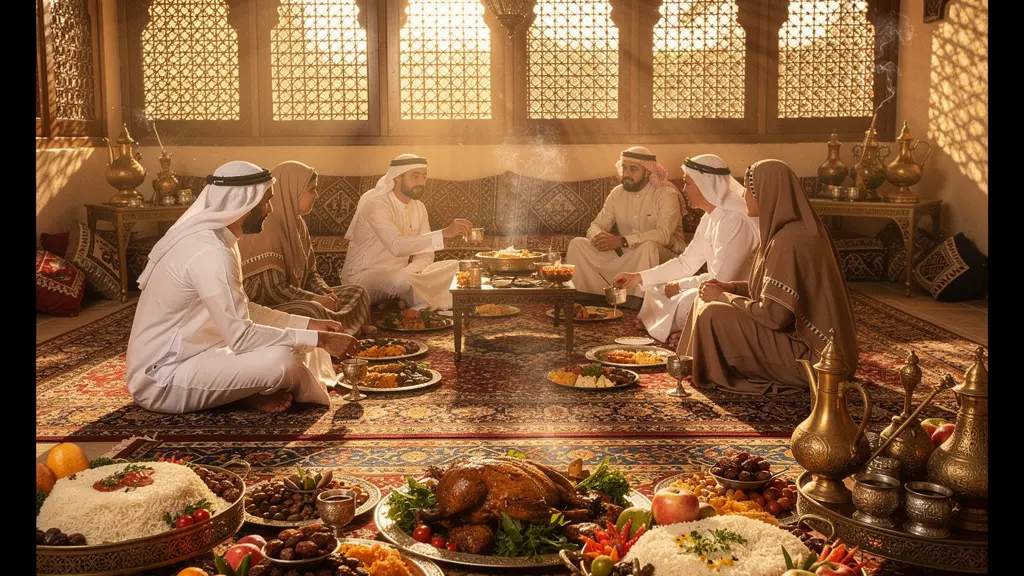
The fear of causing offense in the UAE comes from not knowing the ‘why’ behind the rules; true confidence comes from understanding the core cultural values of generosity and respect.
- Hospitality is an expression of honor, meaning food and drink are offered in abundance as a sign of welcome.
- Respect for hierarchy (age and gender) dictates everything from greetings to seating arrangements in a traditional setting.
- Gift-giving and conversation are not just formalities, but opportunities to build trust and show thoughtfulness.
Recommendation: Instead of memorizing rules, focus on observing your host and responding with genuine gratitude and respect—this is the key to navigating any social situation with grace.
An invitation to an Emirati home or wedding is a tremendous honor, a chance to experience the legendary hospitality that is a cornerstone of the culture. Yet for many expats and tourists, this honor is accompanied by a quiet anxiety: “What if I do or say the wrong thing?” The internet offers plenty of advice, often a list of rigid do’s and don’ts: use your right hand, dress modestly, don’t refuse coffee. While well-intentioned, these rules can feel like a cultural minefield, leading to stiff, overly cautious behavior that misses the point entirely.
But what if the key to navigating these social interactions wasn’t about memorizing a script? What if, instead, it was about understanding the underlying principles that drive every gesture and tradition? The truth is that Emirati etiquette is not a random collection of rules, but a beautiful system built on the core values of generosity, respect for elders, and the preservation of social harmony. By grasping these fundamentals, you move beyond fear and gain a deeper cultural fluency, allowing you to act with confidence and genuine warmth, not just correctness.
This guide will deconstruct those essential rules, revealing the cultural logic behind them. We will explore the language of hospitality, the nuances of gendered greetings, the art of conversation in a Majlis, and even the symbolism behind prestigious traditions like falconry. The goal is to equip you not with a list to memorize, but with the insight to be a gracious, respectful, and—most importantly—relaxed guest.
For those who prefer a visual format, the following video offers a wonderful immersion into the daily life, culture, and food of the Emirati people, perfectly complementing the practical advice in this guide.
To help you navigate these cultural nuances with confidence, we’ve structured this guide to cover every key aspect of Emirati social etiquette. Each section addresses a common question or potential point of confusion, providing clear, actionable insights.
Summary: A Guide to Emirati Social and Dining Etiquette
- Why Is Food Quantity So Important in Emirati Hosting Culture?
- How to Greet Emirati Men and Women Respectfully Based on Gender?
- Dates or Chocolate: What Is the Appropriate Gift When Visiting an Emirati Home?
- The Conversational Mistake That Can Create Awkward Silence in a Majlis
- Where to Sit in a Traditional Majlis to Show Respect to the Elders?
- How to Order “Sukar Ziyada” or “Khaleek” Like a Local?
- Why Will “Smart Casual” Get You Turned Away at the Burj Al Arab?
- Understanding Falconry: Why Is It So Expensive and Prestigious in the UAE?
Why Is Food Quantity So Important in Emirati Hosting Culture?
The sheer amount of food presented to a guest in an Emirati home can be overwhelming, but it is the most visible expression of the generosity principle. Hospitality is not just a custom; it’s a pillar of national identity and a measure of honor. A host’s reputation is tied to their ability to provide for their guests lavishly. This is reflected not just in private homes but across the nation; recent data shows that with 15.3 million hotel guests visiting the UAE in the first half of 2024 alone, this deep-rooted culture of welcome is a significant driver of the economy.
For a host, an empty plate is not a sign of a satisfied guest, but a sign that they have failed to provide enough. This perspective is crucial to understanding the ritual of dining. Refusing food outright can be interpreted as rejecting the host’s hospitality. Instead, the etiquette involves a delicate dance of acceptance and subtle signals. You should always accept what is offered initially, especially the traditional welcome of dates and Arabic coffee (gahwa). To do justice to the spread, take small portions of many different dishes rather than a large helping of one.
As cultural commentator Ali Al Saloom explains, the local mindset is different from the Western norm of clearing one’s plate:
To some people of our country or the Gulf region in general it’s not polite to clear your plate because the host is more than happy to serve you more food.
– Ali Al Saloom, Ask Ali column, The National
Leaving a small amount of food on your plate is the most polite way to signal that you are full and have been more than satisfied. It communicates that the host’s generosity has exceeded your appetite, which is the highest compliment you can pay them.
Your Action Plan: Navigating Generous Hospitality
- Accept the first serving of Arabic coffee (gahwa) and dates, always using your right hand.
- Take small portions from multiple dishes to sample everything and honor the host’s effort.
- Praise the food often using appreciative phrases like “Mashallah” (as God has willed) or simply “This is delicious.”
- When you are full, leave a small amount of food on your plate to signal satisfaction without appearing to reject their generosity.
- To refuse more coffee, gently shake your empty cup from side to side when the server approaches.
How to Greet Emirati Men and Women Respectfully Based on Gender?
Greetings in the UAE are governed by a deep respect for personal space, religious values, and gender. Navigating this requires observation and patience, not assumptions. The most common error is to initiate a handshake with a member of the opposite gender. While some Emiratis are comfortable with this, many are not, and the rule is to always let the other person initiate physical contact.
When greeting an Emirati man, a verbal greeting (“As-salamu alaykum”) followed by a handshake is standard if you are also a man. If you are a woman, it is best to wait and see if he extends his hand. If he does not, the most respectful and widely accepted alternative is the hand-on-heart gesture. Simply place your right hand over your heart, give a slight nod, and offer your verbal greeting. This gesture conveys warmth and respect without crossing physical boundaries.
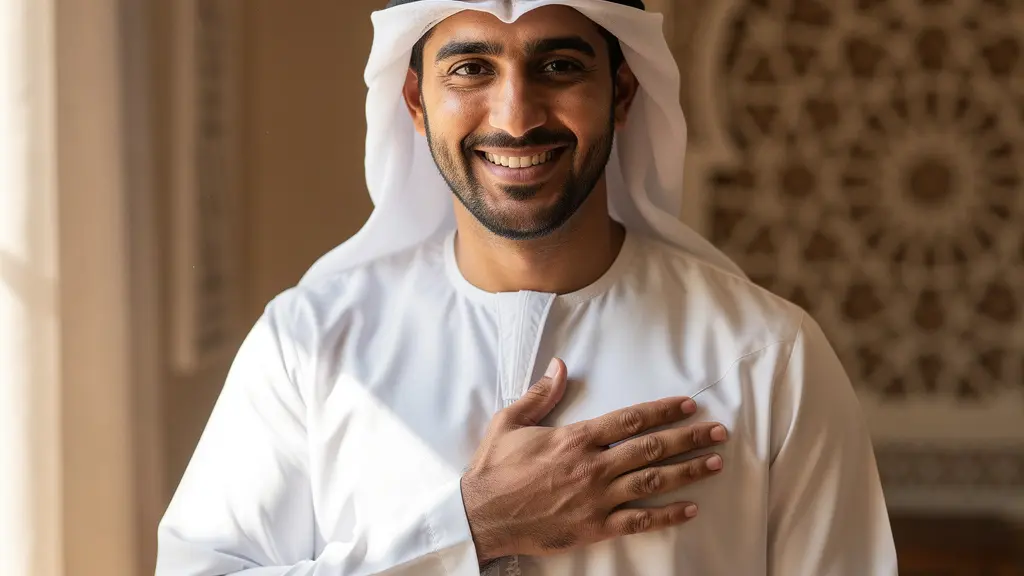
The same principle applies when greeting an Emirati woman. Men should never initiate a handshake. Wait for her to extend her hand; if she doesn’t, the hand-on-heart gesture is the correct and respectful response. Among women, handshakes and even cheek kisses are common, but again, it’s wise to let your Emirati counterpart take the lead. This deference shows you are conscious of and respect their cultural norms.
Case Study: Gender-Specific Greetings in a Professional Setting
In UAE business environments, foreign professionals are advised to closely observe their host’s lead. Typically, men will shake hands with other men. An Emirati woman in a professional role may or may not extend her hand to a male colleague or visitor. If she does not, the hand-on-heart gesture serves as a polite and culturally aware alternative, demonstrating respect in mixed-gender interactions without causing awkwardness.
Dates or Chocolate: What Is the Appropriate Gift When Visiting an Emirati Home?
Arriving at an Emirati home empty-handed is a cultural misstep. Bringing a gift is a crucial way to express gratitude for the invitation. However, the choice of gift is just as important as the gesture itself. Your gift should be thoughtful and reflect an understanding of cultural and religious sensitivities. The golden rule is to avoid anything too personal, alcohol, or non-halal food items.
High-quality chocolates, premium dates, and traditional sweets are always a safe and appreciated choice. They align with the culture of hospitality and sharing. Another excellent option is a unique, high-quality item from your home country, as this shows personal thought and effort. Educational books or high-quality toys for the children of the household are also highly valued, as they demonstrate respect for the family unit. When presenting a gift, it is customary, as highlighted by the UAE Stories Cultural Guide, to offer and receive it with both hands or your right hand, never the left hand alone, as a mark of respect.
The following table, based on insights from local custom guides, provides a clear comparison of what works and what to avoid.
| Appropriate Gifts | Why It Works | Gifts to Avoid | Cultural Reason |
|---|---|---|---|
| Premium dates | Traditional symbol of hospitality | Alcohol/wine | Islamic prohibition |
| Quality chocolates | Universal appreciation | Perfumes/cologne | Too personal |
| Specialty items from your country | Shows thoughtfulness | Home decor | Taste is subjective |
| Educational toys/books for children | Values family and future | Cash/money | Can cause offense |
| Traditional sweets (halal) | Respects dietary laws | Pork products | Religious restriction |
The Conversational Mistake That Can Create Awkward Silence in a Majlis
The Majlis (a traditional sitting room and meeting place) is the heart of social life, but its conversational rhythm can be unfamiliar to outsiders. The biggest mistake is not the topic you choose, but the style of communication you employ. Western conversation often values direct debate, quick responses, and filling every silence. In a Majlis, this can be perceived as aggressive, impatient, and disrespectful. The goal is not to “win” an argument but to build consensus and maintain conversational harmony.
Conversation flows in a circular, relaxed manner. One person speaks, and others listen attentively. Pauses and silence are not awkward; they are moments for reflection and consideration. Jumping in to interrupt, contradict directly, or force a topic can create a deeply uncomfortable atmosphere. The most common mistake is treating the Majlis like a boardroom, trying to drive an agenda or dominate the floor. This disrupts the collaborative and egalitarian spirit of the gathering.
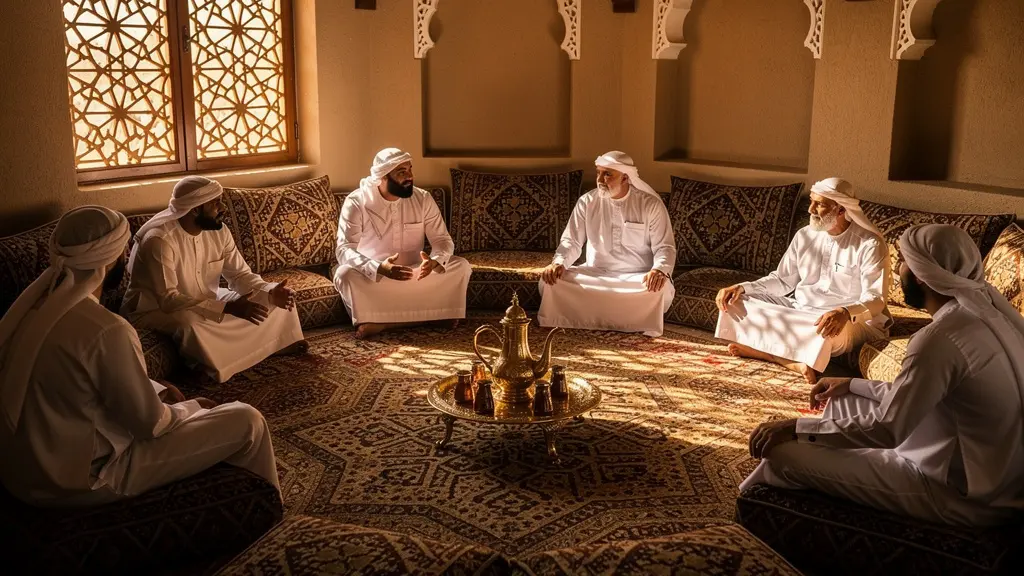
Safe topics include family (in general terms), sports (especially football and horse racing), travel, and business in a positive light. Compliment your host, their home, and the food. It’s wise to avoid overly personal questions, especially about female family members, and sensitive topics like regional politics or criticism of the leadership. The key is to listen more than you speak, show genuine interest in others, and contribute to the pleasant, flowing nature of the discussion rather than trying to steer it.
Where to Sit in a Traditional Majlis to Show Respect to the Elders?
The seating arrangement in a Majlis is not random; it is an unspoken map of the hierarchy of respect. Choosing your own seat without guidance is a significant cultural error, as it can be seen as disrespectful to the host and the elders present. The cardinal rule is to pause at the entrance and wait to be guided by your host. They will indicate the appropriate place for you to sit, taking into account your status as a guest and the presence of others.
The most honored position in the room is known as the ‘Sadr’. This is typically the seat farthest from the entrance, often with the best backrest or most comfortable cushions. This spot is reserved for the eldest or most senior person present, or for the guest of honor. Other seats radiate outwards from the Sadr in descending order of age and status. By waiting to be seated, you show that you understand and respect this invisible hierarchy.
Once seated, be mindful of your posture. If sitting on floor cushions, it is customary to sit cross-legged or with your legs tucked to one side. It is considered highly disrespectful to point the soles of your feet at anyone. You should also avoid leaning back too casually or sprawling, as this can be seen as a lack of decorum. Maintaining a respectful posture is a continuous, non-verbal way of showing deference to your host and the other guests.
Case Study: Majlis Seating Protocol
At institutions like the Sheikh Mohammed Centre for Cultural Understanding, visitors are explicitly taught about the invisible seating hierarchy of the Majlis. The host will always guide guests to a seat, and attempting to choose one’s own place is highlighted as a major faux pas. The head of the room, or ‘Sadr’, is reserved for the eldest or most honored guest, and all other seating radiates from this point, visually reinforcing the cultural importance of respecting one’s elders.
How to Order “Sukar Ziyada” or “Khaleek” Like a Local?
Speaking a few words of Arabic goes a long way in showing respect and building a connection. While English is widely spoken, using key local phrases during dining and coffee rituals demonstrates a genuine effort to engage with the culture. This is particularly true for coffee and tea, which are central to social interactions. Knowing how to specify your preference can make you feel less like a tourist and more like an informed guest.
When it comes to Arabic coffee (gahwa), it’s traditionally served unsweetened. However, if you are having tea or Turkish coffee, you can tailor it. “Sukar ziyada” means “extra sugar,” while “khaleek” or “wasat” means “medium” or “normal sweetness.” For tea, you can specify “Shai” for regular black tea or “Karak” for the popular strong, milky, spiced tea. Mastering the famous coffee cup shake—a quick, gentle side-to-side wrist motion—is the most elegant, non-verbal way to signal you’ve had enough and prevent endless refills.
Beyond ordering, a few phrases of appreciation can leave a lasting positive impression. Saying “Teslam yaddak” (“Bless your hands”) to the host or cook is a beautiful compliment on the food. After the meal, instead of a simple “thank you,” the phrase “Daimah” (“May your table always be plentiful”) is a powerful blessing that honors your host’s generosity. And when you are truly full, “Alhamdulillah, shibaan” (“Praise God, I’m full”) is a more culturally resonant way to express satisfaction than a simple “No, thank you.”
Your Checklist: Essential Arabic Dining Phrases
- For extra sugar in your coffee/tea, say: “Sukar ziyada.” For normal sweetness, say: “Khaleek” or “Wasat.”
- To praise the cook and the food, say: “Teslam yaddak” (Bless your hands).
- After the meal, to bless your host’s home, say: “Daimah” (May your table always be plentiful).
- Distinguish between “Shai” (regular tea) and “Karak” (strong, milky tea).
- To politely express you are full, say: “Alhamdulillah, shibaan” (Praise God, I’m full).
- Signal you don’t want more coffee by gently shaking the empty cup from side to side.
Why Will “Smart Casual” Get You Turned Away at the Burj Al Arab?
In many parts of the world, “smart casual” is a safe bet for an upscale evening. In Dubai’s most iconic luxury venues, it can be a recipe for disappointment. The city’s identity is intrinsically linked to luxury, glamour, and offering a world-class experience. With 67.3% of Dubai’s hotel rooms falling into the luxury, upper upscale, or upscale categories, maintaining impeccable standards is a core part of the brand.
Strict dress codes at places like the Burj Al Arab are not about snobbery; they are a crucial tool for protecting the brand and the guest experience. When patrons are paying a premium for an atmosphere of exclusivity and elegance, allowing shorts, t-shirts, or flip-flops would devalue that experience for everyone. The dress code is a promise to all guests that the ambiance they paid for will be upheld.
The term is often “smart elegant.” For men, this means a collared shirt, full-length trousers (not jeans), and closed-toe dress shoes. For women, it means an elegant dress, a sophisticated skirt and top, or stylish separates. Overly revealing clothing should be avoided out of respect for local culture. It’s important to note that the traditional Emirati national dress—the kandura for men and the abaya for women—is always considered appropriate and commands the highest respect in any setting.
Case Study: Dress Codes as a Luxury Branding Strategy
Dubai’s flagship hospitality venues, such as the Burj Al Arab, enforce stringent “smart elegant” dress codes as a fundamental part of their global luxury brand positioning. This policy ensures a consistent, high-end atmosphere for all guests, protecting the multi-thousand-dollar experience they offer. The explicit exception is always the traditional national dress (kandura and abaya), which is revered as the pinnacle of formal and respectful attire in any context.
Key Takeaways
- Generosity is honor: The abundance of food is a reflection of the host’s reputation; accept graciously and eat small portions of many things.
- Respect is hierarchical: Defer to elders in seating and let hosts guide you. In greetings, let the other person initiate physical contact.
- Modesty is key: This applies to dress code in formal venues and to communication style in a Majlis, which favors harmony over direct confrontation.
Understanding Falconry: Why Is It So Expensive and Prestigious in the UAE?
While you may not encounter it at a dinner party, understanding the significance of falconry provides deep insight into the Emirati soul. Far more than a sport, falconry is a living link to Bedouin heritage and a powerful symbol of courage, skill, and the profound connection between man and nature. Its prestige is rooted in the harsh realities of desert survival, where a well-trained falcon was essential for hunting and providing for the family.
Today, this tradition continues as a revered art form, recognized by UNESCO as an Intangible Cultural Heritage of Humanity. The expense is tied to several factors. A prime falcon, often a Gyr or Peregrine, can cost tens of thousands, sometimes hundreds of thousands, of dollars depending on its lineage, health, and hunting prowess. The training is an incredibly patient and intimate process, creating a bond of trust between the falconer and the bird that can take years to perfect. Furthermore, the upkeep, including specialized veterinary care and housing, is substantial.

The prestige comes from this mastery. A skilled falconer commands immense respect, as their ability is seen as a continuation of the wisdom and resilience of their ancestors. Falconry competitions, with their multi-million dollar prizes, are major social events, attended by ruling families and enthusiasts from across the Gulf. Owning a prized falcon is not just a hobby; it’s a statement of status, wealth, and deep cultural pride. It signifies a commitment to preserving a heritage that defines the very character of the nation.
Ultimately, navigating Emirati social settings with grace is not about a fearful adherence to rules, but a confident embrace of its core values. By understanding the principles of generosity, respect, and social harmony, you are equipped to be more than just a polite visitor; you become a welcome and appreciative guest. The next logical step is to apply this understanding with mindfulness and genuine warmth in every interaction.
Frequently Asked Questions on Emirati Etiquette
What if I accidentally sit in the wrong place?
Emiratis are very understanding of cultural differences and do not expect foreigners to know every nuance. If a host gently guides you to move to a different seat, you should do so gracefully and without any embarrassment. They are not correcting you, but rather honoring you by placing you in the proper position within the group.
How should I sit on floor cushions respectfully?
When sitting on traditional floor cushions, the main point of etiquette is to avoid pointing the soles of your feet at anyone, as this is considered rude. The most common and respectful postures are sitting cross-legged or tucking your legs to one side. You can and should use the provided cushions for back support to remain comfortable during the gathering.
When can I leave a majlis gathering?
There is no strict time to leave, but it is impolite to depart too soon after arriving. A good rule of thumb is to stay at least until after the coffee service has made its rounds. When you are ready to leave, avoid making a large, disruptive announcement to the whole room. Instead, quietly and discreetly approach the host, thank them for their hospitality, and take your leave.