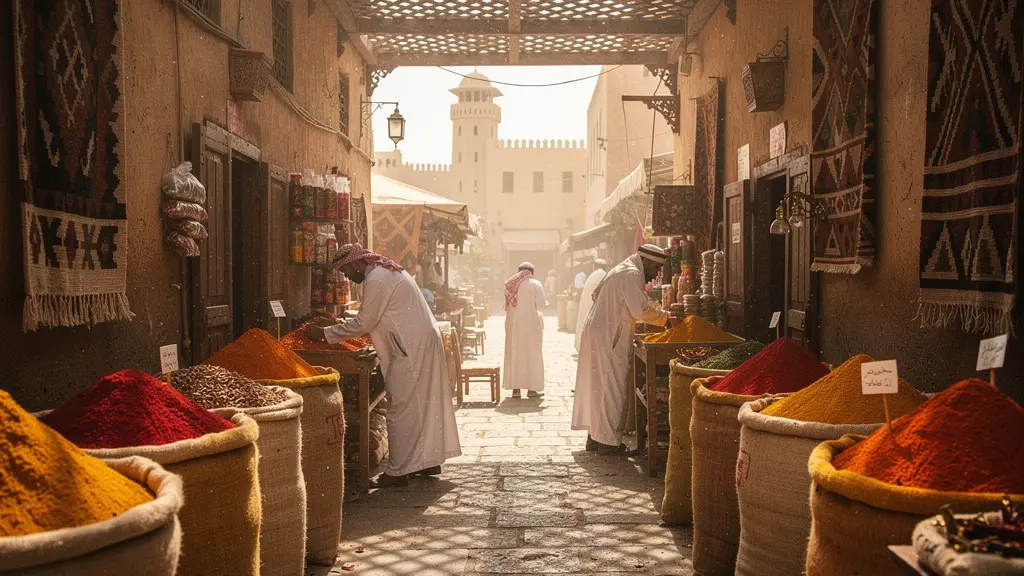
The real flavor of Dubai isn’t found in 5-star hotels, but in the gritty alleyways of Deira where history and spice trade collide.
- Authenticity lies in the “cafeteria culture” dominated by Indian and Levantine flavors.
- Safety and hygiene are strictly regulated, debunking the “dirty dining” myth.
Recommendation: Skip the mall food courts and plan a DIY walking tour through Deira and Bur Dubai to experience the city’s true soul.
Most visitors land in Dubai expecting gold-flaked cappuccinos and celebrity chef outposts. They see the glimmering skyline but miss the heartbeat of the city entirely. If you stick to the air-conditioned malls, you are merely skimming the surface of a culinary heritage that is sweaty, chaotic, and incredibly delicious.
Real Dubai tastes like crispy falafel eaten on a street corner, spicy charcoal chicken wrapped in paper, and steaming cups of tea that cost less than a bottle of water. This isn’t just about eating; it’s about understanding the “Remittance Cuisine” economy—food made by expats, for expats, which has inadvertently created a fusion culture you won’t find anywhere else. From the distinct ordering etiquette of a cafeteria to the spice markets that smell of history, we are going to navigate the delicious labyrinth of Old Dubai.
To navigate this sensory overload effectively, we have structured a guide that takes you through the cultural whys, the practical how-tos, and the specific neighborhoods that define this street food scene.
text
Contents: The Street Food Guide
- Why Is Dubai’s Street Food Scene Dominated by Indian and Levantine Flavors?
- How to Order a “Hassan Mathar” or “Francisco” Sandwich?
- Satwa or Karama: Which Neighborhood Has the Best Budget Eats?
- The “Dirty Dining” Myth: Why Are Hole-in-the-Wall Places Safe?
- Progressive Dinner: How to Plan a DIY Food Tour with 4 Stops?
- Why Do Spices from Iran and India Dominate the Dubai Markets?
- Heart of Sharjah or Al Fahidi: Which Heritage District Feels More Authentic?
- The Cult of Karak: Where to Find the Best AED 1 Tea in the UAE?
Why Is Dubai’s Street Food Scene Dominated by Indian and Levantine Flavors?
The flavor profile of Old Dubai is not a modern culinary experiment; it is a direct result of demographics and migration history. When you bite into a street snack here, you are tasting the nostalgia of the people who built the city. The dominance of spicy curries, flaky parathas, and garlic-heavy shawarmas exists because Dubai’s population is 85% expat, with the vast majority hailing from the Indian subcontinent and the Levant. These communities didn’t just bring their labor; they brought their grandmothers’ recipes.
This culinary landscape is often referred to as “Remittance Cuisine.” It wasn’t designed for tourists. It was designed to provide comfort and affordable sustenance to workers far from home. Consequently, the food is unpretentious, heavy on spices, and incredibly soulful. You aren’t eating “fusion” created in a test kitchen; you are eating a natural evolution of flavors where a Lebanese garlic sauce might find its way onto an Indian-style grilled chicken simply because those two cultures live side-by-side in Deira.
The authenticity here is palpable. It is not about white tablecloths but about the bustling energy of survival and community.
Understanding this human element changes every bite you take, transforming a simple meal into a history lesson.
How to Order a “Hassan Mathar” or “Francisco” Sandwich?
Walking into a Dubai cafeteria—often neon-lit and buzzing with activity—can be intimidating if you don’t speak the language of “cafeteria food.” These aren’t just sandwiches; they are institutions. The “Hassan Mathar” (a cheese and chicken concoction) and the “Francisco” are local legends, but ordering them requires a specific cadence to ensure you get the authentic taste rather than a sanitized version.
The preparation is a performance in itself. The speed at which these sandwiches are assembled is blinding, a testament to the high volume of hungry customers these small shops serve daily.
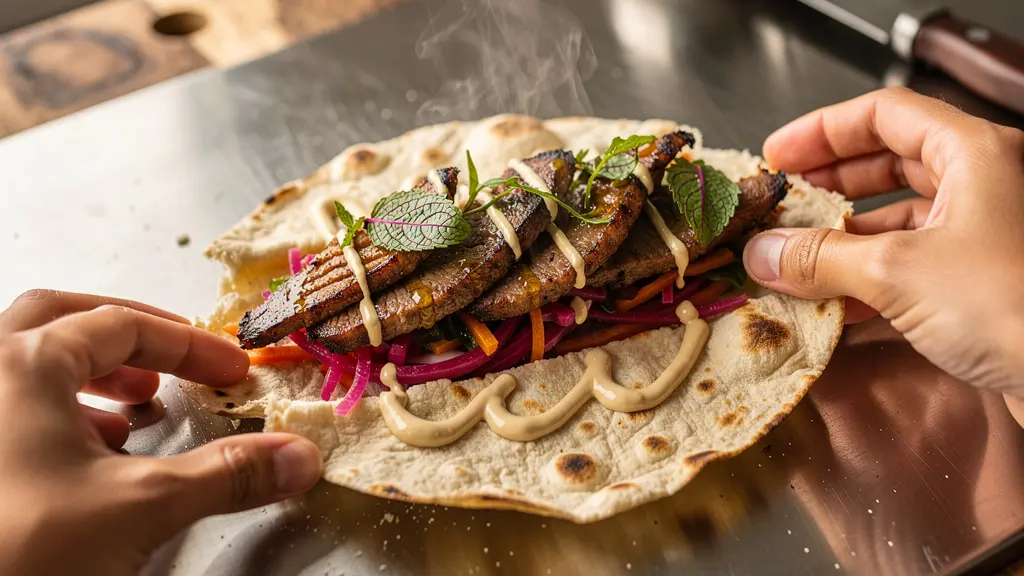
As illustrated above, the assembly is tactile and fast. To get the result you see in the image—dripping with tahini and perfectly toasted—you need to follow a specific protocol. It’s about signaling to the staff that you know what you are doing.
Your Cafeteria Ordering Checklist: The 5-Step Protocol
- The Greeting: Start with “Marhaba” to establish immediate rapport with the cook.
- The Foundation: Specify your bread preference first—choose “khubz” (flat) or “samoon” (baguette-style).
- The Heat Level: Place “spicy” at the end of your sentence for authentic heat; putting it at the beginning often results in “tourist-mild.”
- The Insider Add-on: Request tahini explicitly to signal insider knowledge; never ask for ketchup.
- The Quality Check: Watch the wrapping paper; an evenly distributed oil absorption pattern indicates master preparation.
Once you have your sandwich in hand, the next challenge is finding the perfect spot to enjoy it, which brings us to the neighborhood rivalry.
Satwa or Karama: Which Neighborhood Has the Best Budget Eats?
If Deira is the historic heart, Satwa and Karama are the battling siblings of the budget food scene. Satwa feels raw, chaotic, and unapologetically gritty, often described as having a “Little Manila” and “Little Pakistan” vibe. Karama, on the other hand, is slightly more suburban but packs a density of restaurants that is mathematically improbable. Choosing between them depends entirely on the dining atmosphere you crave.
To help you decide where to spend your calories and your Dirhams, here is a direct comparison of what you can expect in each district. As noted in a detailed analysis by Digital Roam Ads, the differences are distinct.
This breakdown highlights the practical differences for a hungry traveler:
| Aspect | Satwa | Karama |
|---|---|---|
| Average meal price | AED 15-25 | AED 20-35 |
| Dining format | Standing/counter service | Family-style seating |
| Portion sizes | Single-serve focus | Sharing platters available |
| Peak hours | Late night (post 10pm) | Dinner time (7-9pm) |
| Cuisine diversity | Lebanese, Pakistani dominant | Filipino, Indian, Arabic mix |
| Atmosphere | Quick turnover, minimalist | Relaxed, family-friendly |
As Travel And Tour World aptly notes regarding these areas:
Old Dubai, particularly Bur Dubai and Deira, provides a rare glimpse into the city’s roots, far from the glitz of modern skyscrapers and luxury shopping malls.
– Travel And Tour World, Step Into History with Old Dubai’s Food Tours
Regardless of the neighborhood, a common concern for first-timers is hygiene, which is often misunderstood.
The “Dirty Dining” Myth: Why Are Hole-in-the-Wall Places Safe?
There is a persistent myth that “hole-in-the-wall” equals “unsafe.” In Dubai, this couldn’t be further from the truth. The Dubai Municipality operates one of the strictest food safety inspection regimes in the world. Appearance can be deceiving; a cracked tile floor or a plastic table does not indicate a dirty kitchen. In fact, the high turnover of ingredients in these busy spots often guarantees freshness that outpaces empty luxury establishments.
The “dirty dining” moniker is a term of endearment among locals, not a health warning. The intense heat of the grills and the rapid consumption of food mean that bacteria rarely have a chance to settle. Furthermore, inspection grades are prominently displayed, and the inspectors are notoriously rigorous.
Case Study: The Truth Behind the ‘Conditional Pass’
Frying Pan Adventures, a team of local experts, highlights a counter-intuitive reality regarding municipal ratings. They note that a yellow ‘Conditional Pass’ sticker on a Shawarma joint often indicates frequent inspections due to high meat turnover. Paradoxically, this can suggest fresher ingredients than some ‘Excellent’ rated establishments that see fewer inspectors and fewer customers. The sticker proves the system is watching, and the high volume proves the food is moving fast.
With your fears assuaged, it is time to map out a route that hits all the right notes without burning you out.
Progressive Dinner: How to Plan a DIY Food Tour with 4 Stops?
Planning a food tour in Old Dubai requires more than just an appetite; it requires strategic timing. You are battling the desert heat and navigating around prayer times, which can temporarily shutter businesses. A successful DIY tour moves geographically and texturally, starting with lighter bites and ending with heavy sweets. You want to hit the streets when the grills are firing up and the energy is peaking.
The atmosphere near the Creek changes dramatically as the sun sets. The water reflects the lights of the dhows, and the air cools down just enough to make walking pleasant.
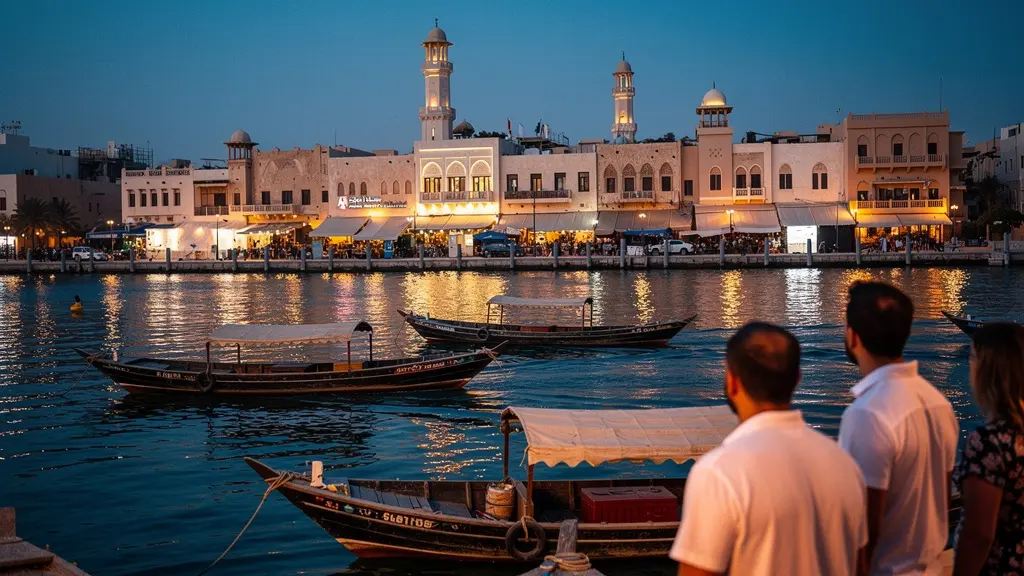
As shown in the image, the Creek is the artery that connects your food stops. A typical route involves walking through Deira for appetizers, crossing the water on a traditional Abra (boat), and finishing in Bur Dubai. It is essential to pace yourself. Do not eat a whole shawarma at stop one, or you will fail to complete the mission.
Part of this journey involves walking through the souks, where the smell of spices tells another story of Dubai’s trade history.
Why Do Spices from Iran and India Dominate the Dubai Markets?
The Dubai Spice Souk is not a tourist prop; it is a functioning trading port. The overwhelming scents of saffron, dried limes (loomi), and cardamom are the olfactory evidence of centuries-old trade routes connecting Dubai to Iran, India, and Zanzibar. The dominance of these specific spices is also linked to local ecology. The desert offers little in terms of agriculture, forcing reliance on imported flavors to preserve and season food.
Interestingly, ecological changes have deepened this reliance. A report highlights a shocking 80% decline in UAE fish population over the last 30 years. As local fresh protein became scarcer or more expensive historically, heavily spiced rice dishes (like Machboos) became even more critical to the culinary identity, masking the taste of preserved foods or stretching smaller amounts of fresh meat further. The sacks of spices you see are the engine of this cuisine.
While the souks feel ancient, other “heritage” areas spark a debate about what is real and what is reconstructed.
Heart of Sharjah or Al Fahidi: Which Heritage District Feels More Authentic?
For the traveler seeking the “Old Arabia” vibe, two main options present themselves: the Heart of Sharjah and Al Fahidi Historical Neighborhood in Dubai. The difference lies in their soul. Al Fahidi is beautiful, with its wind towers and narrow lanes, but it has largely been converted into a commercial hub of galleries and cafes. It is polished, accessible, and English-friendly, but it can feel like a curated museum exhibit rather than a living neighborhood.
Sharjah, just a short drive away, offers a different flavor. The restoration there feels quieter, more solemn, and less focused on selling latte art to tourists. However, regarding food, Al Fahidi offers easier access to the fusion street food we love, whereas Sharjah leans towards more traditional, sit-down Emirati establishments. If you want the “Instagram shot” with a side of fusion sliders, Al Fahidi wins. If you want silence and history, Sharjah calls.
No matter where you end up, there is one unifying drink that binds every neighborhood, every nationality, and every social class in the UAE.
Key Takeaways
- Authentic Dubai food is a result of “Remittance Cuisine” from expats.
- Don’t fear the “hole-in-the-wall” spots; they are safe and regulated.
- Master the ordering protocol: specific bread, “spicy” at the end, and always tahini.
The Cult of Karak: Where to Find the Best AED 1 Tea in the UAE?
You cannot claim to have visited Dubai without drinking Karak Chai. It is the lifeblood of the city. This strong tea, boiled with milk, sugar, and cardamom, is the great equalizer. CEOs in Land Cruisers and construction workers on breaks all drink the same tea from the same styrofoam cups. The magic lies in its price and its ubiquity. It is a symbol of stability in a city that changes overnight.
Despite inflation and the city’s luxury branding, the street price has remained remarkably resistant to change. The unspoken rule of the street maintains an AED 1 price point for karak tea in many traditional spots, acting almost as a loss leader that brings communities together. Finding the “best” one is subjective, but look for places where cars are double-parked honking for service—that is the universal sign of quality Karak.
Grab your AED 1 coin, head to the nearest cafeteria, and take that first sip of authentic Dubai culture today.
Questions fréquentes sur Dubai Food Tours
Why do wet floors in old Deira restaurants indicate freshness?
Constant ice deliveries for fresh fish and seafood create water accumulation, signaling high ingredient turnover rather than poor hygiene
How long does the ‘Dubai Gut’ adaptation take for tourists?
Most visitors report digestive adjustment within 3-5 days of eating at local establishments, building immunity for other Global South destinations
What does a high customer turnover rate indicate about food safety?
Rapid customer flow ensures ingredients don’t sit, reducing bacterial growth opportunities and maintaining optimal food freshness