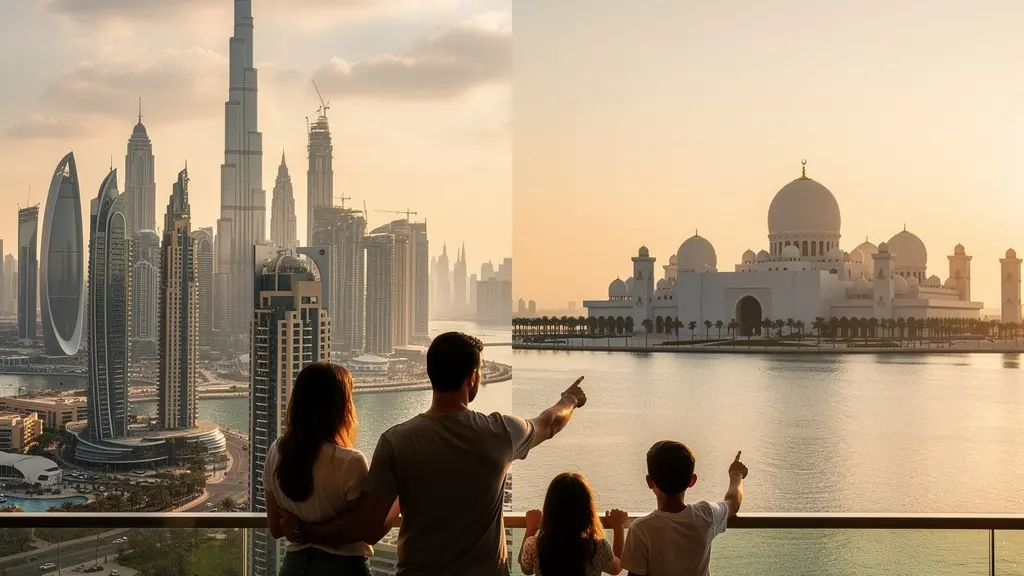
While Dubai offers an astonishing array of attractions, Abu Dhabi provides a superior family vacation by prioritizing a ‘luxury of pace’ over sheer scale.
- Reduced traffic and smarter urban planning significantly cut down on transit stress and wasted time.
- World-class attractions are often clustered together, allowing for richer, multi-experience days without family burnout.
Recommendation: For a more relaxed and manageable core vacation, base your family in Abu Dhabi. Use Dubai for targeted, high-impact day trips rather than as your primary hub.
The United Arab Emirates presents a dazzling choice for families: the futuristic, hyper-energetic skyline of Dubai or the culturally rich, stately grandeur of Abu Dhabi? For parents planning a trip, the decision can feel overwhelming. It’s easy to get lost in lists of record-breaking attractions and luxurious hotels. Many guides simply state that Dubai is for thrills and Abu Dhabi is for culture, but this oversimplification misses the most crucial factor for family travel: the operational reality of the trip.
The true difference isn’t just *what* you can see, but *how* you experience it. While Dubai tempts with its sheer volume of activities, this often comes with significant “operational friction”—the traffic, the vast distances between attractions, and the logistical challenges that can drain a family’s energy. What if the real key to a successful UAE family holiday wasn’t about seeing everything, but about enjoying what you see without the stress?
This is where Abu Dhabi’s “luxury of pace” becomes its winning feature. This guide moves beyond a simple checklist comparison. We will analyze the practical aspects of a family trip—from driving stress and theme park strategy to cultural immersion and hotel choices—to demonstrate why the capital might be the smarter, more rewarding base for your family’s adventure.
This comparative guide is designed to help you understand the distinct personality of each city from a family’s perspective, allowing you to make an informed decision. Explore the detailed breakdown of key travel considerations in the sections below.
Summary: A Family-Focused Comparison of Dubai and Abu Dhabi
- Why Is Driving in Abu Dhabi Less Stressful Than the Traffic of Dubai?
- How to Combine Ferrari World and Warner Bros in One Day Pass?
- Sheikh Zayed Mosque or Louvre Abu Dhabi: Which Should You Prioritize for a Half-Day?
- The Wardrobe Error That Gets 20% of Tourists Turned Away at the Grand Mosque
- Saadiyat or Corniche: Which Abu Dhabi Area Offers the Best Beach Hotels?
- Meeting Penguins or Zorbing: Which Add-On Is Worth the Money?
- How to Navigate the Pearl Diving Dioramas at Dubai Museum Effectively?
- Kayaking in Abu Dhabi Mangroves: What to Know Before Booking?
Why Is Driving in Abu Dhabi Less Stressful Than the Traffic of Dubai?
One of the most significant, yet often underestimated, factors in a family vacation’s success is time spent in transit. Here, Abu Dhabi offers a clear and immediate advantage over Dubai. The capital was designed on a logical grid system with wide, numbered streets and significantly less congestion. This translates into less time staring at brake lights and more time enjoying your destination. For families, this “luxury of pace” is a game-changer, reducing the likelihood of tired, irritable children in the backseat.
The difference isn’t just anecdotal; it’s backed by data. While every major city has rush hour, the scale of congestion is vastly different. Recent traffic statistics reveal that Dubai motorists lost 35 hours in traffic in 2024, compared to just 19 hours for drivers in Abu Dhabi. That’s nearly double the time spent navigating traffic jams in Dubai, a precious resource on a limited family holiday.

This organized layout, clearly visible from above, means navigating with a GPS is more predictable, parking is generally more available near major attractions, and travel times between key points like Yas Island, the Corniche, and Saadiyat Island are reliably shorter. For a family juggling nap schedules and attraction booking times, this predictability and efficiency are invaluable, making self-driving a far less daunting prospect in the capital.
How to Combine Ferrari World and Warner Bros in One Day Pass?
Abu Dhabi’s Yas Island is a masterclass in experience density, clustering several world-class theme parks in one compact, easily navigable area. This allows for a feat nearly impossible in more sprawling cities: visiting two major theme parks in a single day without complete exhaustion. The key is a strategic approach to the Ferrari World and Warner Bros. World combo pass, a popular choice for families.
The strategy hinges on understanding each park’s strengths. Ferrari World is home to high-octane outdoor thrills, including the world’s fastest rollercoaster, Formula Rossa, which hits 240km/h. Warner Bros. World, in contrast, is entirely indoors and air-conditioned, a perfect refuge from the midday desert heat. A UK family with kids aged 9 and 11 who successfully used a combo pass reported saving 30% on admission and, more importantly, avoiding heat exhaustion by planning their day around the climate. As confirmed by guides for family travel in the region, a smart itinerary is crucial.
To make the most of your one-day, two-park pass, follow a timed itinerary:
- 9:00 AM – 12:00 PM: Arrive at Ferrari World right at opening to experience the most popular rides like Formula Rossa with the shortest queues and while your family’s energy is at its peak.
- 12:00 PM – 1:00 PM: Take a lunch break at Yas Mall. It’s strategically located between the two parks and offers a wide variety of food options away from the park crowds.
- 1:00 PM – 1:30 PM: Transition to Warner Bros. World. You can take the free Yas Express shuttle or simply walk through the air-conditioned mall.
- 1:30 PM – 6:00 PM: Immerse yourselves in the fully indoor world of Warner Bros. as the afternoon heat peaks outside. Explore Gotham City, Metropolis, and Cartoon Junction in complete comfort.
- Post-6:00 PM: End your day with character meet-and-greets, which often have shorter lines as the park begins to empty out.
Sheikh Zayed Mosque or Louvre Abu Dhabi: Which Should You Prioritize for a Half-Day?
For families with limited time, choosing between Abu Dhabi’s two cultural titans—the Sheikh Zayed Grand Mosque and the Louvre Abu Dhabi—can be a difficult decision. Both are architectural marvels offering profound experiences, but they cater to different family dynamics and interests. The choice depends on your children’s ages, attention spans, and what you hope to take away from the visit.
The Sheikh Zayed Grand Mosque offers an unparalleled “wow” factor. Its scale, pristine white marble, and intricate details are visually stunning for all ages. It’s an immersive experience in Islamic architecture and faith. The Louvre Abu Dhabi, on the other hand, provides a journey through global art history. Its celebrated Children’s Museum offers interactive, hands-on exhibits that make art accessible and engaging for younger visitors.

To make an informed decision, a direct comparison is most helpful. While the Mosque is free to enter, it has a strict dress code that requires careful planning. The Louvre is ticketed for adults but offers a more relaxed environment and dedicated kids’ spaces. The table below, based on insights from specialist family travel guides, breaks down the key considerations.
| Criteria | Sheikh Zayed Grand Mosque | Louvre Abu Dhabi |
|---|---|---|
| Entry Cost | Free | AED 63 adults, free under 18 |
| Best Time | 9 AM opening (fewer crowds) | Late afternoon (cooler) |
| Kid-Friendly Features | Visual wow factor, marble floors | Children’s Museum, interactive exhibits |
| Time Needed | 1.5-2 hours | 2-3 hours |
| Dress Code | Strict (abayas provided) | Casual modest |
| Educational Value | Islamic architecture & culture | Global art history journey |
The Wardrobe Error That Gets 20% of Tourists Turned Away at the Grand Mosque
Visiting the Sheikh Zayed Grand Mosque is a highlight of any trip to Abu Dhabi, but a successful visit requires more than just showing up. The mosque is an active place of worship, and its dress code is strictly enforced out of respect. Failing to adhere to it is the single biggest point of “operational friction” for visitors. In fact, some visitor statistics show that up to 20% of tourists face entry issues or delays due to inappropriate attire. Understanding the nuances of the dress code is essential to avoid being part of that statistic.
The rules are simple in principle: loose-fitting, non-transparent clothing that covers the arms, legs, and for women, the hair. However, tourists often make a few common mistakes. The most frequent error is with fabric. What appears opaque in a hotel room, like white linen or light-colored cotton, can become transparent in the bright Emirati sunlight, leading to an entry refusal. Another common misstep is assuming the code doesn’t apply to older children; teenage boys in shorts and girls in tank tops will be turned away just as adults would be.
For women, hair must be completely covered. While you can bring your own scarf (pashmina), the provided ‘abaya’ (a traditional cloak) and ‘shayla’ (headscarf) are often the most convenient option. They guarantee compliance, are provided free of charge, and offer a wonderful opportunity for photos that feel culturally authentic. Men should wear long trousers and shirts with sleeves. For a smooth and respectful visit, the best advice is to err on the side of caution. Dress more conservatively than you think is necessary, or simply plan to use the complimentary traditional attire provided on-site.
Saadiyat or Corniche: Which Abu Dhabi Area Offers the Best Beach Hotels?
Choosing the right neighborhood for your hotel is crucial for setting the tone of your family vacation. In Abu Dhabi, the two primary contenders for beach-loving families are Saadiyat Island and the Corniche. While both offer beautiful coastlines, they provide distinctly different experiences. The choice comes down to whether your family prefers a secluded luxury resort escape or a vibrant city-beach atmosphere.
Saadiyat Island is the pinnacle of family-friendly luxury. It’s home to a stunning, protected natural beach with soft white sand and turquoise waters, where Hawksbill turtles still nest. The hotels here—like the St. Regis, Park Hyatt, and Rixos Premium—are expansive resorts with sprawling pools, outstanding kids’ clubs, and a sense of tranquil exclusivity. This is the ideal choice for families who want to spend significant time relaxing at the hotel, enjoying high-end amenities, and having direct access to a pristine beach. It’s a destination in itself.
The Corniche, by contrast, offers a more integrated city experience. The hotels are located along the bustling 8km waterfront promenade, with public beaches just across the road. While the hotels themselves are excellent (many with private beach clubs), the vibe is more urban. This area is perfect for families who want to be in the heart of the action, with easy access to parks, cycling paths, and a wide array of nearby restaurants. You trade the serene isolation of Saadiyat for the dynamic energy of the city. Official tourism statistics demonstrate that Abu Dhabi hotels achieved 78% occupancy in 2024, with beach resorts consistently showing the highest family satisfaction rates, underscoring the appeal of both areas.
Meeting Penguins or Zorbing: Which Add-On Is Worth the Money?
If your itinerary includes a day trip to Dubai, you’ll be faced with a dizzying array of “add-on” experiences, each competing for your dirhams. At the Mall of the Emirates’ Ski Dubai, two popular but very different options are the Penguin Encounter and Zorbing (rolling downhill in a giant inflatable ball). For families, deciding which is “worth it” involves looking beyond the price tag to consider uniqueness, age-appropriateness, and long-term memory value.
The Penguin Encounter consistently scores higher in family satisfaction, primarily due to its uniqueness. The sheer novelty of meeting penguins in the desert creates a powerful, lasting memory that children and parents talk about for years. This 40-minute experience is also educational, teaching about penguin conservation, and allows for gentle, up-close interaction suitable for a very wide age range. It’s a shared family moment.
Zorbing, or the ‘Giant Ball’ ride, offers a quick, thrilling adrenaline rush. It’s fun and often more affordable, but it’s an experience that can be found at adventure parks worldwide. Its appeal is less universal, with age and weight restrictions (typically 6+ years and under 120kg) that might exclude younger siblings or even some parents, making it less of a whole-family activity. The decision requires balancing a unique, shared experience against a more generic, individual thrill.
Decision Checklist: Choosing Your Dubai Add-On
- Assess Age Suitability: Is the activity inclusive for everyone in your family, from the youngest to the oldest? (Penguins: yes, Zorbing: no)
- Evaluate Uniqueness Factor: Is this a once-in-a-lifetime experience you can only have here? (Penguins in the desert: yes, Zorbing: no)
- Consider Group Dynamics: Can the whole family participate and create a shared memory together?
- Factor in Scheduling: Does the activity require a strict, pre-booked time slot that impacts itinerary flexibility? (Penguin encounters often do).
- Calculate the “Memory ROI”: Which experience will your family still be talking about in five years?
How to Navigate the Pearl Diving Dioramas at Dubai Museum Effectively?
The Dubai Museum, located in the Al Fahidi Fort, offers a fascinating glimpse into the city’s pre-oil past. Its most extensive exhibits are the underground dioramas depicting traditional life, with a major focus on pearl diving. While historically significant, these dark, atmospheric displays can sometimes be overwhelming or even a little scary for younger children. A strategic approach can transform the visit from a passive walk-through into an engaging historical treasure hunt.
The key is to create a narrative. Instead of just looking at the scenes, explain the story of how the hardship and bravery of these divers built the foundation for the modern Dubai your children see outside. One parent found success by connecting the old with the new, explaining how the wealth from the tiny pearls in the museum eventually led to the construction of the massive Burj Khalifa. This connection can spark a child’s imagination.
We visited the Dubai Museum with our 9 and 11-year-old children. The pearl diving dioramas initially seemed dark and potentially scary, but by turning it into a ‘treasure hunt’ and explaining the historical significance – how these divers’ hardships built the foundation for modern Dubai – the kids became completely engaged. The connection between old pearl diving and the current Burj Khalifa really captured their imagination.
– Parent review, Family Trip Magazine
To navigate the dioramas effectively, follow this chronological path to build the story:
- Start with the Dhow: Begin at the dhow-building display to establish the context of the pearl divers’ vessels.
- Explore Life Onboard: Move to the exhibits showing the sailors’ daily routines, simple food, and basic equipment.
- Witness the Dive: Progress to the underwater diving scene. Point out the authentic details like the diving stones (for rapid descent) and the nose clips.
- See the Treasure: End at the merchant displays, which show how the pearls were painstakingly graded and traded. Turn it into a game: ask kids to find the ‘dallah’ (coffee pot) or count the pearls in a merchant’s box.
Key Takeaways
- Pace & Stress: Abu Dhabi’s logical grid system and lower traffic volumes offer a fundamentally calmer and more efficient base for a family vacation.
- Attraction Strategy: Abu Dhabi’s Yas Island allows for easy multi-park days, while Dubai’s attractions, though numerous, are more geographically dispersed, requiring more transit time.
- Cultural Depth: Both cities offer rich cultural sites, but Abu Dhabi’s Grand Mosque requires specific logistical planning (especially dress code) to be enjoyed stress-free.
Kayaking in Abu Dhabi Mangroves: What to Know Before Booking?
Beyond the gleaming skyscrapers and grand monuments, Abu Dhabi holds a serene natural treasure: the Mangrove National Park. Kayaking through these tranquil waterways offers a stunning contrast to the urban landscape and is a perfect activity for families seeking a different kind of adventure. It’s an opportunity to connect with the region’s unique ecosystem, but a little knowledge beforehand can greatly enhance the experience.
The most important factor to consider is the tide. The mangrove ecosystem is tidal, and your experience will vary dramatically depending on the water level. At high tide, you can paddle deeper into the channels, exploring more of the network and getting closer to the wildlife. In fact, wildlife observation data shows that 85% of families on guided tours spot native birds like flamingos and herons during high tide. At low tide, more of the unique root systems are exposed, but navigation can be limited.
You also have a choice between tour types, which cater to different needs and budgets. A basic self-guided rental is great for experienced paddlers, while a premium eco-tour is highly recommended for families with children. These tours often include a marine biologist guide who can point out wildlife and explain the ecosystem, making it a far richer educational experience. Some even offer transparent kayaks for a unique view of the marine life below.
| Tour Type | Basic Self-Guided | Premium Eco-Tour |
|---|---|---|
| Price Range | AED 100-150 per person | AED 250-350 per person |
| Duration | 1-2 hours flexible | 2-3 hours guided |
| Equipment | Standard kayaks | Transparent kayaks available |
| Guide | None | Marine biologist included |
| Best For | Experienced paddlers | Families with children |
| Extras | Basic safety gear | Refreshments, photos included |
Now that you’ve compared the practical realities of a family vacation in both cities, the next step is to align these insights with your family’s unique priorities and travel style to build your perfect UAE itinerary.
Frequently Asked Questions About the Sheikh Zayed Grand Mosque
What fabric mistakes do tourists commonly make?
Light-colored or lightweight fabrics like white linen can become transparent in bright sunlight, leading to entry refusal even if they seem opaque indoors. It’s best to choose thicker, darker materials.
Do dress codes apply to teenagers and children?
Yes, strict dress codes apply to all visitors who have reached puberty. Generally, this is enforced for children over age 5. Teenage boys in shorts or girls in tank tops will be turned away, so ensure they are dressed in long trousers and long-sleeved tops.
Should I bring my own modest clothing or use the provided abayas?
Using the provided abayas (for women) and kanduras (for men, if needed) is often the most convenient and stress-free option. It guarantees you are compliant with the rules and offers an authentic cultural photo opportunity without having to worry if your own clothing is appropriate.