
Many adventurous travelers seek the ‘real’ UAE but often only find curated tourist sites or silent, empty ruins. The key to discovering authenticity, however, isn’t just about where you go, but *how* you observe. This guide shifts the focus from simple sightseeing to understanding the fragile, disappearing rhythms of coastal life—from the pull of the tides to the nuances of local etiquette—enabling you to foster genuine, respectful encounters with the country’s seafaring soul.
Beyond the shimmering skylines of Dubai and Abu Dhabi lies a quieter United Arab Emirates, one whose story is written not in steel and glass, but in the salt-worn wood of traditional dhows and the intricate weave of fishing nets. For the traveler yearning to connect with this deeper heritage, the small coastal villages of the northern Emirates beckon. It’s a journey away from the metropolises and back in time, toward the origins of the nation as a community of fishermen and pearl divers.
The common advice is often to simply “head north” or to visit the well-known Al Jazirat Al Hamra, the so-called ‘ghost town’. While these are valid starting points, they only scratch the surface. They present history as a static exhibit, a collection of silent buildings. But what if true authenticity isn’t a place you can pinpoint on a map, but a rhythm you can learn to observe? What if it’s found not in abandoned ruins, but in the living heritage of communities still intimately tied to the sea?
This guide is an invitation to slow down, to look beyond the obvious, and to travel with patience and intention. It’s about understanding the delicate temporal rhythms that dictate life on the coast, from the timing of the tides to the unspoken rules of cultural exchange. By learning to practice quiet observation, you can move from being a tourist to becoming a respectful witness of a culture that is both resilient and profoundly fragile.
In the following sections, we will explore the forces reshaping these traditional communities, offer guidance on how to interact with grace and respect, and highlight the places where living history can still be found. We will cover the practicalities, from avoiding a common mistake that can leave you stranded to experiencing the simple joy of a freshly caught meal, all to help you plan a truly memorable escape to the UAE’s serene Indian Ocean getaway.
Summary: A Guide to the UAE’s Coastal Heritage
- Why Are Traditional Fishing Techniques Disappearing from the Northern Coast?
- How to Approach Local Fishermen for Photos Without Being Intrusive?
- Jazirat Al Hamra or Rams: Which Coastal Spot Offers the Best Ruins?
- The Tide Mistake That Can Block Your Access to Remote Coastal Areas
- Where to Eat Fresh Catch in Coastal Hamlets: Exploring the “Cook Your Own” Markets
- Why Were Pearl Divers Often in Debt Despite the High Value of Pearls?
- How to Obtain a Recreational Fishing License for a Weekend Trip?
- Weekend in Fujairah: How to Plan a Relaxing Indian Ocean Getaway?
Why Are Traditional Fishing Techniques Disappearing from the Northern Coast?
The quiet fishing villages that dot the UAE’s northern coastline are not just scenic backdrops; they are the last vestiges of a way of life facing immense pressure. The serene image of a lone dhow on the water belies a complex reality of economic and environmental challenges that threaten the very existence of traditional fishing. The most alarming signal is the state of the fisheries themselves. The UAE’s Ministry of Climate Change and Environment has reported a staggering 90% decline in the adult stock of key fish species over recent decades, a direct threat to the livelihood of local fishermen.
This decline is driven by a confluence of powerful forces. Understanding them is the first step to appreciating the fragility of the culture you seek to experience. These economic and social undercurrents are reshaping the coast faster than any tide:
- Economic Pressure: The local market is heavily impacted by cheaper imported fish from countries like Oman, India, and Pakistan, where labor costs are significantly lower. This makes it difficult for Emirati fishermen to compete on price.
- Environmental Degradation: Decades of rapid coastal development, dredging, and land reclamation have damaged vital marine habitats, including coral reefs and mangrove forests, which serve as crucial breeding grounds for many commercial fish species.
- Regulatory Challenges: While regulations exist, a history of ineffective enforcement and a slow adoption of fully sustainable practices have contributed to the over-exploitation of fish stocks.
- The Generational Shift: Perhaps the most profound challenge is the social one. The average age of a commercial fisherman in the region is now over 50. The younger generation, drawn to more stable and lucrative careers in the cities, shows little interest in inheriting the demanding and uncertain life of a fisherman.
When you visit these hamlets, what you are witnessing is not a timeless tradition, but a precious and dwindling art. Every net mended and every boat launched is an act of cultural preservation in the face of overwhelming change. This context transforms a simple visit into a meaningful observation of resilience.
How to Approach Local Fishermen for Photos Without Being Intrusive?
One of the most powerful ways to connect with the spirit of the UAE’s coastal villages is by observing the fishermen at work. However, the desire to capture these moments on camera can easily cross the line from respectful appreciation to unwelcome intrusion. The key is to prioritize human connection over the photograph itself. Before you even think of raising your camera, your goal should be to become a quiet, unobtrusive presence. Patience is your most valuable tool.
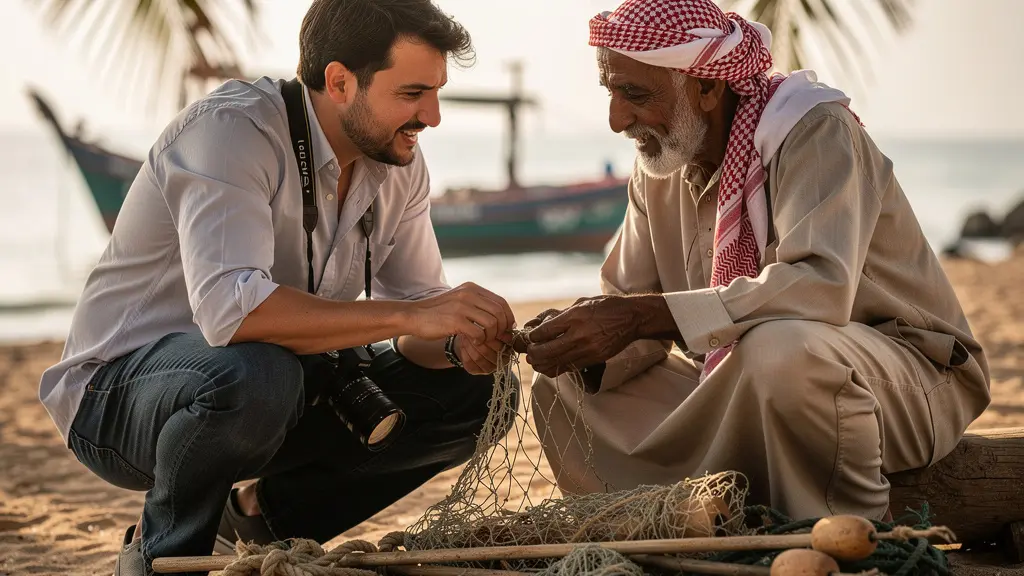
As the image above suggests, the most meaningful exchanges happen when the camera is down and genuine curiosity takes its place. The practice of quiet observation involves more than just being silent; it means learning the daily rhythm of the place. To approach with grace and increase your chances of a positive interaction, consider the following principles of etiquette:
- Establish a Human Connection First: The simplest way to break the ice is through a small commercial transaction. Buy some fish from their catch or offer to purchase a cup of tea from a nearby cafeteria. This simple gesture changes your status from a mere spectator to a patron.
- Learn the Daily Rhythm: A fisherman’s day is structured around tasks. Avoid approaching during moments of intense focus, such as when they are mending nets, sorting a valuable catch, or negotiating a sale. These are moments of work, not performance.
- Identify the Best Timing: The ideal time for a gentle approach is during periods of downtime. This might be after the main work is done, as they clean their boat, or during a break. Fishermen are often more relaxed and open to a chat during these lulls.
- Focus on Storytelling Details: Instead of immediately aiming for a direct portrait, focus your lens on the details that tell a story: the weathered texture of their hands, the vibrant colors of the catch, the peeling paint on a dhow. This is often less intrusive and can result in more powerful images.
- Always Ask for Permission: This is the golden rule. Before taking a picture of an individual, always make eye contact, smile, and ask for permission, even if it’s with a simple gesture of pointing to your camera. If they decline, thank them with a nod and respect their decision without question.
Remember, you are a guest in their workspace. By showing respect for their time, their craft, and their personal space, you are far more likely to be welcomed and perhaps even be invited to see their world a little more closely.
Jazirat Al Hamra or Rams: Which Coastal Spot Offers the Best Ruins?
For travelers seeking a tangible connection to the UAE’s pre-oil past, the question often arises: where to go for the most authentic experience? Two names dominate the conversation: Al Jazirat Al Hamra and Rams. However, they offer fundamentally different encounters with history. The choice between them isn’t about which has “better” ruins, but about whether you want to explore a silent museum or witness living heritage.
Al Jazirat Al Hamra, famously known as the ‘ghost town’ of Ras Al Khaimah, is a remarkable open-air museum. Its abandoned buildings, constructed from coral and shell, offer a haunting and beautiful look into the architecture and layout of a pearling village frozen in time. For the architectural history enthusiast, it is an unparalleled destination. Yet, its primary characteristic is absence; the life that once filled its alleyways is long gone. In contrast, the small coastal area of Rams, just north of Ras Al Khaimah city, presents a different story. Here, old structures are interspersed with modern homes, and the fishing port is still active. It is not a ruin but an evolving community.
This table compares the two experiences, helping you choose based on the kind of connection you’re seeking, as suggested by local travel observers.
| Feature | Jazirat Al Hamra | Rams |
|---|---|---|
| Type of Experience | Preserved open-air museum | Living history with active community |
| Architecture | Coral and shell construction buildings | Mix of old and modern structures |
| Best For | Architectural history enthusiasts | Authentic cultural immersion |
| Atmosphere | Abandoned ghost town feel | Active fishing village |
| Historical Significance | Well-preserved pre-oil economy structures | Ongoing community evolution story |
Beyond these two, other Emirates offer their own quiet corners of history. The emirate of Umm Al Quwain, for example, provides a tranquil middle ground. While not a ghost town, its old town and dhow-building yards operate at a much slower pace, retaining the charm of its past as a fishing hub without being a curated exhibit. The choice ultimately depends on your goal: do you want to walk through the echoes of history, or do you want to see where history still breathes?
The Tide Mistake That Can Block Your Access to Remote Coastal Areas
Exploring the UAE’s wilder coastlines offers a thrilling sense of discovery, but the physical threshold of access is often dictated by a powerful, and frequently underestimated, natural force: the tide. The most common and dangerous mistake adventurous travelers make is misjudging the tidal cycle, particularly when driving on or near coastal salt flats, known locally as sabkha. These vast, flat areas can appear solid and safe at low tide, tempting drivers to venture further for that perfect remote spot. However, as the tide turns, these seemingly dry plains can rapidly become impassable, muddy traps, leaving vehicles stranded miles from solid ground.

A sabkha’s deceptive surface, often marked by crystalline salt patterns and sparse, salt-tolerant vegetation, hides a soft, saturated base. Identifying these areas is a critical skill for any coastal explorer. The danger is not just getting stuck; it’s being cut off by the rising water, turning a scenic drive into a serious emergency. Careful planning is not optional; it is essential for a safe and successful trip. Before heading to any remote coastal or beach area, a thorough check of the day’s tidal patterns and a clear exit strategy are paramount.
Your Essential Tide Safety Checklist: Coastal Exploration
- Equip Yourself with Data: Download reliable tide apps like Windy.app or Tides Near Me for UAE-specific data. Don’t rely on general estimations.
- Check Local Regulations: Consult the Hadaq interactive map provided by MOCCAE to understand zone-specific rules, protected areas, and known hazards.
- Learn Visual Cues: Train your eye to identify the signs of a sabkha. Look for the characteristic white salt crust, sparse, hardy vegetation, and faint water lines on nearby rocks that indicate the high-tide mark.
- Plan Your Exit Window: Never park your vehicle below the high-tide line. Always plan your departure with at least a two-hour buffer before high tide to ensure a safe extraction, especially if driving a 4×4 on sand.
- Prepare for the Worst: Always carry basic recovery equipment (tow rope, shovel, deflation gauge) and have the contact numbers for local towing services saved on your phone. Cell service can be spotty, so preparation is key.
Treating the tide with respect is the fundamental rule of coastal exploration. It is a powerful rhythm that commands the landscape, and understanding it is the first step to unlocking the coast’s most secluded secrets safely.
Where to Eat Fresh Catch in Coastal Hamlets: Exploring the “Cook Your Own” Markets
One of the most authentic and rewarding sensory experiences in a coastal village is tasting the local catch, fresh from the sea. While some hamlets have small, rustic restaurants, the ultimate local dining experience is found at the fish markets that feature a “cook your own” service. This tradition allows you to immerse yourself in the local food culture from start to finish, engaging with vendors and enjoying a meal prepared exactly as the locals do. The process is simple, direct, and incredibly satisfying.
The journey begins at the fish stalls, where the morning’s catch is laid out on ice. Here, you can observe the variety of local species and choose your meal with your own eyes. This is a chance for a friendly, low-pressure interaction with the fishermen and vendors. Once you’ve made your selection, the experience unfolds in a few simple steps, turning your purchase into a delicious, hot meal in minutes.
To navigate this experience like a local, follow this simple process:
- Choose Your Fish: Look for the signs of freshness—clear, bright eyes and vibrant red gills. Popular local choices include Hamour (grouper), a firm white fish perfect for grilling; Shaari (emperor), a smaller, tender fish; and Kanaad (kingfish), often sold as steaks.
- Head to the Cleaning Station: After paying for your fish, take it to the designated cleaning area. Ask for ‘tandhif‘ (cleaning). The staff will ask if you want the head and tail removed; it’s a matter of personal preference.
- Select Your Cooking Style: Next, take your cleaned fish to one of the small, adjacent grill shops. The most common request is ‘mashwi‘ (grilled). For an authentic local flavor, ask them to add ‘bezar‘, a traditional Emirati spice mix of cumin, coriander, and turmeric.
- Consider a Kerala Fusion: Many of the cooks in these markets are from the Indian state of Kerala and are masters of seafood. You can ask if they have their own special Keralan spice preparation for a delicious South Indian twist on your meal.
- Complete the Meal: While your fish is grilling, visit a nearby bakery for hot, fresh ‘khubz‘ (flatbread) and a small grocery store (‘baqala’) for a pot of yogurt and some pickles. This trio is the classic accompaniment to a grilled fish feast.
This market-to-table journey, from selecting your fish to enjoying it on a nearby beach or bench, is more than just a meal. It’s an active participation in the local economy and a direct connection to the seafaring heart of the community, as seen in places like Dibba Al Fujairah where this rhythm still defines daily life.
Why Were Pearl Divers Often in Debt Despite the High Value of Pearls?
Before oil, the economy of the Trucial States was built on the iridescent luster of pearls. The Gulf’s pearling industry was a global powerhouse, reaching an astonishing peak value. Historical records show that in the 1912-1913 season alone, Gulf region pearl exports were valued at over 2,000,000 English Pounds—a colossal sum for the era. This incredible wealth, however, rarely trickled down to the men who risked their lives to harvest the pearls. The vast majority of divers lived and died in a state of perpetual debt, trapped in a complex and often ruthless socio-economic system.
The root of this systemic poverty was the financing structure of the pearling expeditions. The entire operation was built on credit, creating a cycle of dependency that was nearly impossible to break. Abdulla Al Suwaidi, founder of Suwaidi Pearls and a historian of the industry, explains the mechanism clearly. As he notes, the system was controlled from the top down:
At the beginning of each pearling season, wealthy families gave advance loans to nukhadas (captains) who would spend money to maintain boats and buy supplies for the crew
– Abdulla Al Suwaidi, Founder of Suwaidi Pearls
This initial loan set off a chain of debt. The nukhada (captain) would in turn provide advances to his divers to support their families while they were at sea for months. These loans, along with the cost of food and supplies on the boat, were recorded against the diver’s name. At the end of the season, the value of the diver’s share of the pearl catch was calculated. After the captain, merchants, and moneylenders took their substantial cuts, the remaining amount was often insufficient to cover the diver’s initial debt. The outstanding balance was then carried over to the next season, with interest. This system of debt bondage, known as ‘ghaus’, ensured that a diver and even his sons were legally bound to the same captain until the debt was repaid—a feat that was rarely achieved.
This historical context of economic hardship is crucial for understanding the psyche of the coastal communities. It fostered a deep sense of resilience, community reliance, and a cautious relationship with external traders and financiers. The echoes of this past are a key part of the “economic undercurrents” that subtly shape the social fabric of these villages today.
How to Obtain a Recreational Fishing License for a Weekend Trip?
After observing the local fishing culture, some visitors may feel inspired to cast a line themselves. Recreational fishing is a popular pastime in the UAE, but it is a regulated activity designed to protect the fragile fish stocks. Fishing without a permit can lead to significant fines. Fortunately, for residents and tourists in certain emirates, obtaining a short-term recreational license is a relatively straightforward digital process. The rules and application methods can vary by emirate, but the process in Dubai serves as a good example.
It is important to note that a license is required for shore fishing. If you book a trip on a chartered fishing boat, the license is typically included and handled by the boat operator, though it is always wise to confirm this beforehand. For those wishing to fish from permitted beaches or breakwaters, securing your own permit is mandatory. Be aware of seasonal restrictions; for instance, the service for new permits in Dubai is often suspended between June and October to allow fish stocks to replenish during the breeding season.
If you are a resident or visitor with a UAE Pass, you can apply for a free recreational fishing permit in Dubai online. The process is managed through the Dubai Municipality portal and can be completed in a few steps:
- Log in to the Dubai Municipality portal (hub.dm.gov.ae) using your verified UAE Pass account.
- Navigate to the ‘Services’ menu and select ‘Individual Services’ from the dropdown.
- Find the service category labeled ‘Marine and Coastal Environment’ and click on it.
- From the list of services, choose ‘Permit for Recreational Line and Hook Fishing’ to begin your application.
- Follow the on-screen instructions, noting that children under 18 are generally exempt but must be accompanied by a licensed adult.
Once issued, the permit allows you to fish with a traditional line and hook in designated areas, which typically include specific zones like Khor Al Mamzar, parts of Jumeirah beach, and Al Sufouh beach. Always respect the designated zones and any catch limits to ensure this pastime can be enjoyed for generations to come.
Key Takeaways
- The culture of traditional fishing villages is highly fragile, threatened by a 90% decline in fish stocks and a major generational shift away from the profession.
- True cultural connection comes from quiet, respectful observation. Always prioritize human connection over photography and ask for permission before taking photos of individuals.
- Distinguish between historical sites: Al Jazirat Al Hamra is a preserved “open-air museum,” while places like Rams offer a chance to see “living history” in an active community.
- The tide is a critical safety factor. Never drive on coastal salt flats (sabkha) without checking tide times and ensuring a safe exit strategy to avoid getting stranded.
Weekend in Fujairah: How to Plan a Relaxing Indian Ocean Getaway?
For the traveler seeking to put the principles of slow, observant travel into practice, the emirate of Fujairah offers the perfect canvas. Situated entirely on the UAE’s East Coast, it faces the Indian Ocean (via the Gulf of Oman) and presents a landscape and atmosphere that are worlds away from the Arabian Gulf coast. This is where you can truly synthesize the experience—combining an appreciation for history, a respect for local rhythms, and the simple pleasure of a natural escape.
What makes Fujairah so different? The dramatic backdrop of the Hajar Mountains crashing down to the sea creates a stunning visual contrast, while the ocean itself offers a different character. The waters are generally cooler and the coastline feels more rugged and less developed than the sprawling resort strips of the west coast. This unique environment makes it the ideal destination for a weekend getaway focused on relaxation and authentic discovery.
This table, based on insights from travel experts at guides like Rough Guides, highlights the key differences that define the East Coast experience.
| Feature | Indian Ocean (East Coast) | Arabian Gulf (West Coast) |
|---|---|---|
| Water Temperature | Cooler, more refreshing | Warmer year-round |
| Landscape | Dramatic Hajar Mountains backdrop | Flat desert and urban development |
| Development Level | Relatively untouched, somnolent | Heavily developed, modern |
| Marine Life | Different species, coral reefs | Traditional Gulf species |
| Best Features | Mountain-sea combination, scenic drives | Luxury resorts, water sports facilities |
To plan a weekend that embodies the spirit of quiet observation, consider an itinerary that blends mountain, coast, and culture. This allows you to experience the diverse rhythms of the region:
- Morning: Begin your day inland by exploring the mountain pools and hiking trails of a wadi, such as Wadi Al Wurayah. This connects you to the natural source of life in this arid landscape.
- Midday: Take a scenic drive along the coastal road, heading towards the small fishing hamlets of Dibba or Dadna. This is your opportunity to practice patient observation of the local fishing activity.
- Afternoon: Visit Al Badiyah Mosque, the oldest known mosque in the UAE. Try to time your visit near a prayer time to experience the powerful soundscape and witness a moment of community ritual from a respectful distance.
- Late Afternoon: Find a spot on a quiet beach, like the one at Khor Fakkan, and simply take in the view. Watch the light change on the Hajar Mountains as the sun begins to set.
- Evening: End your day with a visit to a local fish market for a ‘cook-your-own’ seafood dinner, putting your newfound market skills to the test for a perfect, authentic meal.
To truly connect with the UAE’s coastal soul, the next step is to plan your own slow journey. Use this framework as a starting point, pack your patience, and prepare to simply observe the subtle, beautiful rhythms of life by the Indian Ocean.
Frequently Asked Questions About Exploring UAE Coastal Villages
Do I need a license if I’m on a chartered boat?
Usually the license is included with chartered boats, but it is always best to confirm with the operator before booking. They are responsible for ensuring all passengers are covered under their commercial permit.
What are the fines for fishing without a license?
The penalties for fishing without a valid permit can be severe. According to regulations approved by Sheikh Hamdan bin Mohammed, fines can reach up to 20,000 dirhams, so it is crucial to follow the rules.
Where can I fish with a recreational permit in Dubai?
Permitted areas are clearly designated to protect sensitive marine ecosystems. In Dubai, these typically include parts of Khor Al Mamzar, Creek Park, Jumeirah, Umm Suqeim, and the beaches at Al Sufouh.