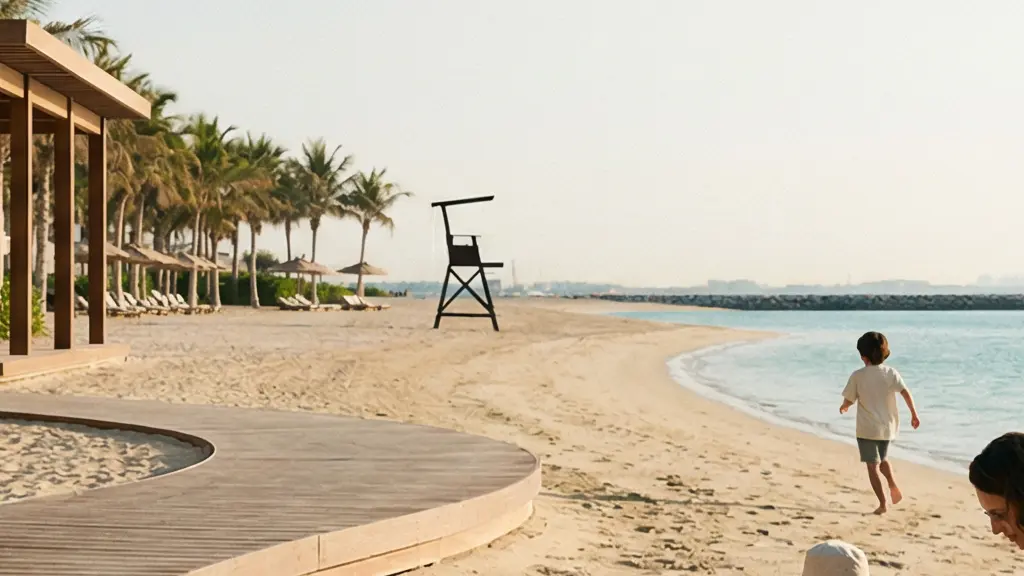
The difference between a stressful family trip and a truly relaxing one isn’t the size of the waterpark—it’s mastering the small logistical details hotels don’t advertise.
- Prioritize unseen safety features like rubberized splash areas and calm lagoon waters over flashy amenities.
- Analyze meal plans with a cynical eye; “all-inclusive” isn’t always the money-saver it seems when “buffet fatigue” sets in.
- Master the unspoken logistics of resort life, from securing sunbeds to negotiating late check-outs around nap schedules.
Recommendation: Shift your focus from the glossy brochure to how a resort handles the unspoken, real-world challenges of traveling with children. That’s where parental sanity is won or lost.
Let’s be honest. The dream is simple: a sun-drenched beach, a cool drink in hand, and the sound of your children laughing happily… in the distance. Under the careful supervision of someone else. For years, the glossy brochures of Palm Jumeirah resorts have sold us this exact fantasy. They flash images of sprawling waterparks and vibrant kids’ clubs, promising the ultimate family escape. We book the trip, fueled by hope and a desperate need for a break, only to find ourselves embroiled in the gritty reality of resort life: the 6 a.m. scramble for a sunbed, the toddler meltdown on a scorching hot pool deck, the tyranny of the 12 p.m. checkout time clashing with a non-negotiable nap schedule.
The standard advice is to compare the big-ticket items: which resort has the biggest water slides or the most restaurant choices? But what if that’s the wrong approach entirely? What if the key to a genuinely restful family vacation isn’t found in the headline attractions, but in the dozens of tiny, unglamorous details that dictate your daily comfort and sanity? This isn’t just another list of hotels. This is a field guide to the unspoken logistics of a UAE family beach holiday. We’re going to ignore the marketing hype and focus on the things that actually matter: the texture of the splash pad floor, the real value of a meal plan, and the strategic importance of a guaranteed interconnecting door.
For those who prefer a visual summary, the following video offers an immersive look into the vibrant atmosphere of a Dubai family holiday, perfectly complementing the practical advice in this guide.
This guide breaks down the critical, often-overlooked elements that determine the success of your trip. We’ll navigate everything from micro-safety features to macro-budget decisions, equipping you with the knowledge to see past the brochure and choose a resort that genuinely works for your family.
Contents: Your Battle Plan for a Genuinely Relaxing Vacation
- Why Are Rubberized Floors Essential for Toddler Splash Areas?
- Half-Board or All-Inclusive: Which Meal Plan Saves Money for Families?
- Calm Lagoon or Open Waves: Which Water Is Safer for Non-Swimmers?
- The Towel Mistake: How Early Must You Go Down to Save a Sunbed?
- Late Check-Out: How to Negotiate an Extra 2 Hours for Nap Time?
- Saadiyat or Corniche: Which Abu Dhabi Area Offers the Best Beach Hotels?
- Why Do Blue Flag Beaches Matter for Your Family’s Health?
- Traveling with Teens: How to Book Interconnecting Rooms Guaranteed?
Why Are Rubberized Floors Essential for Toddler Splash Areas?
The kids’ club might have a pirate ship and a water slide, but for a parent of a toddler, the first five minutes are spent doing a subconscious risk assessment. And the number one hazard? The ground. Standard tile or concrete becomes a terrifyingly slick surface the moment water hits it. Pair that with a wobbly, excited toddler, and your relaxing afternoon is replaced by a high-alert state of constant cringe, waiting for the inevitable slip and fall. This is where the unsung hero of resort design comes in: the rubberized safety surface. It’s a detail you’ll never see in a marketing photo, but its presence is a profound signal that the resort understands families.
These soft, porous, EPDM-granule floors offer superior grip even when wet, turning a high-stress zone into a place of genuine fun. Beyond the slip-resistance, there’s the heat factor. In the intense UAE sun, traditional hard surfaces can become dangerously hot. In fact, a NASA-backed heat analysis shows that sun-exposed hard surfaces can reach temperatures that burn skin fast, posing a real risk to tender little feet. A rubberized floor mitigates this dramatically. The good news is that this is becoming an area of formal focus. As Briana Valente from Life Floor notes, progress is being made on safety standards:
In 2024, NSF International published a new section within NSF/ANSI/CAN Standard 50 for surfaces around pool deck perimeters.
– Briana Valente, Life Floor (blog post)
This macro shot shows the texture and grip that make all the difference. The slightly yielding, granular surface is designed to disperse water and provide purchase, a stark contrast to the slick, unforgiving nature of wet tile.

When you’re researching resorts, look closely at photos of the toddler splash areas or even email the hotel to ask. A resort that has invested in this critical safety infrastructure is a resort that has thought about your peace of mind. It’s one of the most significant, albeit hidden, features a “family-friendly” hotel can offer.
Half-Board or All-Inclusive: Which Meal Plan Saves Money for Families?
Ah, the great meal plan debate. “All-inclusive” sounds like the holy grail: a world without wallets, where every plea for a juice or an ice cream can be met with a breezy “yes.” The reality, however, can be a gilded cage of buffet monotony and questionable value. “Half-board” (breakfast and dinner) offers more freedom but brings back the anxiety of every poolside drink order. So, how do you decide? The answer isn’t about luxury; it’s a cold, hard break-even calculation. You have to become a cynical family accountant for a moment.
First, find the price difference between the half-board and all-inclusive packages. Let’s say it’s 800 AED per day for your family. Now, do the math. Using typical Dubai food-and-drink prices as a baseline (e.g., ~40 AED for a simple lunch, ~5 AED for a soft drink, ~15-20 AED for an ice cream), calculate what your family would realistically spend on lunch, drinks, and snacks throughout the day. If that total is consistently less than 800 AED, all-inclusive is a waste of money. If it’s more, it could be a smart move. Be brutally honest: will your kids be happy with the buffet, or will you end up paying extra for the à la carte pizza place anyway to avoid a meltdown?
The second factor is what I call “buffet fatigue.” Eating at the same buffet restaurant for lunch and dinner for seven straight days can become a unique form of holiday torture. This is where you need to scrutinize the fine print of the meal plan. Some resorts offer a far more flexible approach. A great case study is the plan at some Centara properties, which explicitly offers variety.
Case Study: The “Dine-Around” Advantage
Centara Mirage Beach Resort Dubai offers a prime example of a flexible half-board plan. As detailed on their website, the plan includes breakfast and dinner, but critically, the dinner options extend beyond a single buffet. Guests can choose from special menus at their specialty restaurants (like Thai or Italian), with the only extra cost being beverages. This “dine-around” model prevents buffet fatigue and allows families to have a different culinary experience each night without breaking the bank, offering a smart middle ground between restrictive all-inclusive and expensive pay-as-you-go. This is a model to look for when evaluating a resort’s meal plan.
The ideal plan, therefore, isn’t necessarily all-inclusive. It’s a plan that offers choice. Look for half-board or full-board options that include credit at à la carte restaurants or have “dine-around” privileges. This gives you the cost control you need without sacrificing the variety that keeps a week-long vacation from feeling repetitive.
Calm Lagoon or Open Waves: Which Water Is Safer for Non-Swimmers?
The idyllic image of your child splashing in the sea can quickly turn into a high-stress situation. Unpredictable waves, even small ones, can easily knock over a small child or a tentative swimmer, causing panic. The universal risk is significant; CDC data underscores how common limited swim training is, with over half of adults reporting they’ve never had a swimming lesson. This context makes the physical nature of a resort’s beach a paramount safety consideration. In the UAE, particularly on the Palm Jumeirah, you have a distinct choice: the protected, placid waters of the inner-frond lagoons or the open sea of the outer crescent.
For families with non-swimmers or very young children, there is no contest: the lagoon is infinitely safer. These are engineered environments designed for calm. The water is shallow for a significant distance from the shore, and the crescent of the Palm acts as a massive breakwater, shielding the lagoons from the open Arabian Gulf. There is virtually no swell or current, creating a swimming pool-like environment where you can relax your vigilance (just a little) and let the kids play with more freedom.
This isn’t just a happy accident of geography; it’s a result of deliberate coastal engineering. Projects on the Palm have been specifically designed to ensure this tranquility. For instance, Nakheel’s recent beach enhancement project wasn’t just about adding sand; it involved carefully re-profiling the beach slope and width to improve water circulation and guarantee a calm, visitor-friendly experience. This engineered approach creates a fundamentally different environment from a natural, open-water coastline.

Resorts on the outer crescent, while often offering spectacular views, face the open sea. While the water in Dubai is generally calm, you will experience waves and a much quicker drop-off in depth. This requires constant, hands-on supervision for little ones. When booking your Palm resort, look at the map. If your priority is a worry-free water experience for your toddlers and non-swimmers, a resort on an inner frond with a lagoon beach is the clear and logical choice.
The Towel Mistake: How Early Must You Go Down to Save a Sunbed?
It is a truth universally acknowledged that a parent in possession of a good vacation must be in want of a sunbed. Specifically, a sunbed in the shade, with a clear line of sight to the kids’ pool, and not directly next to the speakers. This is the holy grail, and securing it requires a level of strategic planning worthy of a military campaign. The biggest mistake you can make is assuming you can just wander down after a leisurely breakfast at 9:30 a.m. By then, the war is already over, and you have lost.
The battlefield is littered with the ghosts of sleepers-in: single towels, a book, a stray flip-flop, all silently screaming “OCCUPIED” from 6:45 a.m. To win the sunbed war, you must understand the rules of engagement, which vary by resort but follow a general pattern. The first wave of combatants is the pre-breakfast patrol. These are the seasoned pros who emerge around 7:00 a.m., place their towels and a decoy novel, and then retreat for coffee, having secured their prime territory for the day. To compete, you must join them.
Your mission, should you choose to accept it, is to designate one parent as the “dawn raider.” This person’s sole job is to head down to the pool area between 7:00 and 7:30 a.m. with the family’s towels and other assorted paraphernalia. Do not just lay a towel. This is an amateur move and can sometimes be cleared away by diligent pool staff. You must create an ecosystem of occupation: a book, a child’s brightly colored bucket, a half-empty water bottle. Make it look like you’ve just popped away for a moment. This level of commitment may feel absurd, but it is the price of a shaded spot by the toddler pool.
Some luxury resorts have tried to combat this by enforcing “no-saving” policies, but these are rarely effective and often lead to awkward confrontations. The unspoken social contract remains: early arrival and clear markers of intent are what secure your patch of poolside paradise. So, set the alarm. The extra 30 minutes of sleep is not worth a full day of squinting in the sun, miles away from where your kids are splashing. This is not relaxation; it’s survival.
Late Check-Out: How to Negotiate an Extra 2 Hours for Nap Time?
The final day. You’ve survived the sunbed wars and navigated the buffets. A fragile sense of calm has descended. Then you see it: “Check-out time: 12:00 p.m.” For a parent with a child who naps from 1 p.m. to 3 p.m., this is not a logistical inconvenience; it is a declaration of war. It presents you with an impossible choice: wake a sleeping dragon and suffer the fiery consequences, or spend three hours trying to keep an overtired gremlin entertained in a hotel lobby. This is where the art of negotiating a late check-out becomes the most important skill of your entire trip.
Do not wait until the morning of your departure. That is a rookie error. By then, the hotel’s housekeeping schedule is set in stone, and your request will likely be met with a polite but firm “no.” The negotiation begins at the moment of check-in. As you are handing over your passports, with a friendly and non-demanding tone, mention your flight time and your child’s nap schedule. “Our flight isn’t until 7 p.m., and our little one has their main nap right at 1 p.m. Would it be at all possible to note a request for a 2 p.m. or 3 p.m. check-out on our last day? It would make a world of difference.” This plants the seed early. It shows you’re planning ahead and positions your request as a matter of family wellbeing, not just convenience.
The day before you leave, follow up at the front desk. Reiterate your request politely. If the initial answer is no, this is where you deploy your strategic advantages. Are you a member of the hotel’s loyalty program? Mention it. Did you book directly with the hotel instead of a third-party site? Point that out, as they have more flexibility. The ultimate leverage is offering to pay. Ask if they have a half-day rate or an hourly charge. Often, paying for two extra hours is a small price for avoiding the nap-time-tyranny apocalypse. A successful late check-out isn’t a gift; it’s a hard-won victory that saves the last day of your vacation from descending into chaos.
Saadiyat or Corniche: Which Abu Dhabi Area Offers the Best Beach Hotels?
Once you’ve mastered the intricate logistics of a Dubai resort, you might start to wonder what lies beyond. Is the grass greener—or the sand whiter—in the neighboring emirate of Abu Dhabi? For families seeking a premium beach experience, the capital presents two main contenders: the pristine, natural expanse of Saadiyat Island and the vibrant, urban setting of the Corniche. The choice between them is a choice between two different vacation philosophies.
Saadiyat Island is, without question, the premier beach destination in the UAE. This is not an engineered beach; it is a protected natural shoreline with powder-soft white sand and stunningly clear turquoise water. The area is zoned for low-density, luxurious development, meaning the beaches feel spacious and serene, even when the hotels are busy. It’s famous for its Hawksbill turtle nesting site, a testament to its protected status. For families, this means a truly beautiful and often calmer beach experience. Hotels like the St. Regis, Park Hyatt, and Jumeirah at Saadiyat Island Resort offer expansive grounds, incredible pools, and a feeling of secluded luxury. The downside? It’s an island retreat. You are a taxi ride away from most of the city’s attractions.
The Abu Dhabi Corniche, on the other hand, offers a completely different vibe. Here, the hotels are integrated into the city’s bustling waterfront. The beach is a long, manicured public park with dedicated family areas, playgrounds, and bike paths. Hotels like the Emirates Palace Mandarin Oriental and The St. Regis Abu Dhabi are landmarks of city luxury, offering stunning views and immediate access to urban life. You can walk out of your hotel and be in the heart of the action. The trade-off is that the beach, while lovely and well-maintained, is a public space. It can be busier and lacks the exclusive, natural feel of Saadiyat. For families who want to mix beach time with city exploration, the Corniche is a fantastic and convenient option.
Ultimately, the “best” choice depends on your family’s priorities. If your goal is a pure, immersive beach escape where the sand and sea are the main attractions, Saadiyat is unparalleled. If you want a dynamic vacation that blends sunbathing with the energy and convenience of a major city, the Corniche is the smarter pick.
Why Do Blue Flag Beaches Matter for Your Family’s Health?
When you’re choosing a beach, “clean” is a subjective term. What looks clean to the naked eye might not be when it comes to water quality and safety standards. This is where the Blue Flag certification comes in. It’s not just a fancy award; it’s a rigorous, internationally recognized eco-label that serves as a powerful guarantee for parents. Seeing that blue flag flying is an immediate, trustworthy signal that the beach you’re on meets a high global standard for health, safety, and environmental management.
For a beach to earn a Blue Flag, it must meet and maintain a series of strict criteria, which are grouped into four main categories. For families, the most important are Water Quality and Safety and Services. The water quality standards are non-negotiable. The beach must comply with stringent requirements for microbiological parameters, meaning the water is regularly tested and proven to be free from harmful levels of bacteria. For a parent whose child will inevitably swallow a mouthful of seawater, this is a profound reassurance.
The safety criteria are just as critical. A Blue Flag beach must have adequate lifeguard coverage and/or other safety measures, first aid equipment must be available, and emergency plans must be in place to deal with any pollution hazards. It also mandates that information about the beach’s ecosystem and water quality be publicly displayed. This transparency empowers you and turns a simple beach day into a subtly educational experience. Many beaches along Saadiyat Island and the Dubai coastline, including Jumeirah and parts of the Palm, have achieved this status.
In a world of marketing buzzwords, the Blue Flag is a mark of substance. It cuts through the noise and provides a simple answer to the question, “Is this beach truly safe and clean for my family?” When you have a choice between a certified and a non-certified beach, especially with young children, opting for the one with the Blue Flag is a simple, smart decision that helps protect your family’s health and wellbeing.
Key takeaways
- Parental sanity is the true measure of a successful family vacation; prioritize details that reduce your stress.
- Unseen safety features, like rubberized floors and calm waters, are more valuable than flashy, brochure-friendly amenities.
- A successful trip requires tactical planning for unspoken challenges like sunbed allocation, meal plan value, and nap-friendly check-outs.
Traveling with Teens: How to Book Interconnecting Rooms Guaranteed?
Traveling with toddlers is a physical challenge; traveling with teenagers is a delicate psychological negotiation. They crave independence, and you crave a door you can close. The holy grail for this stage of family travel is the guaranteed interconnecting room. Not “adjoining” rooms that are merely next to each other. Not a “request” for an interconnecting room that leaves you in a state of anxiety until check-in. A 100%, non-negotiable, guaranteed pair of rooms with a door in the middle.
Getting this guarantee is notoriously difficult. Most online booking systems don’t have a simple checkbox for it. A “request” in the special notes field is often ignored, as room allocation is a complex puzzle managed by the hotel’s front office team. To secure your family’s harmony, you must abandon the easy click-to-book path and engage in a more direct, old-school approach. The only way to get a true guarantee is to speak directly with the source.
Your first step is to call the hotel’s in-house reservations team directly—not the central call center for the entire hotel chain, but the people physically located at the property. Explain your needs clearly: “I need to book two rooms for these dates, and I require a written confirmation that they will be interconnecting.” They are the only ones who can look at their actual room inventory and block off a specific pair for you. If they agree, ask for that guarantee to be sent to you in writing via email. This email is your contract. Do not proceed with the booking until you have it.
If the hotel is hesitant, this is a major red flag. It likely means their number of interconnecting pairs is limited and they want to keep their options open. In this case, your best alternative is a trusted, high-end travel agent. A good agent has personal relationships with hotel sales managers and can often secure guarantees that are unavailable to the general public. They can leverage their booking volume to make requests into demands. It may cost a little more, but it buys you certainty—the certainty of having your own space while knowing the teens are just a door away.
Action Plan: Securing Your Interconnecting Rooms
- Identify Targets: Research hotels and specifically look for “Family Rooms” or floor plans that show interconnecting options on their website.
- Direct Contact: Bypass central reservations. Call the hotel’s direct line and ask for “In-House Reservations.” State your need for a *guaranteed* interconnecting room.
- Get it in Writing: Before providing credit card details, insist on an email from the reservations agent explicitly confirming the guaranteed interconnecting rooms.
- Re-Confirm: One week before your arrival, forward your confirmation email to the front office manager to politely re-confirm your room allocation is in place.
- Check at Check-In: Upon arrival, have your confirmation email ready and verify the room arrangement before you hand over your passports.
For parents of teens, a vacation isn’t just about shared experiences; it’s about respecting the need for personal space. Securing that interconnecting door isn’t a luxury; it’s a fundamental requirement for a trip where everyone, parents included, feels like they’ve had a break.
Now that you’re armed with this practical, detail-oriented mindset, the next logical step is to apply it. Start planning your next family trip not by looking at what the brochures show, but by actively asking what they hide.