A 2000 AED minimum spend is often more economical than individual passes for groups of six, provided you navigate the exclusion clauses.
- The “fully redeemable” promise often excludes high-margin items like tobacco and premium spirits.
- Prime cabana real estate relies on sun angles and surface temperatures, not just proximity to the water.
Recommendation: Audit the menu prices against your group’s consumption capacity before booking, and always prioritize fixed-structure shade over retractable umbrellas.
The group chat debate is inevitable. You are staring at a 2000 AED (or $500) minimum spend requirement for a Saturday cabana. Half your friends argue it’s a rip-off; the other half claim it’s a steal compared to paying for individual entry and drinks separately. Most people make this decision based on vibes or a vague sense of budget. They fail to calculate the “cost-per-usable-hour” or the operational limitations that can turn a luxury splurge into a logistical headache.
We often hear standard advice: “arrive early” or “check the cancellation policy.” While valid, these platitudes ignore the financial and physical mechanics of a luxury pool day. We need to look at gem-like facets of the experience—from the thermodynamics of deck surfaces to the tax implications of shisha—to determine the real value.
The equation isn’t just about money; it is about efficiency. If the spend is fully redeemable, the cabana is essentially free real estate, provided you were going to spend that money on food and beverage anyway. However, the variables of shade, service speed, and hidden exclusions can drastically alter the ROI.
The following analysis breaks down the cabana equation into eight critical variables to help you calculate whether the upgrade is a smart investment or a sunk cost.
Table of Contents: The Cabana Calculus
- Why Does “Fully Redeemable” Not Always Include Shisha?
- Poolside or Beachfront: Which Cabana Location Is Cooler in Summer?
- Dedicated Butler or Flag Service: What Level of Attention Do You Need?
- The Sun Angle Mistake: Picking a Cabana That Loses Shade at Noon
- 6 People in a 4-Person Cabana: How Strict Are Hotels on Headcount?
- How to Use Smart Palms and Public Showers Without Local Coins?
- Day Pass vs Overnight: When Is It Cheaper to Just Visit for the Day?
- The Towel Mistake: How Early Must You Go Down to Save a Sunbed?
Why Does “Fully Redeemable” Not Always Include Shisha?
When a venue advertises a “fully redeemable” minimum spend, the savvy calculator assumes every dollar spent contributes to the quota. However, tobacco products—specifically cigars and shisha—are frequently excluded from this credit. This isn’t just a hotel trying to be difficult; it is often a matter of tax structures and liability. High excise taxes on tobacco products mean the profit margin is different from food or alcohol, complicating how “credit” is applied accounting-wise.
For context on the financial weight of these products, some jurisdictions impose significant levies, with cigarette excise taxes of $5.00+ per pack in certain U.S. regions. While this data is specific to cigarettes, the principle applies to the luxury markup on shisha. If your group plans to reach the minimum spend heavily relying on three or four shisha pipes, you might find yourself 600 AED short at the end of the day because those items were billed separately. Always verify the “F&B only” vs. “Total Bill” distinction before committing.
If the spend mathematics work out, the physical comfort must follow suit.
Poolside or Beachfront: Which Cabana Location Is Cooler in Summer?
The choice between poolside and beachfront is rarely about aesthetics; it is a question of thermodynamics. In high summer, the surface material of your environment dictates the ambient temperature. Beachfront cabanas often sit directly on sand. While picturesque, sand has a low specific heat capacity and high reflectivity, meaning it heats up rapidly and radiates that heat upwards into your enclosure.
This heat trap effect is significant. Real-world measurements have recorded beach sand reaching 137°F at peak heat, effectively turning the ground beneath you into a radiator.
The visual below illustrates this microclimate difference. The poolside environment benefits from the evaporative cooling of the water and typically cooler decking materials, whereas the beachfront setup fights against the radiant heat of the sand.
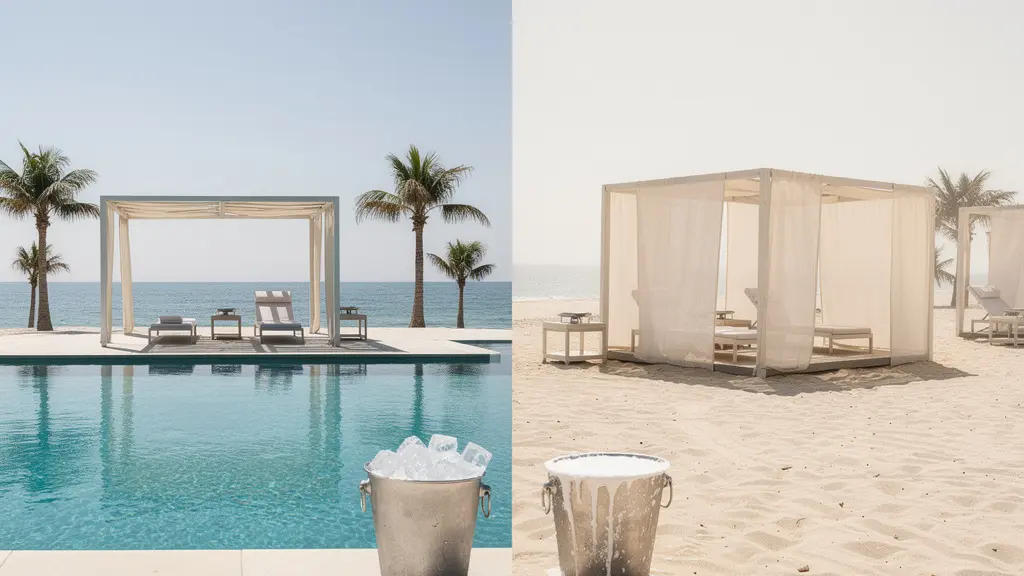
As illustrated, the poolside cabana (left) benefits from the proximity to water and solid shade, while the beachfront structure (right) is exposed to the thermal radiation of the sand. For a group sensitive to heat, the “premium” beach view often comes with a thermal penalty.
Therefore, paying extra for the “beach front” tier may actually be paying for a hotter experience.
Dedicated Butler or Flag Service: What Level of Attention Do You Need?
Service latency is the hidden killer of the pool day vibe. When calculating the value of a cabana, determine if the price includes a dedicated butler or merely “flag service” (raising a flag to summon roaming staff). The mathematical difference is in the “cost of attention.” A dedicated butler ensures your drink orders are processed immediately, maximizing the consumption speed required to hit a high minimum spend comfortably.
However, this service level often triggers hidden surcharges. You must factor in the service charge and automatic gratuities that are tacked onto the final bill, which are rarely part of the “redeemable” credit. A guide to Las Vegas pool parties notes that one should expect 20–30% automatic gratuity on top of the minimum spend. If your group has a budget of exactly 2000, a 20% surcharge pushes the real cost to 2400. If the service is slow (flag system), you might struggle to even order enough food to hit the minimum, leading to a “forced spend” on champagne at 5:00 PM just to meet the contract.
True luxury math accounts for the “net price” after tax and tip, not the headline number.
The Sun Angle Mistake: Picking a Cabana That Loses Shade at Noon
A cabana’s primary function is sun protection. Yet, many structures are designed for aesthetics rather than astronomical alignment. A pergola with widely spaced slats might look elegant at 10:00 AM, but as the sun reaches its zenith, it allows direct beams to strike the daybed, rendering the space unusable during lunch hours. This is the “Solar Noon Failure.”
Audit checklist for shade coverage: Sun Protection Plan
- Simulation: Open a sun/shadow app for your specific date and preview the 11:00–15:00 window.
- Structure Type: Verify if the roof is a fixed solid pergola or a retractable canopy (assume fixed unless stated).
- Orientation: Check exposure; West-facing units roast in the afternoon, East-facing are bright early.
- Airflow: Ensure curtains or walls do not block the prevailing breeze during peak heat.
- Backup Plan: Identify if there is nearby natural shade (trees) or dark decking to reduce glare.
Furthermore, shade does not guarantee UV immunity. The surface surrounding your cabana matters. Reflective surfaces bounce UV rays into the shaded area. While grass absorbs most radiation, sand can reflect about 10–15% of incident UVB rays, and water even more.
The image below demonstrates the geometric trap of a static roof during solar noon, where the shadow offset exposes the lounging area entirely.

As shown, the shadow has migrated off the bed, leaving the occupants fully exposed. A savvy booker checks the cardinal direction of the cabana opening before putting down a credit card.
Don’t pay for a roof that only works in the morning.
6 People in a 4-Person Cabana: How Strict Are Hotels on Headcount?
It is tempting to book a 4-person cabana for a group of six to lower the “cost-per-head” ratio. However, hotel policies on this are rarely flexible. This is not just about revenue protection; it is often a matter of life-safety codes and insurance liability. The capacity of a pool deck is strictly regulated, and overcrowding a specific zone can trigger a violation.
Hotels are bound by these regulations. For instance, specific pool policies may cite that the maximum number of people is limited by 25 per state safety code or similar local ordinances. If you exceed the cabana headcount, you aren’t just cramping your style; you are giving the venue grounds to evict you or force the purchase of a second cabana at the walk-in rate. The calculated move is to negotiate the headcount before booking, or simply split the cost of a larger unit, which often comes with a higher credit limit anyway.
The math of “squeezing in” falls apart if you are forced to buy a second spot on the day.
How to Use Smart Palms and Public Showers Without Local Coins?
In many modern beach destinations, the infrastructure is moving rapidly toward digital integration. “Smart Palms” (solar-powered Wi-Fi and charging stations) and public showers often no longer accept coins. Relying on physical cash for these micro-transactions is a strategic error. The shift is global and accelerating.
Data from major recreational operators confirms this trend. The U.S. National Park Service, for example, notes that cash sales now represent only 10-percent of in-person sales, driving a move toward fully cashless fee collection. If you are visiting a public beach area adjacent to the hotel, or using municipal amenities, ensure your phone is set up with Apple Pay or Google Pay. Being stuck with a pocket full of useless coins while needing a rinse is a friction point that luxury planning eliminates.
Digital wallets are now as essential as sunscreen for beach logistics.
Day Pass vs Overnight: When Is It Cheaper to Just Visit for the Day?
Sometimes, the minimum spend for a cabana is so high that it rivals the cost of a room night. This begs the question: is it smarter to book a “day use” room or a standard overnight stay just to access the pool? The answer lies in the “inclusions per dollar.” A cabana offers prime location and F&B credit. A room offers a private shower, A/C, and a bed, but usually zero F&B credit.
To visualize this trade-off, consider the comparison below. Note that a “Day Room” often provides the infrastructure of a hotel stay at a fraction of the overnight price, sometimes as low as $69 for a 9-to-5 block, though it rarely includes the prime poolside seating of a cabana.
The following table breaks down the access types to help you decide which “key” buys you the best experience.
As this comparative analysis of pool access suggests, the choice depends on your priority: F&B consumption vs. private rest.
| Option | What you’re paying for | Example access window / price (when provided) | Best when | Common gotchas |
|---|---|---|---|---|
| Day room (via a day-room listing) | Guaranteed private room for a set daytime block; may be separate from pool access. | Example cited: 9 a.m.–5 p.m. day-room listing at $69 (Sheraton Houston Brookhollow). | You need a shower/nap/work base between travel legs, not just a lounger. | Pool access may not be included; verify amenity list. |
| Resort day access (bought directly from a resort) | Facility access (often pool/water park) without an overnight room. | Example cited: Great Wolf Lodge day passes starting at $40 (half day) and $50 (day) in Gurnee, Illinois. | You want maximum usable daytime hours and amenities, not a bed overnight. | Prime seating (cabanas/daybeds) can still cost extra. |
| Resort day access (destination resort example) | Higher-end pool + facilities access packaged as a day experience. | Example cited: Botánika Osa Peninsula day access at $150 for two guests (includes pool, fitness center, and a day room). | You want ‘resort feel’ for a single day while staying elsewhere. | Limited availability on peak dates; confirm inclusions. |
| Overnight stay | Room overnight plus whatever amenities are included for registered guests. | Varies by property (not standardized). | You need late-night / early-morning room access and on-property convenience. | Daytime access before/after the stay may be constrained; premium seating may still be priced separately. |
The “Day Room” is the secret weapon for groups who value a private shower over a bottle of vodka.
Key Takeaways
- Check for “fully redeemable” exclusions like tobacco and premium taxes.
- Poolside beats beachfront for temperature control in high summer.
- Calculate the “net price” including the automatic 20-30% service gratuity.
The Towel Mistake: How Early Must You Go Down to Save a Sunbed?
If you forego the paid cabana, you rely on the “towel reservation” strategy. This is a high-risk game. In competitive luxury resorts, the “30-minute rule” is the unwritten (and often written) law. Staff are trained to remove belongings from unattended chairs after half an hour to accommodate other guests. This operational reality defines the value of the paid cabana: you are paying for the security of leaving your spot.
Etiquette guides and recent coverage of “sunbed wars” highlight that a 30-minute grace period is the standard expectation. Beyond that, your towel is just laundry, not a reservation.
The image below captures the texture of this battleground—a wet towel marking territory, vulnerable to removal.

To avoid the stress of the early morning sprint and the anxiety of losing your spot during lunch, the cabana minimum spend acts as an insurance policy. It buys you time, not just space.
Run the numbers on your group size and consumption habits today to decide if the upgrade pays for itself.