In summary:
- A successful architectural tour of the UAE involves understanding the “why” behind the design, not just listing iconic buildings.
- Focus on the dialogue between engineering ambition, cultural symbolism, and environmental context.
- Mastering specific photographic techniques and timing is crucial to capturing the essence of these glass and steel structures.
- Balance visits to “vertical” skyscrapers with “horizontal” landmarks to appreciate the full scope of the region’s innovation.
- Plan your itinerary around the movement of light (Golden Hour, Blue Hour) to experience the architecture dynamically.
For the aspiring architect or design aficionado, the UAE’s skyline presents a dazzling, almost overwhelming, display of structural ambition. A common approach is to treat it like a checklist of superlatives: the tallest, the shiniest, the most expensive. This method, however, misses the profound narrative woven into the steel, glass, and concrete. It overlooks the intricate dialogue between buildings that speak of technological prowess, cultural identity, and a bold vision for the future. Simply gazing up at the Burj Khalifa is to see a postcard; understanding its foundation is to read the first chapter of a fascinating engineering epic.
The real challenge is not to see these buildings, but to *decode* them. It’s to move beyond the spectacle and engage in an analytical appreciation of their form, function, and philosophy. This requires a different kind of itinerary, one that isn’t just about location-hopping but about sequencing your visit to reveal the underlying story. Why is one tower twisting while another is a hollow cube? How does a building designed in a desert climate manage to create a ‘rain of light’? These are the questions that transform a simple tour into a field study.
This 48-hour guide is structured as an architectural historian would approach it: thematically. We will explore the symbolism behind the shapes, the engineering that defies the environment, and the techniques to capture their essence. Prepare to see the UAE’s modern marvels not as isolated monuments, but as interconnected characters in a grand story of 21st-century design evolution.
To help you navigate this intensive architectural exploration, the following guide breaks down the key themes and practical steps for your 48-hour tour. Each section is designed to build upon the last, creating a comprehensive understanding of the UAE’s architectural landscape.
Summary: A Design-Focused 48-Hour UAE Architecture Itinerary
- Why Is the Museum of the Future Shaped Like a Torus with a Void?
- How to Photograph Glass Buildings Without Glare ruining the Shot?
- Twisting Tower or Hollow Cube: Which Structure Is More Engineeringly Complex?
- The Misconception That Dubai Architecture Is Only About Height
- In Which Order Should You Visit Sheikh Zayed Road Towers for Sunset Light?
- Why Does Building Skyscrapers on Sand Require Technology That Costs Billions?
- Why Do Artists Need 3D Scans of Buildings Before Creating the Light Show?
- Where to Find the Best Views of Dubai Skyscrapers Without the Crowds?
Why Is the Museum of the Future Shaped Like a Torus with a Void?
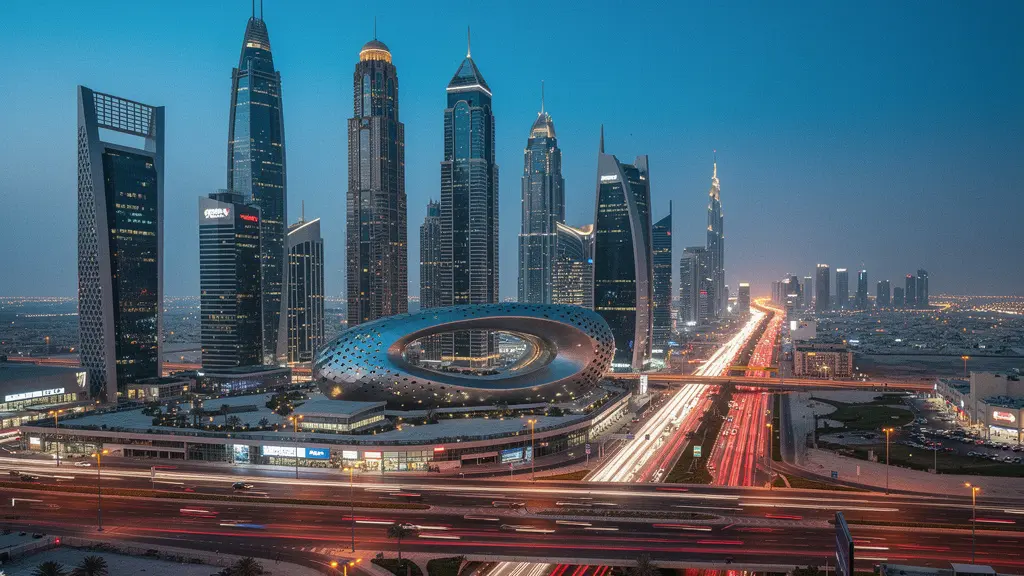
The striking form of the Museum of the Future is not an arbitrary aesthetic choice; it is a profound philosophical statement rendered in stainless steel and glass. The structure is a masterclass in architectural symbolism, where each element contributes to a larger narrative. According to the design team, the building embodies a trinity of concepts. The green mound upon which it rests symbolizes the Earth—solid, permanent, and the foundation of all our endeavors. The gleaming, elliptical superstructure represents humanity’s capacity for innovation and creation, a continuous ring of progress.
Most importantly, the central void, the empty space at the building’s heart, is a deliberate and powerful metaphor for the unknown future. It represents the knowledge and discoveries yet to be made. While the structure celebrates what we can build, the void honours what we do not yet know, positioning the pursuit of knowledge as an infinite journey. The entire facade is adorned with Arabic calligraphy, quoting poetry from Sheikh Mohammed bin Rashid Al Maktoum about the future, turning the building itself into a readable manuscript of ambition.
This complex shape required groundbreaking construction techniques. The museum’s skin is comprised of 1,024 unique robotic-manufactured plates, a testament to the digital design and fabrication that made its seamless, flowing form possible. It is an architectural argument that a building’s most significant feature can be the empty space it defines.
How to Photograph Glass Buildings Without Glare ruining the Shot?
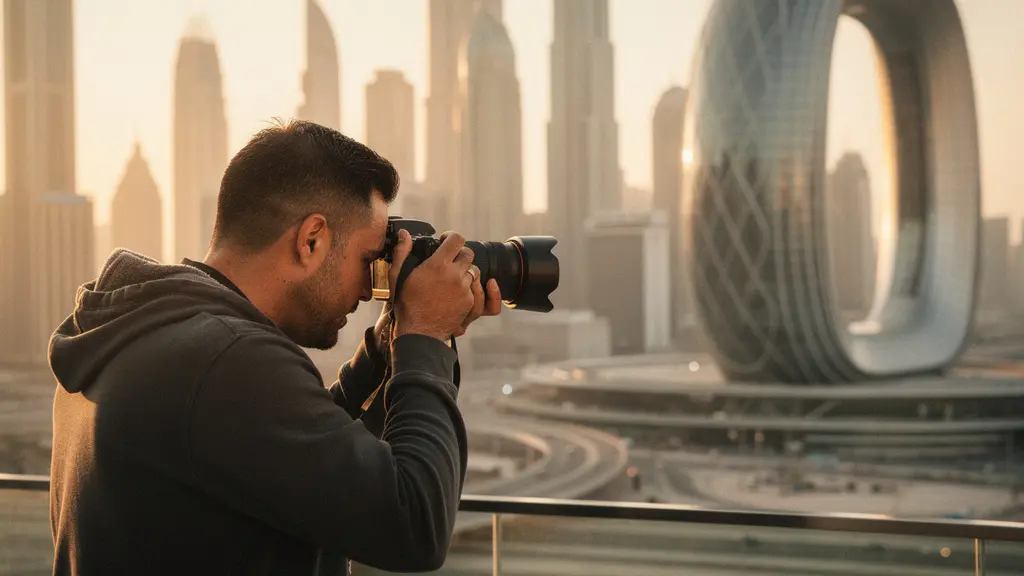
Photographing the glass-clad skyscrapers of the UAE presents a unique challenge: managing reflection and glare. Instead of fighting the glass, the key is to work with it, using light and timing to reveal the building’s form and complexity. The most critical factor is timing. Professional architectural photographers overwhelmingly favour the “Blue Hour”—the brief 15-20 minute window just after sunset. During this time, the ambient light from the sky perfectly balances with the artificial light from within the buildings, making them glow like lanterns and dramatically reducing external glare.
Beyond timing, composition is paramount. Rather than shooting a facade head-on, focus on architectural details where light and shadow play. Use the seams, curved panels, and structural joints to create texture and reveal the complexity of the construction. Another powerful technique is to use the reflective surfaces to tell a story. Frame your shot to capture the reflection of an older, more traditional building in the facade of a modern skyscraper. This creates a visual dialogue between the past and present, elevating a simple photo into a narrative piece.
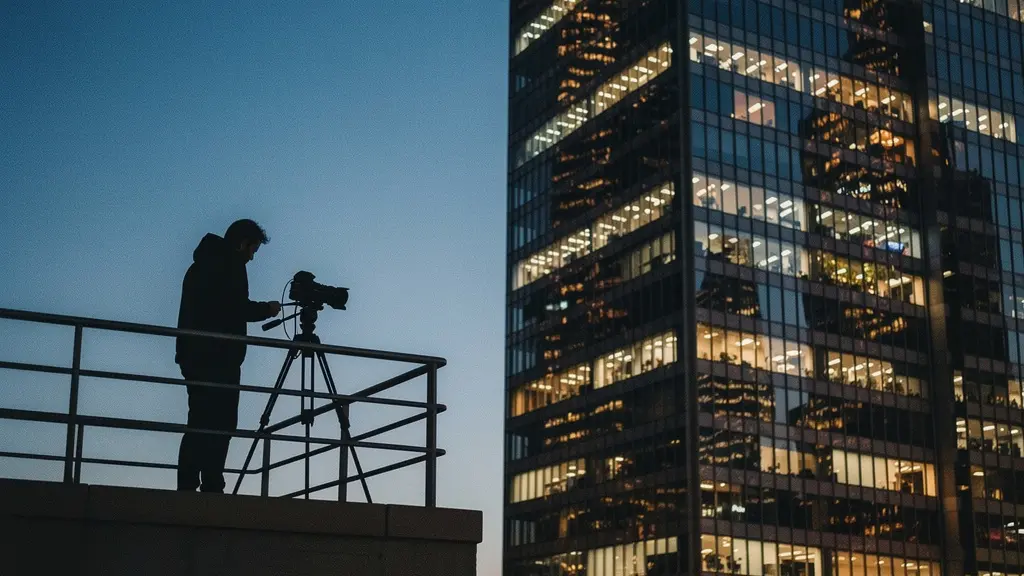
For more advanced control, exposure bracketing is an indispensable technique. This involves taking multiple shots of the same scene at different exposure levels to capture detail in both the bright sky and the darker building elements. These shots can then be merged in post-processing software to create a single, perfectly balanced image that does justice to the architectural vision. This methodical approach transforms a potential photographic problem into an artistic opportunity.
Twisting Tower or Hollow Cube: Which Structure Is More Engineeringly Complex?
Comparing the Cayan Tower and the Dubai Frame is an excellent exercise in understanding different facets of engineering complexity. At first glance, the Cayan Tower’s dramatic 90-degree twist seems the more complex feat. However, the apparent simplicity of the Dubai Frame conceals a structural challenge of equal, if not greater, magnitude. The core engineering problem for each is fundamentally different.
The Cayan Tower’s primary challenge is managing torsional wind loads. A standard rectangular tower faces wind pressure, but a twisting one also faces rotational forces that can cause instability. The solution was to rotate each floor by 1.2 degrees, which disrupts the organized pattern of wind vortexes (a phenomenon known as vortex shedding), thereby making the structure more stable. Its complexity lies in solving a continuous, dynamic problem along its entire height.
The Dubai Frame, on the other hand, presents a massive static load problem. Its primary challenge is the 150-meter-long, 93-meter-high bridge that connects the two towers to form the “hollow cube.” This massive horizontal span must support its own weight, plus the weight of the glass sky-deck, without any central support. The engineering solution is a Vierendeel Truss system hidden within the bridge’s gold cladding. This design uses rigid, fixed joints to handle the immense cantilever stress. The complexity here is hidden, focusing on overcoming gravity over an enormous, unsupported span.
This comparative analysis of engineering principles highlights that complexity is not always visible. While the Cayan Tower’s form is an overt display of structural gymnastics, the Dubai Frame’s elegance is achieved by masterfully concealing the immense forces at play.
| Engineering Aspect | Cayan Tower (Twisting) | Dubai Frame (Hollow Cube) |
|---|---|---|
| Primary Challenge | Torsional wind loads | Cantilever stress on 150m bridge |
| Design Solution | 90-degree twist (1.2° per floor) | Vierendeel Truss system |
| Engineering Principle | Vortex shedding disruption | No central support structure |
| Load Type | Dynamic (wind forces) | Static (gravity over span) |
| Complexity Rating | Solves continuous dynamic problem | Hidden complexity in apparent simplicity |
The Misconception That Dubai Architecture Is Only About Height
The global perception of UAE architecture is often dominated by the race for verticality, exemplified by the Burj Khalifa. This singular focus, however, is a misconception that overlooks a significant and innovative trend: the rise of the “horizontal landmark” and a deep commitment to sustainable design. These buildings make their architectural statements not through elevation, but through intelligent form, cultural resonance, and environmental performance.
Case Study: The Louvre Abu Dhabi’s ‘Rain of Light’
The Louvre Abu Dhabi, designed by Jean Nouvel, is arguably the most powerful counter-argument to the height-centric narrative. Its architectural centerpiece is a massive, 180-meter-diameter dome composed of nearly 8,000 interlocking metal stars. This complex layered structure doesn’t soar; it hovers, creating a mesmerizing ‘rain of light’ effect on the galleries below. This design is not just poetic; it is highly functional, significantly reducing solar gain and lowering air conditioning demands, demonstrating how modern UAE architecture prioritizes climate-responsive innovation over sheer height.
This focus on sustainability is not an isolated case. In Abu Dhabi, Masdar City serves as a living laboratory for green architecture. Recent studies of its design show that its combination of angled rooftops, solar-integrated towers, and narrow, shaded streets result in a remarkable 40% reduction in energy consumption compared to conventional buildings. These projects prove that the region’s architectural ambition is multi-dimensional, exploring how to build intelligently and sustainably in a challenging desert environment. The true narrative is one of innovation on all axes, not just the vertical one.
In Which Order Should You Visit Sheikh Zayed Road Towers for Sunset Light?
Sheikh Zayed Road is a canyon of glass and steel, and a drive-by viewing fails to do it justice. For an architecture lover, experiencing this corridor is about strategically positioning yourself to witness the interplay of light and form, especially during the dramatic transition from day to night. Following a chronological itinerary based on the sun’s movement can transform a simple visit into a curated photographic journey. The key is to treat the afternoon and evening as a sequence of distinct lighting opportunities.
Start your journey at the northern end and work your way south as the sun sets in the west. This allows you to keep the sun’s golden rays illuminating the facades in front of you. Begin with the foundational structures that defined the road’s early character before moving towards the contemporary giants as the light becomes more dramatic. The progression from golden hour to blue hour offers entirely different ways to see and capture the same buildings.
This itinerary is not just about location, but also about elevation. Incorporating views from elevated metro stations or pedestrian bridges provides a different perspective, allowing you to capture the sheer density and scale of the urban landscape, complete with the iconic light trails from the traffic below once twilight sets in. This structured approach ensures you are always in the right place at the right time.
Your Sunset Photo Itinerary for Sheikh Zayed Road
- Start at World Trade Centre (3:00 PM): Begin with Dubai’s first skyscraper to capture the crisp afternoon light on its iconic form.
- Move to Emirates Towers (4:30 PM): As Golden Hour approaches, position yourself to capture the dramatic, warm light hitting the towers’ distinct triangular facades.
- Find an Elevated Metro Station (5:30 PM): Use stations like Financial Centre or Emirates Towers for a “canyon” perspective, looking down the road as the sun lowers.
- Reach Business Bay/Burj Khalifa Area (6:00 PM): Arrive as Blue Hour begins. The sky will be a deep blue, and the building interiors will start to glow, creating a perfect balance.
- Capture Light Trails from a Bridge (6:30 PM onwards): Use a pedestrian bridge and a long exposure setting on your camera to capture the streaks of light from moving cars against the illuminated skyline.
Why Does Building Skyscrapers on Sand Require Technology That Costs Billions?
The glistening skyscrapers of Dubai seem to defy their very foundations, rising from soft sand and weak rock. The ability to erect such colossal structures in this environment is not magic; it’s the result of revolutionary geotechnical engineering and foundational technologies that represent a significant portion of a project’s budget. The core problem is the lack of solid bedrock near the surface. To overcome this, engineers had to abandon traditional foundation methods and pioneer new ones.
The primary solution is the use of friction piles. Instead of resting on solid rock, these long, cast-in-place concrete piles—hundreds of them for a single tower—rely on the immense friction generated along their entire length with the surrounding sand and soil. For the Burj Khalifa, which is 828 meters tall, the foundations required 192 piles extending over 50 meters deep. This creates a stable base by transferring the building’s massive load into a large volume of ground.
Case Study: The Burj Khalifa’s ‘Snowshoe’ Foundation
The friction piles of the Burj Khalifa do not work in isolation. They are capped by a massive, 3.7-meter-thick concrete “raft” foundation. This raft acts like a pair of snowshoes, spreading the immense weight of the tower over a very wide area before transferring it to the piles below. This combination of deep friction piles and a wide surface raft is the key to the building’s stability. Furthermore, a cathodic protection system was integrated into the concrete to counteract corrosion from the high chloride and sulfate content in the local groundwater, ensuring the foundation’s longevity for centuries.
This multi-billion dollar investment in what lies beneath the ground is the invisible hero of the Dubai skyline. It is a testament to human ingenuity in adapting engineering principles to one of the most challenging construction environments on Earth, effectively creating man-made bedrock where nature provided none.
Why Do Artists Need 3D Scans of Buildings Before Creating the Light Show?
The spectacular projection mapping shows that transform Dubai’s landmarks into dynamic canvases are far more complex than simply pointing a projector at a wall. To create illusions that make buildings appear to twist, crumble, or dematerialize, artists must have a perfect digital replica of the structure’s surface. This is where 3D laser scanning becomes an essential first step in the creative process.
A building, especially a modern one with complex curves and facets like the Museum of the Future, is not a flat screen. Projecting a standard 2D image onto its surface would result in massive distortion, with lines appearing bent and images stretched. To prevent this, artists create a perfect “digital twin” of the building by scanning its every nuance. This 3D model allows them to pre-distort their animations in software. They essentially “wrap” their content around the digital model, ensuring that when it’s projected onto the real building, the light compensates for every curve, window, and architectural edge, making the final image appear perfectly flat and seamless.
This 3D model also serves a crucial logistical purpose. It allows projection specialists to run simulations to determine the exact number of projectors needed and their precise placement to achieve full coverage without any gaps or overlaps. It is the foundational blueprint for both the artistic content and the technical setup. Without this meticulous digital preparation, the architectural illusions that captivate audiences would be impossible to achieve.
Key takeaways
- Architectural appreciation goes beyond aesthetics; it requires understanding the engineering and symbolic context.
- The UAE’s architectural narrative is a dialogue between vertical ambition, horizontal innovation, and sustainable design.
- Effective architectural photography is a planned activity, relying on timing (Blue Hour), composition, and technical skills like exposure bracketing.
Where to Find the Best Views of Dubai Skyscrapers Without the Crowds?
Experiencing the grandeur of Dubai’s skyline often means contending with large crowds at official observation decks. For the design student or photographer seeking a more contemplative and unique perspective, several “hidden” viewpoints offer stunning vistas without the tourist rush. These spots are often free and provide angles that tell a different story about the city’s urban fabric. The key is to look for infrastructure and residential areas that offer elevated or unobstructed sightlines.
Pedestrian bridges, especially those along the Dubai Water Canal near the V Hotel, provide fantastic ground-level views that incorporate water reflections, adding another layer of depth to your compositions. For a more distant and serene panoramic, the walking paths in residential areas like The Greens & Views offer a tranquil setting from which to capture the Downtown skyline framed by greenery. These spots are particularly effective during the early morning mists or late afternoon glow when the light is soft and the atmosphere is calm.
Even something as mundane as a parking garage can become a strategic vantage point. The upper levels of free garages, such as the one at Dubai Mall Zabeel, provide an elevated angle on the Burj Khalifa and surrounding towers, lifting you above the immediate street-level chaos. Finding these alternative spots is essential, as even with pre-booked tickets at major attractions, recent visitor data can show queues of 30 minutes or more during peak hours. Seeking out these quieter locations not only saves time but also allows for a more personal and creative engagement with the architecture.
Your 48-hour tour concludes here, but your architectural analysis has just begun. Armed with an understanding of the engineering, symbolism, and photographic techniques, you are now equipped to look at any structure not as a static object, but as a dynamic narrative. The ultimate goal of this itinerary was to provide you with a new lens through which to view the built environment. To deepen this understanding, it is crucial to remember the foundational principles of symbolism we explored at the start. To truly master this subject, consider revisiting the core ideas, starting with the symbolic philosophy behind the region’s most iconic new structures. Apply this framework to your own explorations, and you will uncover stories hidden in plain sight within the architecture all around you.