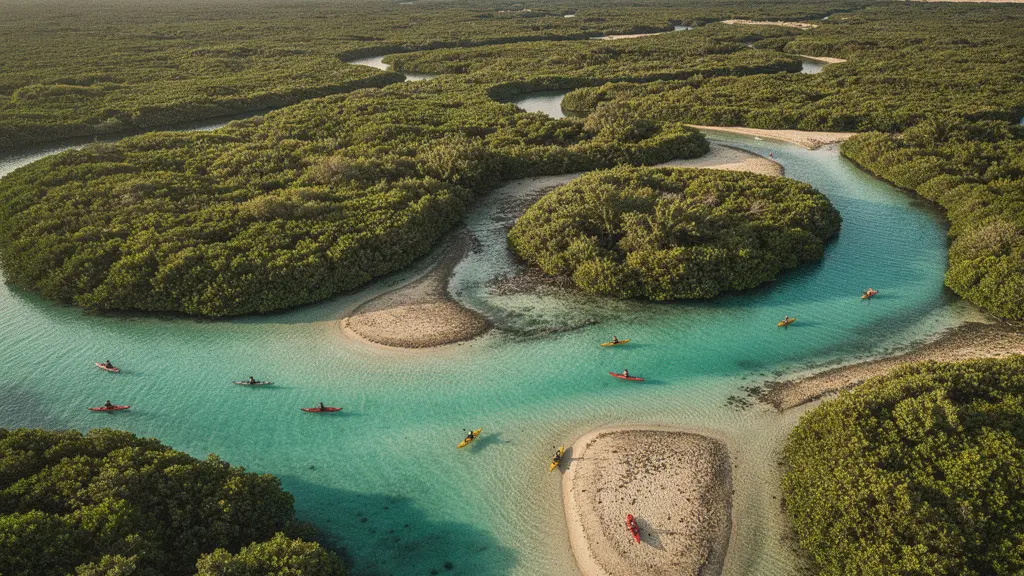
Kayaking the mangroves is less about the tour and more about becoming a temporary guardian of a vital, fragile ecosystem.
- Understanding tidal dynamics is non-negotiable to avoid being stranded on mudflats and harming the environment.
- Your water-level perspective from a kayak offers an unparalleled, intimate view of specific wildlife like herons, kingfishers, and crab-plovers that boardwalks can’t match.
Recommendation: Master a few key skills and timings before you go. It will transform your trip from a simple paddle into a profound and responsible ecological encounter.
The image of a lone kayaker gliding through a serene, green-water labyrinth is a powerful one. For many visiting Abu Dhabi, the mangrove forests of Jubail or the Eastern Mangroves National Park represent a perfect natural escape from the city’s futuristic skyline. It’s an opportunity to connect with nature, to paddle in peace, and maybe snap a few stunning photos. Most guides will tell you where to book a tour and what to bring. They’ll point out a few birds and send you on your way.
But what if the real experience isn’t just about the paddle? As a marine biologist and guide, I’ve seen firsthand that these mangroves are more than just a pretty backdrop; they are the pulsating heart of the UAE’s coastal ecology. The common advice often misses the most crucial point: you are not just a visitor here, you are an active participant in a delicate system. The real magic of the mangroves reveals itself not to the passive tourist, but to the informed paddler who understands the rhythms of the tide, the language of the wildlife, and their own role within this vibrant habitat.
This guide is designed to shift your perspective. We will move beyond the basics and delve into the ecological knowledge and practical skills that turn a simple kayaking trip into a meaningful act of eco-tourism. We’ll explore why these forests are so critical, how to navigate them with skill and respect, and how to time your visit not just for convenience, but for profound connection and breathtaking beauty. Prepare to become more than a tourist; prepare to become a custodian of the coast.
To help you navigate this rich topic, this article is structured to build your expertise progressively. From understanding the ecosystem’s importance to mastering practical skills, each section is a step towards a more conscious and rewarding adventure.
Summary: A Deeper Dive into Kayaking Abu Dhabi’s Ecological Treasures
- Why Are Mangroves Critical for Protecting the UAE Coastline from Erosion?
- How to Kayak in Narrow Mangrove Channels Without Getting Stuck?
- Walking Boardwalks vs Kayaking Tours: Which Offers Better Birdwatching?
- The Low Tide Mistake That Turns Your Mangrove Tour into a Mud Walk
- Sunrise or Sunset: When is the Light Best for Mangrove Reflections?
- Ras Al Khor or Wasit Wetland: Which Is Better for Flamingo Photography?
- Nessnass Beach or Yas Island: Which Is Safer for Independent Riders?
- Which Wildlife Sanctuary in the UAE Allows You to Spot Oryx in the Wild?
Why Are Mangroves Critical for Protecting the UAE Coastline from Erosion?
From the seat of your kayak, the mangroves appear as a dense, tranquil wall of green. But beneath the surface, a powerful biological engine is at work, performing functions absolutely critical to the UAE’s coastal health. These are not just trees; they are ecological engineers. Their intricate, tangled root systems, known as pneumatophores, grip the soft sediment, acting like a natural net that holds the coastline together. This web of roots dissipates wave energy, preventing the steady erosion that would otherwise wash away the shoreline, especially during storms.
Beyond this physical barrier, mangroves are champions of carbon sequestration. In a region with limited carbon-rich environments, their ability to capture and store atmospheric carbon is invaluable. As one study in the Nature Journal highlights, “The protection and restoration of coastal ecosystems, particularly mangrove forests offer a promising pathway.” This isn’t just theory; Abu Dhabi’s own data shows their impact. It’s estimated that in 2018, the emirate’s mangroves were responsible for removing a significant portion of carbon emissions, a figure that underscores their role in climate mitigation.
The UAE’s leadership understands this profound importance. The national commitment to plant 100 million mangroves by 2030 is a testament to their value. This is not just about planting trees; it’s a strategic investment in natural infrastructure. This commitment is built on decades of successful work.
Case Study: Abu Dhabi’s Mangrove Restoration Success
Over the last two decades, Abu Dhabi has dramatically increased its mangrove cover by planting nearly 20 million seeds. A fascinating part of this story is the use of innovative drone technology. According to the World Economic Forum, planting 1.2 million seeds with drones has significantly cut costs while accelerating efforts towards the UAE’s Net Zero 2050 goal. When you paddle here, you are gliding through the living result of one of the world’s most successful coastal restoration projects.
So, as you dip your paddle into the water, remember you are in a protected fortress. The Mangroves National Park alone constitutes a staggering 75% of the UAE’s total mangrove forest area. You’re not in a simple park; you’re in the nation’s primary shield against the sea and a vital weapon in the fight against climate change.
How to Kayak in Narrow Mangrove Channels Without Getting Stuck?
Navigating the main, wide channels of the mangroves is straightforward. But the real magic, the secret corners where shy birds hide and the light filters through the canopy in dazzling patterns, lies within the narrow, winding waterways. Here, your paddling skills are put to the test. A clumsy approach doesn’t just mean getting stuck; it means scraping against delicate roots and disturbing the very habitat you came to admire. The key to elegant and respectful navigation is mastering a few specific strokes, most importantly the bow rudder stroke.
Unlike a wide, sweeping turn that kills your momentum and takes up space you don’t have, the bow rudder is a precision tool. It allows you to pivot the front of your kayak sharply and efficiently, using your forward momentum to your advantage. It’s the difference between a three-point turn and a swift, silent hairpin bend. Mastering this technique is your passport to the mangroves’ inner sanctum.
This image provides a close-up look at the kind of precise paddle placement required for these tight maneuvers, where your paddle becomes an extension of your intent, guiding the kayak with minimal disturbance.
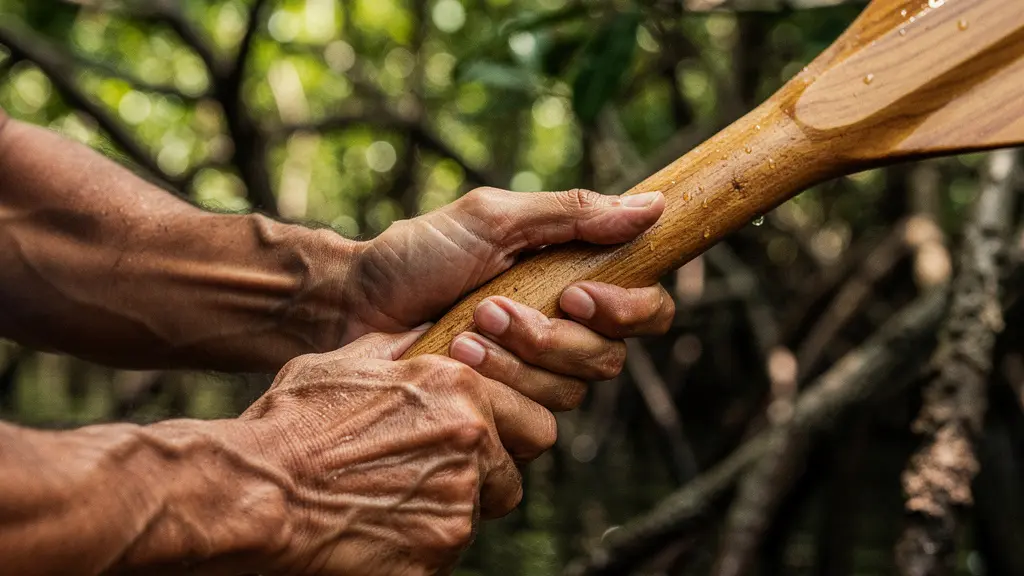
Practicing this before you enter a tight channel is crucial. Find an open area and get a feel for how the kayak responds. The goal is to make the movement feel as natural as a forward stroke. With this skill, you’ll be able to explore confidently and, more importantly, leave no trace but the gentle ripples of your passing.
- Master the bow rudder stroke: Place your paddle vertically in the water near the bow while maintaining forward momentum.
- Use the paddle as a pivot point: Use this placement to execute sharp, controlled turns without losing speed or drifting sideways.
- Lean into the turn: Lean your body slightly towards the direction of your turn to enhance the kayak’s responsiveness.
- Maintain consistent pressure: Keep the paddle blade at a steady angle against the water throughout the turn for a smooth, predictable arc.
- Practice transitions: Work on flowing seamlessly from a forward paddle stroke directly into a bow rudder, making your navigation fluid and efficient.
Walking Boardwalks vs Kayaking Tours: Which Offers Better Birdwatching?
Both the boardwalks at places like Jubail Mangrove Park and kayaking tours offer fantastic opportunities to see the avian inhabitants of the mangroves. But they provide two fundamentally different experiences, tailored to different types of observation. As an eco-guide, I’m often asked which is “better.” The answer depends entirely on *what* you want to see and *how* you want to see it. A boardwalk gives you a stable, elevated platform, which is excellent for spotting birds in the canopy and for using heavy telephoto lenses without the challenge of a moving kayak. You get a great overview.
However, for intimate, eye-level encounters with wading birds, there is simply no substitute for a kayak. When you glide silently through a channel, you are at their level. You become part of the waterscape. This allows for unparalleled views of species like the Western Reef Heron, various species of Kingfisher, and the elusive Crab-plover. These birds hunt and live at the water’s edge, a zone largely inaccessible and distant from a boardwalk. The silent approach of a kayak is far less disturbing than the sound of footsteps and conversations on a wooden platform, often allowing you to get closer and observe natural behaviors for longer periods.
This comparative table breaks down the key differences for any aspiring birdwatcher deciding on their approach.
| Aspect | Boardwalk | Kayaking |
|---|---|---|
| Viewing Height | Elevated (2-3m above water) | Water level (eye-level with wading birds) |
| Photography Stability | Excellent – steady platform for telephoto lenses | Challenging – requires faster shutter speeds |
| Access to Bird Habitats | Limited to boardwalk route | Full access to channels and hidden areas |
| Noise Level | Moderate foot traffic and conversation | Silent gliding, minimal disturbance |
| Best Time | High tide for distant waders | Low tide for channel access |
| Bird Species Visibility | Better for canopy birds | Superior for herons, kingfishers, crab-plovers |
While the boardwalk is a fantastic and accessible way to get an introduction, the kayak offers a deeper, more immersive form of communion with the mangrove’s wildlife. It’s an experience echoed by many who take to the water.
Great 2-hour guided tour with guide Noël, who took the time to show us kayaking, explain the life in the mangrove, as well as letting us relax in the sea and appreciate fresh fruit salad & water. Very calm nature experience, mildly sporty, and very nice exchanges with our great knowledgeable guide.
– TripAdvisor Reviewer, Mangroves Water Sports & Adventures
Ultimately, the choice is yours. For a comfortable overview, the boardwalk is perfect. But to truly enter the world of the wading birds and experience the ecosystem on its own terms, the answer is clear: take to the water.
The Low Tide Mistake That Turns Your Mangrove Tour into a Mud Walk
There is one mistake, above all others, that can single-handedly ruin your mangrove kayaking experience: ignoring the tides. I have seen it happen countless times. A group paddles deep into the enchanting channels, loses track of time, and by the time they turn back, the water has receded, leaving them stranded in a sea of thick, sticky mud. Their serene nature tour has just become an arduous, messy, and environmentally damaging mud walk. Dragging a kayak across exposed mudflats not only destroys the delicate pneumatophore root systems but also disturbs the countless small creatures that live in the sediment.
Understanding tidal dynamics is not optional; it is the single most important piece of knowledge for any mangrove paddler. The water level can drop surprisingly fast, transforming a deep channel into an impassable mudflat in under an hour. You must check a reliable tide chart before you even think about setting out. The key is to plan your trip around high tide. Ideally, you want to enter the narrower channels as the tide is peaking and plan to be back in the main waterways as it begins to recede. This gives you the maximum depth and the widest window for exploration.
The beauty of the mangroves at mid-to-high tide is the clarity it brings. As the official Travel Abu Dhabi guide notes:
The water is crystal clear, very shallow and you can see numerous fish, crabs and we have even spotted small stingrays
– Travel Abu Dhabi Guide, Kayaking in Abu Dhabi – Eastern Mangrove Experience
This vibrant underwater world is completely hidden—and your kayak firmly grounded—when the tide is out. The image below is not an abstract landscape; it is a cautionary tale of what happens when tide planning is neglected. The exposed roots and grounded kayak are a clear visual of a tour gone wrong.
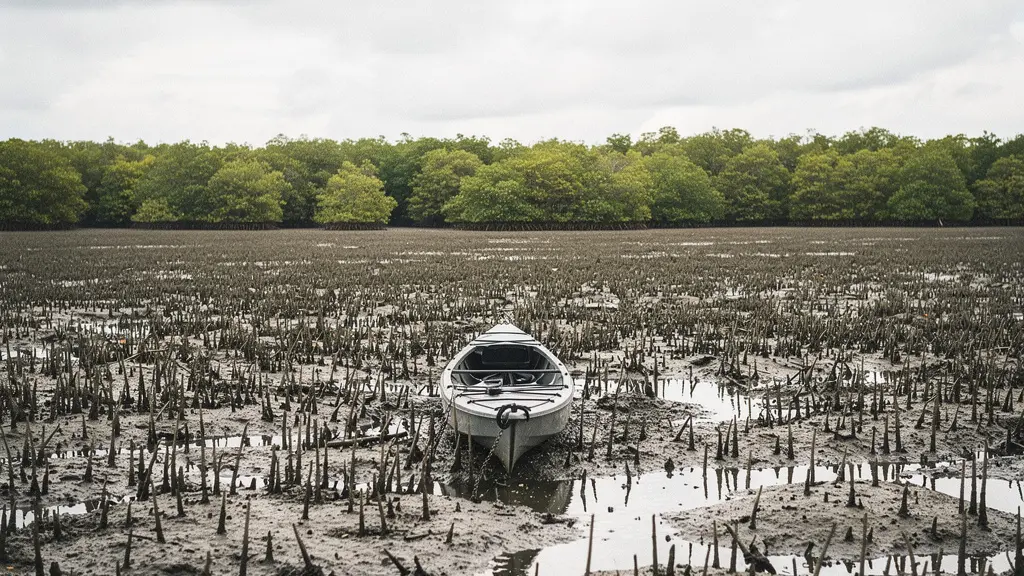
Do not let this be you. Respect the rhythm of the ocean. Check the tide chart, give yourself a generous buffer of time, and always err on the side of caution. Your serene paddle depends on it, and so does the health of this fragile ecosystem.
Sunrise or Sunset: When is the Light Best for Mangrove Reflections?
Beyond the practicalities of tides and techniques lies the art of mangrove exploration: capturing its ephemeral beauty. For photographers and nature lovers alike, the ultimate prize is a perfect, mirror-like reflection of the mangrove canopy on the water’s surface. This magical effect depends on two key ingredients: still water and beautiful light. This begs the question: is sunrise or sunset the better time to chase these reflections?
From an atmospheric perspective, sunrise almost always has the edge. The air is typically calmer in the early morning after cooling overnight, leading to less wind and a glassier water surface. This is the prime condition for those coveted mirror reflections. The light transitions from the deep blues of the pre-dawn “blue hour” to the soft, warm glow of sunrise, offering a wider palette of colors for photography. Sunset, while offering dramatic, fiery skies and the chance to silhouette roosting birds, often comes after a day of thermal winds, meaning the water is more likely to have a slight chop, breaking up the reflections.
Field Report: The Eastern Mangroves Sunrise Experience
Guided tours operating in the Eastern Mangroves consistently praise the morning conditions. They are often marketed as “magical dawn excursions” for a reason. Participants frequently report that the superior calm of the water in the early morning leads to exceptional wildlife visibility and what one paddler described as a “‘magical at dawn’ experience with perfect lighting” for observing the subtle movements of fish and birds, an experience detailed on tour booking sites like Viator.
However, perfect reflections aren’t just about the time of day; they are about the tide. The ideal moment is “high slack tide”—the brief period at the peak of high tide when the water movement is at its absolute minimum. Combining a high slack tide with the calm air of sunrise is the holy grail for reflection seekers. This requires careful planning, cross-referencing tide charts with sunrise times. It’s this dedication to timing that separates a casual paddle from a truly breathtaking photographic and sensory experience.
Action Plan: Your Guide to Perfect Mangrove Reflections
- Check Tide Charts: Identify the time of “high slack tide” – the period of minimal water movement at peak high tide.
- Plan for Sunrise: Aim for a sunrise shoot to take advantage of calmer morning air and glass-like water conditions.
- Capture the Blue Hour: Position yourself in the mangroves 30 minutes before the official sunrise time to capture the moody, deep-blue pre-dawn light.
- Consider Sunset for Silhouettes: Choose a sunset paddle if your goal is to capture dramatic silhouettes of roosting birds against golden or crimson skies.
- Monitor Wind Forecasts: Check the weather for wind. Speeds below 5 knots (around 9 km/h) are ideal for achieving perfect mirror reflections on the water’s surface.
Ras Al Khor or Wasit Wetland: Which Is Better for Flamingo Photography?
While the Abu Dhabi mangroves are home to a diverse range of birds, for many visitors to the UAE, the iconic image of a flock of pink flamingos is a must-see. This often leads to a question that extends beyond Abu Dhabi’s waterways: for dedicated flamingo photography, where should one go? The two premier locations are the Ras Al Khor Wildlife Sanctuary in Dubai and the Wasit Wetland Centre in Sharjah. While both host magnificent flamingo populations, they offer vastly different photographic experiences.
Ras Al Khor is famous for its almost surreal juxtaposition of nature and metropolis. The flamingos wade and feed with the towering skyline of Dubai, including the Burj Khalifa, as their backdrop. This creates a unique urban-wildlife aesthetic that is visually striking and tells a story of co-existence. The sanctuary has three well-maintained, air-conditioned hides, which are essential for comfortable viewing during hot weather. However, the viewing distances can be quite large, often requiring a super-telephoto lens (600mm or more) to get frame-filling shots of the birds.
The Wasit Wetland Centre, in contrast, offers a more natural, isolated environment. Here, the backdrop is a pure wetland habitat, free from urban structures. This is the choice for photographers seeking a “wild” feel. The design of the observation points at Wasit often allows for closer proximity to the birds, meaning a standard telephoto lens (300-400mm) can be sufficient for excellent shots. It feels less like a city park and more like a true natural refuge, also offering opportunities to spot other rare waders and marsh birds that might be harder to find at Ras Al Khor.
The decision ultimately comes down to your photographic goal: are you looking for the iconic Dubai skyline shot, or a pure, intimate portrait of flamingos in their natural habitat?
| Feature | Ras Al Khor | Wasit Wetland |
|---|---|---|
| Backdrop | Dubai skyline (urban aesthetic) | Natural wetland (isolated environment) |
| Viewing Distance | Variable (100-500m) | Closer proximity possible |
| Best Lens | Super-telephoto (600mm+) | Standard telephoto (300-400mm) |
| Access Times | Sunrise to sunset | Limited hours |
| Hide Facilities | 3 purpose-built hides | Basic observation points |
| Secondary Species | Eagles, ospreys | Rare waders, marsh birds |
Nessnass Beach or Yas Island: Which Is Safer for Independent Riders?
The allure of paddling independently, away from a guided tour, is strong for experienced kayakers. The freedom to explore at your own pace, to wait patiently for a bird to appear, or to simply float in silence is a rewarding experience. This often leads to questions about specific launch points, like comparing the open waters of Nessnass Beach to the channels around Yas Island. However, before even considering specific locations, the most critical question for any independent rider in the mangroves is a more fundamental one: Am I truly prepared for the unique safety challenges of this environment?
The mangrove ecosystem is not open water. It’s a complex network of channels, some of which are tidal and can become dangerously shallow, as we’ve discussed. The number one rule of independent kayaking here is self-sufficiency and preparedness. Unlike a tour where a guide is responsible for safety equipment, navigation, and emergency response, when you are on your own, all of that responsibility falls squarely on your shoulders. You are the guide.
This means having, at a minimum, a personal flotation device (life jacket), a reliable communication method (a fully charged phone in a waterproof case), a tide chart, and sufficient water. It also means having a clear plan and letting someone know where you are going and when you expect to return. Many assume the biggest dangers are large animals, but in Abu Dhabi’s mangroves, the most “dangerous” creatures are crabs. The real risks are dehydration, getting lost in the maze of channels, or being stranded by a receding tide—all of which are preventable with proper planning.
Therefore, the question isn’t whether Nessnass is safer than Yas. The real question is: Have you equipped yourself with the knowledge and gear to be safe anywhere? If you are a beginner or new to the area, the answer is simple: start with a guided tour. It’s the best and safest way to learn the specific character of the local waterways before you even think about venturing out alone.
Key Takeaways
- Mangroves are not just trees; they are the UAE’s primary natural defense against coastal erosion and a major tool for carbon capture.
- Your experience and impact are defined by your skill. Mastering tide charts and basic strokes like the bow rudder is essential for responsible exploration.
- For intimate, eye-level birdwatching of waders like herons and kingfishers, a silent kayak is unequivocally superior to a boardwalk.
Which Wildlife Sanctuary in the UAE Allows You to Spot Oryx in the Wild?
Our journey has taken us deep into the coastal world of mangroves, a realm of water, roots, and wings. But the UAE’s commitment to conservation extends far beyond its coastlines, deep into the heart of its desert landscapes. For the nature enthusiast whose curiosity is sparked by the herons and crabs of the mangroves, the next logical step is to witness the revival of one of Arabia’s most iconic creatures: the Arabian Oryx. So, where can you see this magnificent antelope, once hunted to the brink of extinction, now roaming freely?
The definitive answer is Sir Bani Yas Island. This remarkable island, located off the coast of Abu Dhabi, is a world-class wildlife sanctuary and one of the greatest conservation stories in the region. It is not a zoo or a safari park in the traditional sense; it is a protected reserve where thousands of animals, including one of the world’s largest herds of Arabian Oryx, roam freely across the island’s rugged terrain. A visit here allows you to see these animals in a vast, naturalistic habitat that closely mimics their historical wild environment.
A guided 4×4 nature and wildlife drive on the island is the primary way to experience this. As you traverse the savannah-like landscapes, you are likely to encounter not only large groups of Oryx but also Sand Gazelles, Axis Deer, and even cheetahs and giraffes that are part of the island’s managed conservation programs. Seeing the pure white coat of the Oryx against the earthy tones of the Arabian landscape is a profoundly moving experience. It is a living symbol of the UAE’s dedication to bringing species back from the edge and restoring its natural heritage.
Connecting the mangrove experience to the Oryx of Sir Bani Yas Island completes a picture. It shows that the conservation mindset in the UAE is holistic, protecting both the critical blue carbon ecosystems of the coast and the iconic megafauna of the desert. To witness both is to understand the full scope of the nation’s environmental vision.
To truly embrace the spirit of eco-tourism, the next step is to apply this knowledge. Plan your visit with tides in mind, practice your paddle strokes, and approach this vibrant ecosystem not as a consumer, but as a conscious observer ready for an unforgettable encounter.
Frequently Asked Questions about Kayaking in Abu Dhabi’s Mangroves
What safety equipment is required for independent kayaking?
At a minimum, all kayakers must wear a personal flotation device (life jacket) at all times. Guided tours will provide all necessary safety equipment and access to washing facilities. If going independently, you are responsible for bringing your own.
Are there any dangerous animals in the mangroves?
The most dangerous animals you are likely to encounter are small crabs that may nip if provoked. There are no crocodiles or other large predators in Abu Dhabi’s mangrove forests. The primary dangers are environmental, such as dehydration and getting stranded by the tide.
What happens if equipment gets damaged during the tour?
You are generally responsible for your own belongings. Operators strongly advise bringing waterproof cases and bags for all electronics like phones and cameras, as any water damage is typically the paddler’s own responsibility and not covered by the tour company.