In summary:
- The UAE offers world-class public beaches that are not only free but also packed with high-tech amenities and international safety standards.
- Knowing the local etiquette around swimwear, water sports, and public behavior is crucial to avoid fines and have a stress-free day.
- For private beach clubs, understanding what “fully redeemable” really means is the key to getting true value for your money.
- Smart-tech like free Wi-Fi palms and clear UV index warnings are available to help you have a safer and more connected beach day.
The United Arab Emirates conjures images of glittering coastlines and luxurious seaside living. For any traveler or resident, the call of the turquoise Arabian Gulf is irresistible. But this paradise often comes with a question: should you splurge on a private beach club or seek out the free public shores? The easy answer is that private beaches offer luxury amenities for a fee, while public beaches are free. But this barely scratches the surface.
The real art of enjoying the UAE’s magnificent coast isn’t just about choosing between paid and free. It’s about understanding the hidden systems that govern the sand. It’s about knowing where to find world-class safety standards for your family at no cost, how to tap into free, futuristic technology right on the beach, and how to navigate cultural norms with the confidence of a local. It’s about calculating the true “atmosphere-per-dirham” and deciding which spot offers the perfect vibe for your day.
Forget the simple dichotomy of public versus private. This guide dives deeper. We’ll reveal the unwritten rules, the value-hacking tips for so-called “redeemable” credits, and the critical safety knowledge that separates a blissful beach day from a problematic one. From swimwear etiquette to kitesurfing right-of-way, you’ll learn to navigate the UAE’s beach culture like a savvy insider.
To help you navigate your perfect beach day, this guide breaks down everything you need to know. From safety and technology to social etiquette and hidden costs, we’ve covered all the bases.
Summary: The Savvy Traveler’s Guide to UAE’s Public and Private Shores
- Why Do Blue Flag Beaches Matter for Your Family’s Health?
- How to Use Smart Palms and Public Showers Without Local Coins?
- Kite Beach or La Mer: Which Spot Has the Best Atmosphere for Solo Travelers?
- The Bikini Mistake: Where Can You Wear Swimwear Without Fines?
- Morning vs Afternoon: When Is the UV Index Dangerous for Tanning?
- Why Does “Fully Redeemable” Not Always Include Shisha?
- The Right-of-Way Mistake That Gets Kitesurfers Banned from Public Beaches
- Boating in the Arabian Gulf: How to Rent a Yacht Without a Captain?
Why Do Blue Flag Beaches Matter for Your Family’s Health?
When you’re choosing a beach for your family, safety and cleanliness are non-negotiable. That’s where the Blue Flag certification comes in. It’s not just a fancy sign; it’s a globally recognized award that guarantees a beach meets stringent standards for water quality, safety, environmental management, and services. Seeing this flag means you’re at a location committed to excellence. This global program is significant, with more than 5,000 certified sites across 51 countries as of 2023, making it a reliable benchmark for quality worldwide.
For parents, this translates to peace of mind. A Blue Flag beach in the UAE ensures that the water is regularly tested for purity, lifeguards are on duty, first-aid facilities are accessible, and the area is clean and well-maintained. Many also offer amenities like designated safe swimming zones, separate from areas for jet skis or boats, and even accessible pathways for strollers. Choosing a Blue Flag beach is the smartest and simplest first step to ensuring a worry-free day by the sea for the whole family.
Your Blue Flag Beach-Day Checklist
- Look for the official Blue Flag certification displayed prominently at the beach entrance.
- Upon arrival, identify the locations of the lifeguard towers and the first-aid station.
- Check the information boards for the latest water quality testing results, which must be publicly posted.
- Locate the designated swimming zones, usually marked by buoys, and ensure they are separate from water sports areas.
- Confirm the availability of accessible pathways if you are using a stroller or wheelchair.
How to Use Smart Palms and Public Showers Without Local Coins?
One of the most pleasant surprises on Dubai’s public beaches is the forward-thinking approach to amenities. Gone are the days of fumbling for coins for a quick rinse. Most public showers are now operated by a simple push-button system, offering a fresh-water rinse completely free of charge. But the real game-changer for the modern beachgoer is the “Smart Palm,” a futuristic, solar-powered tech hub disguised as a palm tree.
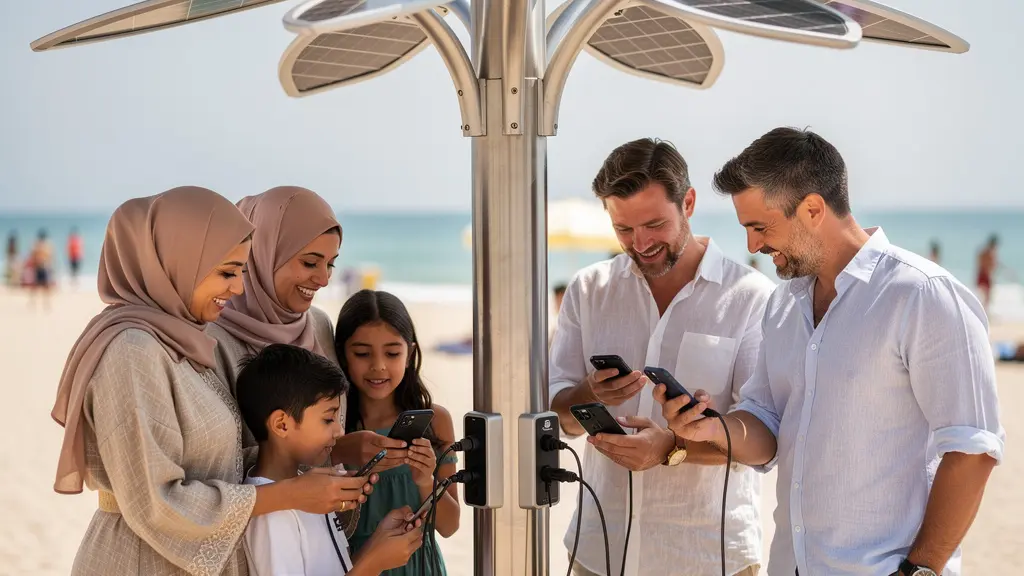
These digital oases are more than just a quirky piece of art. They provide a suite of free services essential for any traveler. Each Smart Palm offers high-speed Wi-Fi in a 53-meter radius and multiple charging ports that juice up your devices 2.5 times faster than a standard charger. With some palms serving over 260 people and charging 31 devices daily, they are a vital resource. They also feature touch-screen displays with city information, weather updates, and sea conditions. Connecting is simple:
- Open your device’s Wi-Fi settings and select the “Smart_Palm_Dubai” network.
- A landing page will open; simply accept the terms and conditions to connect.
- You can connect up to two devices, and each palm can support up to 50 users at once.
- Use any of the 12 available charging ports to power up your phone or tablet.
Kite Beach or La Mer: Which Spot Has the Best Atmosphere for Solo Travelers?
For a solo traveler, the “best” beach isn’t just about sand and water; it’s about the atmosphere. It’s about finding a place where you can feel comfortable, safe, and either engage with others or retreat into your own world. In Dubai, two public beaches stand out as top contenders, each offering a vastly different experience: the energetic Kite Beach and the chic La Mer. Your choice depends entirely on the vibe you’re seeking.
Kite Beach is a hub of activity and energy. It’s the go-to spot for the city’s fitness enthusiasts and water sports lovers. The air is always buzzing, with kitesurfers painting the sky, volleyball games in full swing, and runners pacing the 14km track. This makes it incredibly easy to strike up a conversation with like-minded, active people. On the other hand, La Mer is a masterfully curated destination that blends beach lounging with upscale dining and retail. Its vibe is more relaxed and polished, with a mix of families, couples, and groups enjoying the carefully designed quiet corners, cabanas, and street-art-adorned alleyways.
This decision is a classic example of “atmosphere-per-dirham” thinking, even when both are free to enter. One offers social energy and sport, the other offers stylish tranquility. As a comparative analysis for solo travelers shows, the right choice depends on your mood for the day.
| Criteria | Kite Beach | La Mer |
|---|---|---|
| Ease of Striking Conversation | High – Sports enthusiasts, fitness community | Moderate – More couples and families |
| Quiet Zones for Reading | Limited – Active atmosphere throughout | Excellent – Multiple quiet corners |
| Safety for Belongings | Good – Active lifeguard presence | Very Good – More security, lockers available |
| Solo-Friendly Dining | Casual food trucks, counter seating | Upscale cafes with solo-friendly bars |
| Best Time for Solo Visit | Early morning (6-9 AM) | Evening (5-8 PM) |
| Activities | 14km running track, volleyball, kitesurfing | Shopping, cinema, beach lounging |
The Bikini Mistake: Where Can You Wear Swimwear Without Fines?
Navigating swimwear etiquette is one of the biggest sources of anxiety for first-time visitors to UAE beaches. The rules are actually quite simple and based on a principle of respect for the local culture. The key is understanding the concept of the “transition zone”—the area between the sand and the wider public space like promenades, cafes, and car parks. On the sand and in the water of most public and private beaches in Dubai, standard swimwear, including bikinis, is perfectly acceptable.
The mistake happens when you leave the beach. As soon as your feet leave the sand to head to a cafe, a shop, or even the restroom, you are expected to cover up. It’s not about changing your whole outfit; a simple kaftan, sarong, t-shirt, or dress thrown over your swimwear is all that’s required. This simple act shows respect and ensures you won’t face any uncomfortable situations or potential fines. The official guidance is clear, as noted by the Dubai Tourism Authority.
Avoid overly revealing swimwear on public beaches—opt for one-piece suits or rash guards
– Dubai Tourism Authority, What are the best beaches to visit in Dubai
To avoid any issues, simply think ahead and pack a cover-up. It’s a small step that makes a big difference. For clarity, follow these simple guidelines:
- On the Sand/In the Water: Regular swimwear (including bikinis at most Dubai beaches) is fine.
- On Promenades/Walkways: Put on a cover-up (kaftan, sarong, shirt, shorts).
- In Cafes/Shops/Malls: You must be fully dressed. A cover-up over a wet swimsuit is not enough.
- Sharjah & Ajman: These emirates are more conservative. Opt for more modest swimwear like one-piece suits and rash guards even on the beach.
Morning vs Afternoon: When Is the UV Index Dangerous for Tanning?
The UAE is blessed with near-constant sunshine, but the desert sun is incredibly powerful and must be respected. Understanding the daily fluctuation of the UV Index is not just a good idea; it’s essential for your health. The UV Index measures the strength of the sun’s ultraviolet radiation, and in the UAE, it can reach extreme levels. During the summer, it’s not uncommon for the maximum UV Index in Dubai to hit an intense 13.6, a level considered “Extreme” by the World Health Organization.
This means that during peak hours, unprotected skin can burn in as little as 5 to 10 minutes. The safest times for sun exposure are in the early morning (before 10 AM) and late afternoon (after 4 PM), when the UV index is lower. The period between 11 AM and 4 PM is the danger zone and should be avoided for tanning or prolonged sun exposure. During these hours, it’s best to seek shade, wear protective clothing, and apply a high-SPF sunscreen liberally.
Planning your beach time around the UV Index is the smartest way to enjoy the sun safely and avoid a painful, damaging sunburn. The following table provides a clear guide to the daily risks and recommended actions.
This table breaks down the typical UV risks throughout the day in Dubai, helping you plan your sun exposure for a safe and enjoyable experience.
| Time Period | UV Index | Risk Level | Safe Exposure (Fair Skin) | Recommended Action |
|---|---|---|---|---|
| 7:00-9:00 AM | 1-3 | Low-Moderate | 30-45 minutes | SPF 30, sunglasses |
| 9:00-11:00 AM | 4-6 | High | 15-20 minutes | SPF 50, hat, seek shade |
| 11:00 AM-4:00 PM | 10-13 | Extreme | 5-10 minutes | Avoid sun exposure |
| 4:00-6:00 PM | 4-6 | High | 15-20 minutes | SPF 50, protective clothing |
| After 6:00 PM | 1-2 | Low | 45-60 minutes | SPF 15-30 |
Why Does “Fully Redeemable” Not Always Include Shisha?
The term “fully redeemable” is a common and enticing offer at UAE’s private beach clubs. It sounds like a fantastic deal: pay an entry fee, and get the full amount back to spend on food and drinks. However, this is where savvy travelers need to read the fine print, as “fully” often comes with significant exclusions. The most common pitfall is assuming your credit covers everything on the menu. In reality, high-demand or premium items are frequently excluded.
Specifically, your redeemable credit will almost never cover shisha. It’s treated as a separate service. Similarly, premium imported beverages, special promotional menus, and often the most expensive seafood items are also not included. Furthermore, the credit doesn’t cover the mandatory additional charges. You should always budget for an extra 22% on top of your bill, which includes a 10% service charge, 7% municipality fee, and 5% VAT. These are calculated on the total value of what you consume and must be paid separately.
To truly get value from a redeemable beach day, you have to be strategic. The best approach is to call the venue beforehand and ask for specifics. A few key questions can save you a lot of money and disappointment. Focus your spending on standard menu items, lunch sets, or combo deals to maximize your credit. Arriving early also allows you to enjoy the club’s facilities—like the pool and beach access—for a longer period, making the entry fee more worthwhile.
The Right-of-Way Mistake That Gets Kitesurfers Banned from Public Beaches
Kite Beach earned its name for a reason—it’s one of the world’s premier spots for kitesurfing. However, the coexistence of swimmers, beachgoers, and high-speed water sports in a crowded area requires a strict, non-negotiable etiquette. For kitesurfers, the single biggest mistake—and the one that draws the most ire from authorities and the public—is ignoring the designated zones and right-of-way rules. Public beaches are carefully zoned for safety, with specific areas for swimming, launching/landing kites, and the kitesurfing action itself.
Ignoring these zones and flying a kite over a crowded swimming area is not only dangerous but is the fastest way to get a warning, a fine, or even have the sport temporarily banned from the beach. Within the water, there’s also an “invisible etiquette” that all kiters must follow. The most fundamental is the Starboard Tack rule: a kiter with their right hand forward (traveling to the right) has priority over a kiter with their left hand forward. Another key rule is that kiters entering the water from the beach have right-of-way over those coming back in.
For everyone’s safety and to ensure the sport remains welcome on public beaches, adhering to the safety protocol is mandatory. If you are new to the area, it is always best to check in with a local kitesurfing school for the latest conditions and rules.
Kitesurfing Safety Protocol Checklist
- Identify and stay within the designated kitesurfing zone, usually marked by large flags on the beach.
- Always check current wind and sea conditions with local kitesurfing school staff before heading out.
- Apply the Starboard Tack rule: the kiter with their right hand forward has priority and should keep their course.
- Give way to outgoing kiters who are launching from the beach when you are heading back to shore.
- Maintain a minimum buffer distance of 50 meters from all designated swimming areas.
- Only launch and land your kite in the designated zones, preferably with assistance.
Key takeaways
- Prioritize beaches with Blue Flag certification for guaranteed safety and cleanliness, an essential check for families.
- Leverage the UAE’s free, high-tech beach amenities like Smart Palms for Wi-Fi and charging to enhance your day.
- Mastering local etiquette regarding swimwear in “transition zones” and understanding the real meaning of “fully redeemable” credit are key to a stress-free, budget-smart experience.
Boating in the Arabian Gulf: How to Rent a Yacht Without a Captain?
For many, the ultimate UAE luxury experience is cruising the Arabian Gulf on a private boat, with the stunning Dubai skyline as a backdrop. This leads to a common question from experienced sailors: “Can I rent a yacht without a captain?” This is known as a ‘bareboat charter’. While it’s possible in many parts of the world, in the UAE, the regulations make it extremely difficult for a casual tourist.
The rules are strict for a reason—to ensure safety in the busy waters of the Gulf. Renting a boat without a licensed local captain is generally not an option for short-term visitors, even if you hold internationally recognized licenses. As the local authorities make clear, the barrier to entry is high.
Renting a yacht without a captain (‘bareboat charter’) requires specific, often internationally recognized, licenses (like RYA Day Skipper) AND a local permit, making it nearly impossible for a casual tourist
– Dubai Marine Authority, UAE Marine Regulations Guide
However, this doesn’t mean you can’t get behind the wheel. The market has adapted with brilliant alternatives for those who want a taste of captaining their own vessel without the red tape. These options provide the thrill of self-driving while operating within a safe, regulated framework.
Alternative Boating Options for License-Free Water Activities
HERO OdySea self-drive boats have emerged as the popular alternative for tourists wanting control without licenses. These smaller, agile boats can be rented for a few hours with just a passport and a brief safety orientation, allowing you to lead your own mini-convoy tour along the coast. For a more tranquil exploration, kayak and paddleboard rentals from public beaches like Marina Beach allow you to explore the calm waters around areas like Palm Jumeirah independently. Finally, guided jet ski tours offer a fantastic compromise; you get the thrill of driving your own personal watercraft, but you follow an experienced instructor on a designated safe route, combining freedom with professional oversight.
Armed with this insider knowledge, you are now equipped to explore the UAE’s incredible coastline not just as a tourist, but as a savvy, respectful, and budget-smart traveler. Choose your beach, respect the culture, and enjoy the sun.