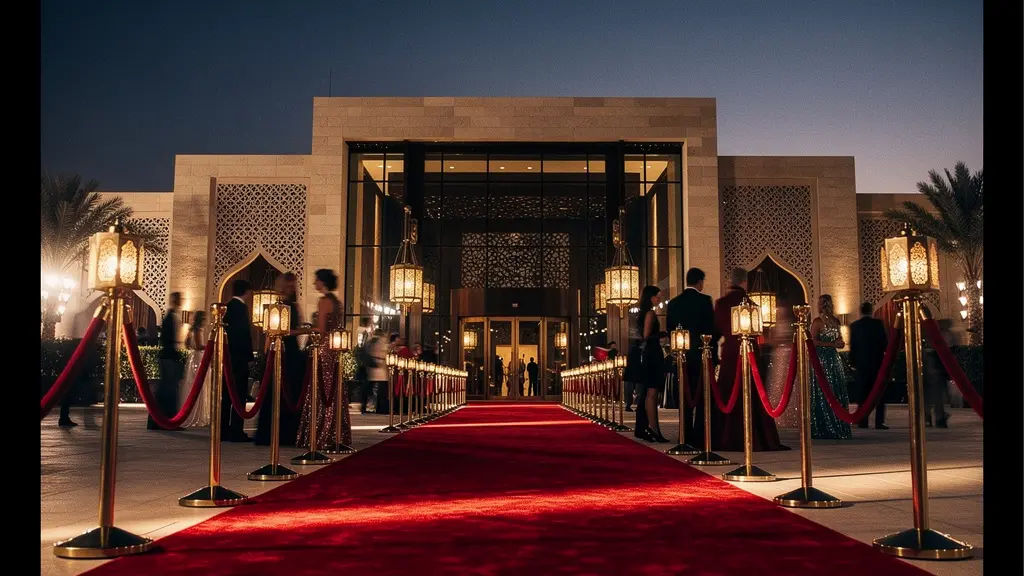
Success on the red carpet is 10% luck and 90% positioning strategy.
- Wristbands are the new currency; arriving early without one is often futile.
- Lighting dictates your photo quality more than your camera does.
- Venue architecture determines whether you need a zoom lens or a wide angle.
Recommendation: Audit your wardrobe for humidity immediately and map out the “transition points” of the specific venue before you arrive.
You have seen the photos: a wall of screaming fans, a blinding flash of light, and Tom Cruise looking effortlessly cool in the middle of a Dubai summer. What you don’t see is the three hours of sweating in a suit, the jostling for position, and the crushing disappointment of standing exactly three feet to the left of where the autograph line actually stops. Most fans assume that seeing a star at a UAE premiere is purely a waiting game.
They are wrong. Whether it is a blockbuster launch at the Emirates Palace or a commercial premiere at a mall, the difference between a blurry back-of-the-head shot and a viral selfie is geometry. It is about understanding security flows, lighting angles, and the specific etiquette that separates the “fan pit” from the VIP list. While standard advice suggests charging your phone and bringing water, the real secret lies in predicting where the publicist will steer the talent.
If you think the red carpet is just a rug, you are already losing. It is a stage with very specific entrance and exit cues. Mastering the logistics of these events transforms you from a passive spectator into a strategic spotter. Here is how to navigate the velvet ropes like an insider.
To help you navigate the chaos of a premiere, we have broken down the logistical realities of the red carpet experience below.
Table of Contents: Strategic Guide to Red Carpet Logistics
- Why Do Some Premieres Require Wristbands for the Fan Pit?
- How to Get a Selfie with a Star Without Being Aggressive?
- Emirates Palace or Typical Mall Cinema: Which Hosting Venue Is More Glamorous?
- The Wardrobe Mistake of Waiting Outside in Suit and Tie in September
- Flash or No Flash: How to Shoot Red Carpet Photos at Night?
- Gala Screening or Community Cinema: Which Experience Is Right for You?
- In Which Order Should You Visit Sheikh Zayed Road Towers for Sunset Light?
- Dubai World Cup Fashion: How to Dress for the Apron Views vs The Suites?
Why Do Some Premieres Require Wristbands for the Fan Pit?
The days of simply camping out overnight to secure a front-row spot are fading, especially for high-profile premieres in the region. Organizers are increasingly adopting a “tiered access” model to manage the sheer density of crowds and ensure safety. This isn’t just about exclusivity; it is a logistical necessity to prevent crushing injuries and blockages in high-traffic areas like mall atriums or hotel driveways.
A prime example of this system in action is the BFI London Film Festival. They operate a structured wristband system for their red carpet viewing areas. Wristbands are distributed early in the morning on a first-come, first-served basis. If you don’t have one, you are relegated to the outer perimeter. This model is being replicated at major UAE events to create distinct “zones” of access. Without that piece of paper or plastic on your wrist, you are essentially a ghost to the security detail.
To understand the tangible value of securing this access, compare the experience of the “Pit” versus the “Barricade”:
As the comparison suggests, the effort to secure a wristband dramatically changes your vantage point, as confirmed by fan zone navigation analysis.
| Criteria | With Wristband (Fan Pit) | Without Wristband (General Barricade) |
|---|---|---|
| Proximity to Stars | Front-row, direct barricade access | Behind multiple rows of fans |
| Selfie Opportunity | High — direct interaction possible | Low — distance and crowd density |
| Photo Quality (Zoom) | Excellent — close range, phone camera sufficient | Moderate — zoom lens or telephoto recommended |
| Time Investment | 3–8 hours queuing before distribution | 1–2 hours for a decent general spot |
| Crowd Density | Controlled capacity, less crushing | Uncontrolled, can be very packed |
| Bag Restrictions | Strict — security bag checks on entry | Minimal — general public area |
| Best For | Selfie hunters and autograph seekers | Photographers with zoom lenses |
How to Get a Selfie with a Star Without Being Aggressive?
There is a fine line between enthusiasm and harassment, and crossing it is the quickest way to get ejected by security. The “grabby” fan never gets the photo; the respectful strategist does. Major festivals like TIFF enforce strict codes of conduct prohibiting aggressive behavior, and UAE security details are even less tolerant. They are trained to spot frantic energy and will physically block a star from approaching a chaotic section of the barricade.
The goal is to be a path of least resistance. Celebrities are working; the red carpet is a job. If you look like a hassle, they will skip you. If you look like a quick, easy, and pleasant interaction, they will stop. It is about reading the room—or in this case, the pavement. A calm demeanor often acts as a magnet in a sea of chaos.
This image illustrates the ideal proximity and the calm, non-intrusive posture that invites interaction rather than repelling it.
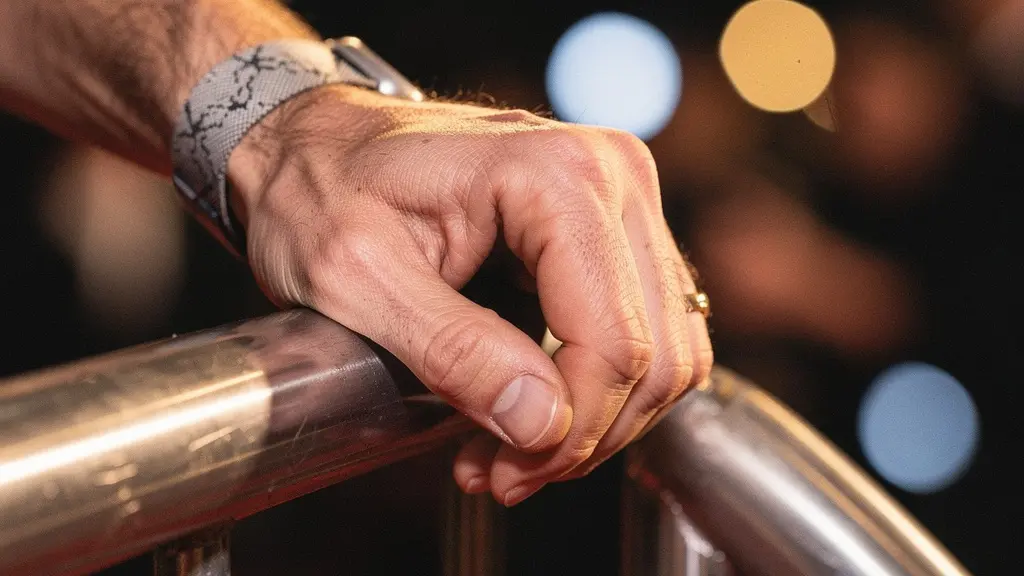
Notice the relaxed grip on the barricade in the image above; tension implies aggression. To replicate this success, follow this specific protocol:
5 Steps to a Successful Celebrity Selfie
- Position: Stand near the car drop-off or venue entrance where stars transition.
- Preparation: Have your phone unlocked, camera ready, and flash OFF to eliminate friction.
- Signaling: Use a clever sign or smile instead of shouting to catch attention respectfully.
- Intelligence: Watch the publicist (with the clipboard/earpiece) to gauge if the star is being rushed.
- Timing: Target the “end-of-the-line” window when stars are most relaxed before entering.
The “Code of Conduct” Reality Check
The Toronto International Film Festival (TIFF) enforces a formal Fan Zone Code of Conduct that prohibits disrespectful, aggressive, or inappropriate behaviour toward staff, volunteers, fellow fans, and festival participants. Fans who violate these rules are removed at TIFF’s sole discretion and may be banned for the rest of the festival. TIFF explicitly states that possessing a wristband does not guarantee celebrity interaction, and that stars cannot be expected to sign or pose for every fan. This framework teaches fans that polite persistence and respectful boundaries yield better results than aggressive approaches.
Emirates Palace or Typical Mall Cinema: Which Hosting Venue Is More Glamorous?
Not all red carpets are created equal. The venue dictates the vibe, the crowd flow, and ultimately, your viewing experience. A premiere at the Emirates Palace in Abu Dhabi or a takeover of Yas Marina Circuit offers a sprawling, cinematic grandeur. These venues allow for long, dramatic car arrivals and wide, airy foyers where the stars linger. The lighting is often architectural and deliberate, designed for the spectacle.
Conversely, a mall cinema premiere—common at Mall of the Emirates or Yas Mall—is a logistical pressure cooker. The “carpet” is often squeezed into an atrium or a corridor. While less “glamorous” in the traditional sense, the mall setting forces the talent into a bottleneck, which can actually be advantageous for fans who secure a spot right at the choke point. However, you are fighting against shoppers, harsh commercial lighting, and retail noise.
We saw this shift recently when Yas Marina Circuit was transformed from a racetrack into a premiere venue, proving that the UAE is moving toward unconventional spaces. Understanding the pros and cons of each venue type is crucial for your strategy.
Here is how the venues stack up for the dedicated celebrity spotter, based on fan access scorecard data.
| Access Factor | Palace / Hotel Venue (e.g., Emirates Palace) | Mall Cinema (e.g., VOX at Mall of the Emirates) |
|---|---|---|
| Car Arrival Visibility | Long driveways with clear sightlines for car arrival shots | Short car drop-off in parking structure — limited visibility |
| Crowd Dispersion | Grand foyers spread crowds across wide spaces | Condensed corridors create bottlenecks — good for proximity |
| Security Restrictiveness | High — multiple controlled access points, security perimeters | Moderate — standard mall security plus event-specific barriers |
| Lighting Conditions | Dramatic architectural and event-specific lighting | Mixed — harsh commercial mall lighting plus event setup |
| Visual Clutter | Minimal — curated event space with clean sightlines | High — shoppers, mall signage, retail storefronts in background |
| Fan Positioning Options | Limited but premium — fewer vantage points but each offers quality views | Multiple — predictable pathways offer several stakeout opportunities |
| Best Strategy | Arrive early, position near the main driveway entrance | Scout the corridor between car drop-off and cinema entrance |
The Wardrobe Mistake of Waiting Outside in Suit and Tie in September
It is the rookie mistake that screams “tourist”: turning up to a September premiere in Dubai wearing a heavy wool suit or a polyester blend. The red carpet might look cool on TV, but the reality of the UAE climate—even in the evening—is a humidity level that can turn a crisp shirt into a translucent rag in minutes. You are not walking the carpet; you are waiting by it. That means standing still in stagnant air for hours.
The “glamour” of the event often tricks fans into overdressing in fabrics that do not breathe. When you are crushed against a barricade with 500 other people, the ambient temperature rises significantly. A suit and tie might look respectful, but if you are sweating profusely, you look distressed, not debonair. Security and publicists subconsciously steer talent away from people who look physically uncomfortable or unhygienic.
This image captures the reality of the wait: relaxed, breathable fabrics are the only way to survive the golden hour heat without melting.
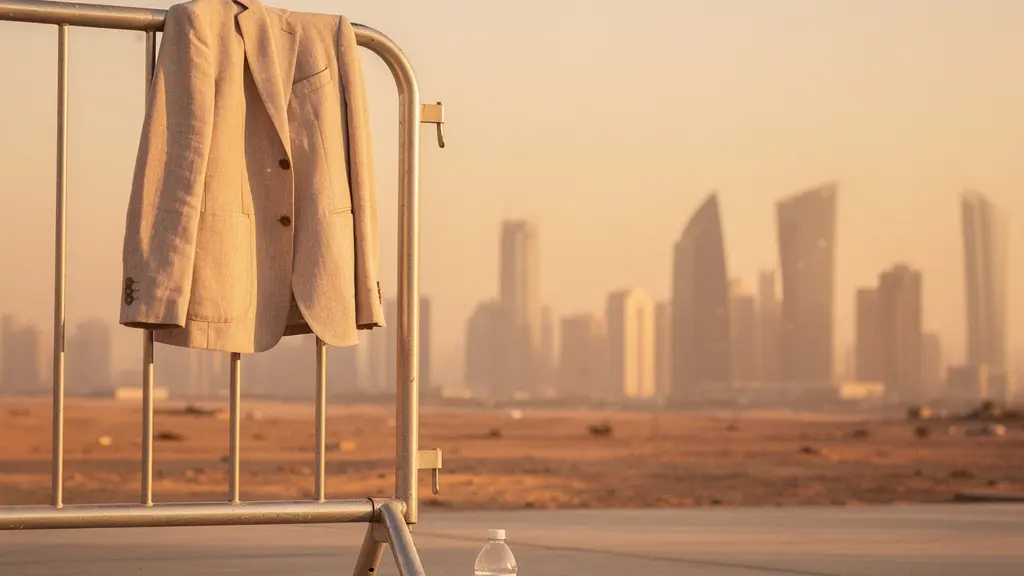
As suggested by the linen jacket above, the strategy is “smart survival.” Opt for high-quality linen or cotton blends. Darker colors hide sweat marks better than the beige aesthetic often associated with desert chic. If you must wear a jacket, carry it until the sun fully sets. Your comfort directly impacts your patience, and patience is the only currency that matters in the fan pit.
Flash or No Flash: How to Shoot Red Carpet Photos at Night?
Lighting is the celebrity spotter’s greatest enemy and greatest ally. The instinct is to blast your smartphone flash, hoping to illuminate the star. This is a mistake. On-camera LED flashes are harsh, unflattering, and often cause “red-eye” or reflect off the sequins and jewelry that dominate premiere fashion. Worse, they flatten the image, removing the depth that makes a photo look professional.
The professionals rely on the ambient light provided by the TV crews. The “scrum” of photographers uses massive strobe lights that illuminate the red carpet zone. Your best bet is to leech off this light. When a TV crew turns on their panel light for an interview, that is your window to shoot. This is a massive industry; we are talking about a sector that generated AED 800 million in cinema revenue last year alone, meaning the lighting setups are industrial-grade.
Pro Smartphone Settings for Low-Light
- Flash OFF: Avoid harsh shadows and amateurish reflections on jewelry.
- Pro Mode: Take control of ISO and shutter speed; auto mode fails in high contrast.
- ISO 400-800: Boost sensitivity enough to see, but keep grain manageable.
- Spot Metering: Tap and hold on the celebrity’s face to expose for skin, not the background.
- Light Leeching: Stand near TV crews and steal their professional illumination.
Gala Screening or Community Cinema: Which Experience Is Right for You?
Are you there for the photo or the film? A Gala Screening is a marketing event. It is about the arrival, the dress, and the noise. The stars are there to be seen, not necessarily to be heard. They are rushed down the line by publicists checking their watches. If your goal is to see Tom Cruise do the “finger guns” point, the Gala is your venue. The energy is electric, but the interaction is superficial.
A Community or Partner Screening, often held a day or two later or in a smaller venue, offers a completely different vibe. These often feature Q&A sessions where the director or cast members actually sit down and talk. The security is looser, the atmosphere is respectful, and the chances of a meaningful interaction—like asking a question or getting a book signed—are significantly higher. You trade the glitz of the red carpet for the substance of the auditorium.
Deciding between the two depends entirely on what you want to take home: a JPEG or a memory. The fan goal comparison table below breaks down the odds.
| Fan Goal | Gala Premiere | Community / Partner Screening |
|---|---|---|
| See A-list Stars | High probability — main cast walks the red carpet | Low — lead actors rarely attend smaller screenings |
| Meet Directors / Writers | Low — creators are escorted quickly through press lines | High — directors and writers often do intimate Q&A sessions |
| Get a Selfie | Possible but competitive — hundreds of fans competing | Very likely — relaxed atmosphere, smaller crowds |
| Have a Conversation | Nearly impossible — interactions are 2-second windows | Excellent — post-screening Q&A and lobby mingling common |
| Security Level | Very high — strict barricades, credentialed zones | Low to moderate — standard venue security only |
| Timing | Opening night or premiere date | 1–5 days after the main premiere |
| Best For | A-lister hunting, red carpet photos, event atmosphere | Creator connecting, insightful film discussions, relaxed access |
In Which Order Should You Visit Sheikh Zayed Road Towers for Sunset Light?
For those capturing the “atmosphere” of a premiere city, or spotting stars doing press junkets at hotels, understanding light on Sheikh Zayed Road is a masterclass in timing. The stars often do press interviews in the high-rise suites of the major hotels (Shangri-La, Dusit Thani, Gevora) before the premiere. They pose against the skyline. To see what they see—or photograph the buildings they are in—you need to follow the sun.
The UAE has positioned itself as a filming destination, accounting for roughly 30% of the Middle East’s total box office revenue. This economic weight attracts talent. When shooting exteriors or looking for “golden hour” reflections, remember that the sun sets towards the Gulf (West). This means the towers on the Trade Centre side face the sunset directly, glowing gold, while the towers on the opposite side fall into silhouette.
This image perfectly captures the golden hour drama that publicists love to use for press backdrops.
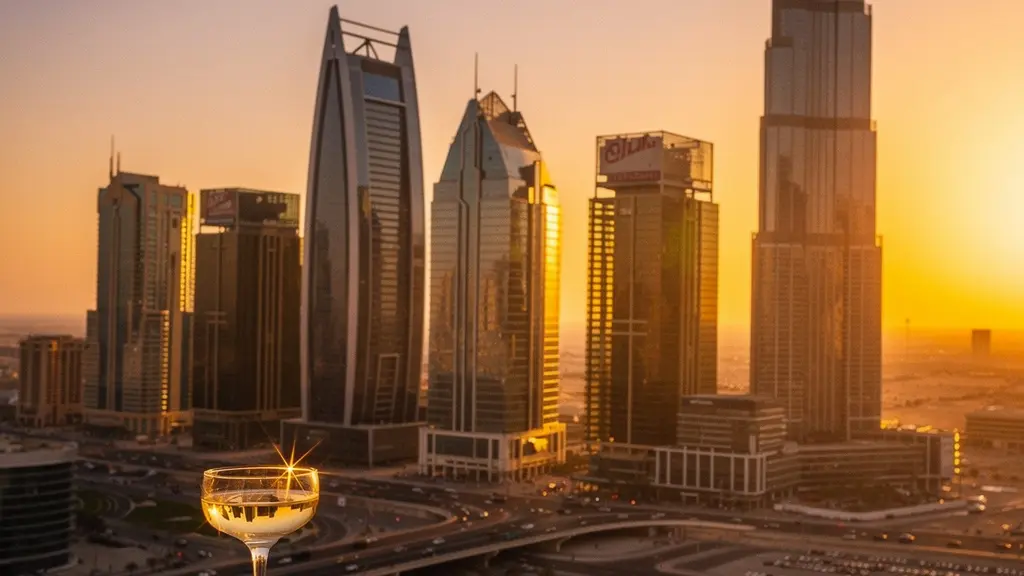
If you are tracking press tours, know that morning interviews usually happen in rooms facing East (Burj Khalifa view) to avoid the harsh afternoon glare, while sunset cocktails and photo ops move to the West-facing terraces. Following the light often leads you to the action.
Key Takeaways
- Wristbands are essential for front-row access; the “general” queue is often a dead end.
- Humidity kills fashion; wear breathable fabrics or carry your jacket until the last second.
- Use the ambient TV lighting for your photos; never use your own on-camera flash.
Dubai World Cup Fashion: How to Dress for the Apron Views vs The Suites?
The Dubai World Cup is the unofficial season finale of the celebrity spotting calendar. It is less about a single film and more about the “scene.” Here, the red carpet extends to the entire venue. However, the dress code is a minefield that varies wildly depending on your ticket. The “Apron Views” (general admission) is a fashion jungle—bold, colorful, and experimental. It is where the “Style Stakes” competition happens, so people dress to be noticed by judges, not just to fit in.
The Suites and VIP areas, however, demand a stricter, more conservative elegance. This is old-money aesthetics. If you try to enter a VIP lounge wearing a novelty suit or a dress that is too avant-garde, you will stick out for the wrong reasons. The goal in the VIP area is to blend in with the high-net-worth individuals, which is often where the celebrities are hiding in plain sight.
As Vivien Sheriff notes in the The National’s fashion coverage:
Proportion, balance and thoughtful styling are key to standing out.
– Vivien Sheriff, The National
For a clear breakdown of what to wear where, consult the access and dress code comparison below.
| Factor | Apron Views (General / Style Stakes Area) | The Suites (VIP / Hospitality Lounges) |
|---|---|---|
| Dress Code | Elegant attire encouraged; headpieces optional; no jeans or trainers | Strict formal dress code; suits with ties/bowties; fascinators or hats for ladies |
| Celebrity Proximity | Opportunities during celebrity walk-throughs and Style Stakes stage appearances | Spotting from balconies; identifying exclusive VIP entrances/exits |
| Crowd Density | High — mass crowds, especially near Style Stakes stage | Low — controlled guest list, spacious hospitality areas |
| Photography Conditions | Natural outdoor light; may require sun management | Mixed indoor/outdoor; balcony vantage points for telephoto shots |
| Price Range | General admission (free or low-cost entry) | Premium packages starting at AED 5,750+ per person |
| Best Strategy for Sighting | Position near the Parade Ring and Style Stakes stage | Monitor VIP entrance corridors and elevator lobbies |
Frequently Asked Questions about Dubai World Cup Fashion
Is there a mandatory dress code for the Dubai World Cup?
There is no strict dress code outside of premium areas, but elegant attire is strongly encouraged across all zones. In VIP and hospitality lounges, formal dress is required — suits with ties for men and fascinators or hats for women. For the Style Stakes competition in Apron Views, specific criteria apply: ladies must wear a fascinator or hat, men must wear a jacket and tie, and jeans or trainers are not permitted.
Can dressing above your ticket level help you access VIP areas?
While dressing impeccably will not override credential checks, it significantly affects how security and staff perceive and interact with you. At high-society events like the Dubai World Cup, blending in sartorially with a higher tier allows you to move more freely through common transitional spaces and reduces the likelihood of being flagged or redirected by security personnel.
What shoes should I wear to the Dubai World Cup for both style and comfort?
Race days are long and the terrain varies from endless concrete concourses to the bouncy turf of Meydan’s Parade Ring. Fashion experts recommend block heels no higher than 85mm for women, and formal leather shoes for men. Slim heels and wedges are generally impractical for the distances and surfaces involved.
Refine your strategy for the next season and secure your spot on the guest list early.