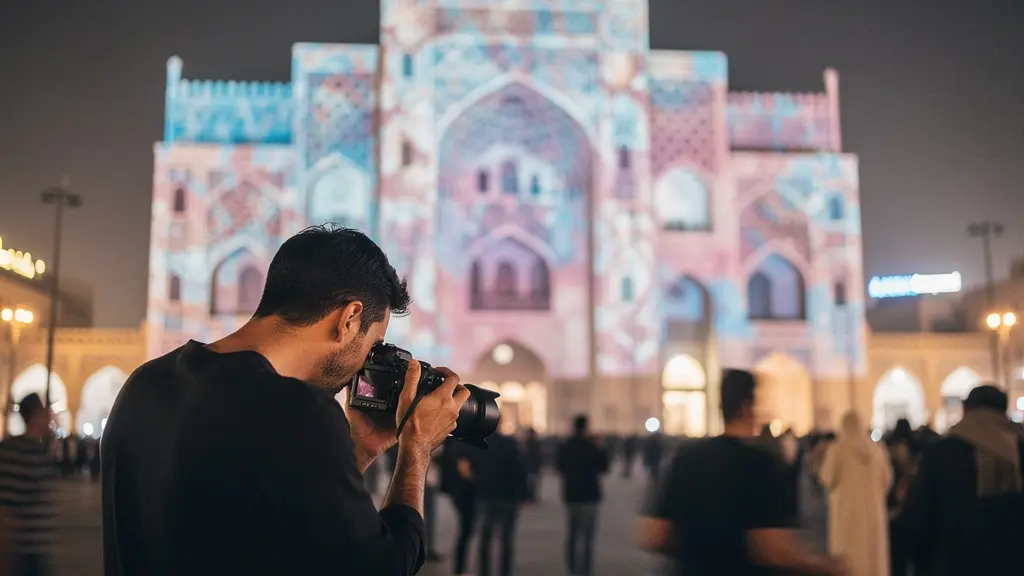
Success at the Sharjah Light Festival relies less on high ISOs and more on using architectural features as stabilization anchors.
- Understand the 3D geometry of the projection surface to predict light behavior.
- Utilize body bracing techniques and “blue hour” timing to mitigate the lack of a tripod.
Recommendation: Scout your location before sunset to identify physical supports like railings or walls for sharper handheld exposures.
For any photographer standing amidst the vibrant crowds of the Sharjah Light Festival, the challenge is immediate and visceral. You are surrounded by colossal architectural canvases painted with light, yet the sheer density of spectators makes deploying a tripod physically impossible and often prohibited. The result for many is a gallery of motion-blurred disappointments or grain-heavy snapshots that fail to capture the crisp grandeur of the event.
The standard advice usually revolves around buying faster lenses or cranking up your ISO until the noise destroys the image detail. While gear matters, these are passive solutions to an active problem. We often overlook the fact that the city itself offers the stability we need. From the stone balustrades of Al Majaz to the pillars of University City, the environment is full of “natural tripods” waiting to be utilized.
But what if the key to sharp projection photography wasn’t just about stability, but about understanding how the light art is constructed in the first place? By analyzing the 3D mapping techniques used by the artists, we can predict where the image will be sharpest and position ourselves to capture the illusion exactly as intended. This guide moves beyond basic settings to explore the structural and technical integration required for mastering handheld night photography in Sharjah.
To navigate this technical approach, we will break down the festival’s challenges into specific locations and optical problems.
text
Table of Contents: A Guide to Handheld Projection Mastery
- Why Do Artists Need 3D Scans of Buildings Before Creating the Light Show?
- University City or Al Majaz: Which Location Has the Most Impressive Show?
- Festival Bus or Driving: How to Avoid Parking Nightmares in Sharjah?
- The Timing Mistake of Visiting the Light Festival on a Thursday Night
- Where to Stand at Al Noor Mosque for the Best Perspective of the Dome?
- How to Photograph Glass Buildings Without Glare ruining the Shot?
- Dubai Marina or Downtown: Which Skyline View Is Better for Night Photography?
- Digital Art on Heritage Walls: How Does Technology Enhance Islamic Geometry?
Why Do Artists Need 3D Scans of Buildings Before Creating the Light Show?
Before you can photograph the light, you must understand the canvas. The sharp lines you see projected onto the facades of Sharjah’s landmarks are not accidental; they are the result of rigorous point-cloud mapping. Artists do not simply project a movie onto a wall; they map the physical imperfections, the depth of the arches, and the texture of the stucco.
As a photographer, knowing this changes how you shoot. You are not photographing a flat surface. You are capturing a “digital skin” that adheres to a physical skeleton. If you shoot from a severe angle, the illusion often breaks because the projection is calculated for a specific viewing axis. To capture the crispness of the artwork, you must align your sensor parallel to the artist’s intended perspective.
This technical foundation is critical because the software used, such as OmniCal, relies on precise calibration. As noted in industry documentation, OmniCal captures images of structured light patterns to construct a 3D representation of projection surfaces. This means the light is sharpest where the building’s geometry is most complex.
The texture of the building plays a massive role in micro-contrast, as seen below.
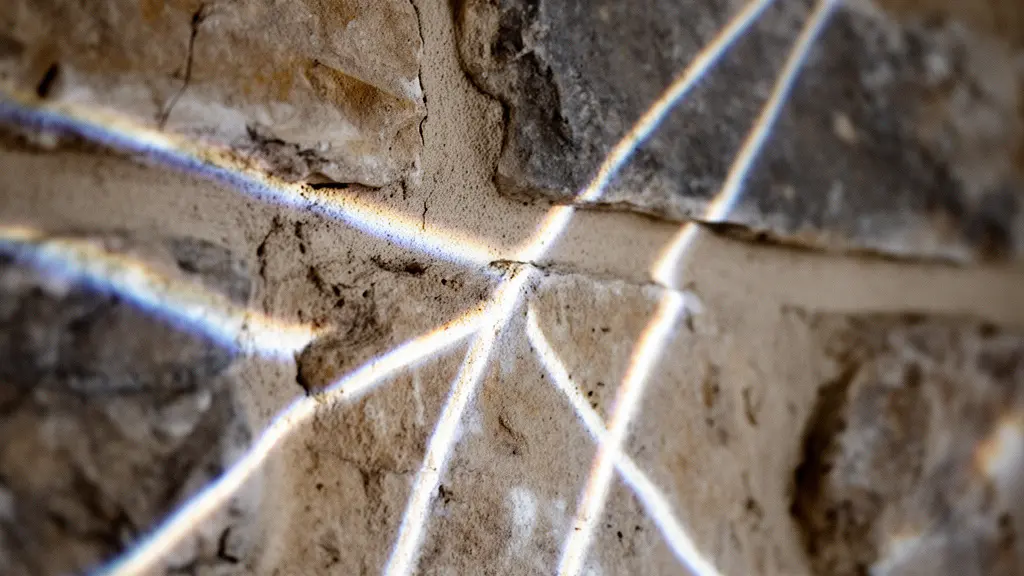
Notice how the light wraps around the physical texture. A tripod allows you to stop down to f/8 to capture this interaction, but handheld, you must prioritize the plane of focus where the light meets the stone.
Therefore, your position relative to the building determines the integrity of the illusion you capture.
University City or Al Majaz: Which Location Has the Most Impressive Show?
The choice between University City and Al Majaz Waterfront is not just aesthetic; it dictates your lens choice and stabilization strategy. University City Hall represents a massive, wide canvas. The sheer scale requires you to stand back, often hundreds of meters. Here, a telephoto lens (70-200mm) compresses the distance but amplifies handshake. You must find a solid pillar or sit on the ground to brace your elbows.
Conversely, Al Majaz offers a different challenge: water and width. The presence of the Khalid Lagoon means you are dealing with reflections that double the light input but require perfect symmetry. The shows here are often designed for panoramic viewing. Reports indicate that a lagoon-side light installation spans 3.2 kilometres, creating a vast horizontal field that demands a wide-angle lens (16mm to 24mm).
Wide-angle lenses are inherently more forgiving of handheld shooting. The “reciprocal rule” suggests you can shoot at 1/20th of a second at 20mm and still get sharp results, whereas University City might demand 1/100th at 100mm. If you lack image stabilization (IBIS), Al Majaz is the safer bet for sharp handheld results.
Your gear dictates your destination: take telephotos to the University, and wide angles to the Lagoon.
Festival Bus or Driving: How to Avoid Parking Nightmares in Sharjah?
Physical fatigue is the enemy of sharp photography. If you have spent 45 minutes fighting for parking and walking three kilometers carrying gear, your muscles will be fatigued, leading to micro-tremors in your hands. This is why logistics are a photographic variable. The traffic density around the main venues during the festival is immense.
Driving offers flexibility but introduces high stress and potential costs. Recent updates from the municipality are strict; specifically, extended operating hours for paid parking in designated blue-sign areas run from 8:00 a.m. to midnight. Miscalculating your parking zone can result in fines that ruin the evening’s mood. Using the festival shuttle buses or taxis allows you to arrive fresh, preserving your physical stability for the shoot.
Your Anti-Fine Parking Plan
- Identify the zone type on-site: standard zones vs seven-day zones (look for the blue information signs)
- Confirm the paid window for that zone before walking away (standard vs seven-day differs)
- Pay using a method you can reliably renew (meter, SMS, or the Digital Sharjah app) and set a phone alarm for renewal
- If you’re using SMS payment, double-check plate source format and hours before sending
- Park farther out on purpose and walk in to reduce stress—and to capture ‘walk-in’ leading-line shots on the approach
Prioritize your energy for the shoot, not the commute.
The Timing Mistake of Visiting the Light Festival on a Thursday Night
Many photographers instinctively plan their shoots for Thursday night, treating it as the start of the weekend. However, in Sharjah, the weekend structure has shifted. As reported, the government established a weekend consisting of Friday, Saturday, and Sunday. This means Thursday evenings are often peak traffic times as commuters mix with early festival-goers, but Friday and Saturday nights see the highest density of pedestrian traffic.
Crowd density is a vibration issue. Thousands of footsteps on a boardwalk or near a bridge create distinct ground vibrations that can blur long exposures, even if you are braced against a railing. Furthermore, heavy traffic kicks up particulate matter. In this region, atmospheric clarity is variable; a recent weather report notes visibility dropping below 2,000 metres due to dust. High traffic nights exacerbate this haze, softening the beams of light and reducing contrast.
For the cleanest shots, aim for a weeknight (Monday or Tuesday). The air is often clearer due to less vehicle churn, and the reduced foot traffic allows you to set up braces against walls without being jostled.
Avoid the crowds to avoid the shake; silence and space are your best tools for sharpness.
Where to Stand at Al Noor Mosque for the Best Perspective of the Dome?
Al Noor Mosque is a masterclass in Ottoman-style architecture, defined by its cascading domes and slender minarets. The projection mapping here usually emphasizes verticality and symmetry. The mistake many make is standing too close, forcing a steep upward angle that distorts the geometry (keystoning). To capture the dome properly, you need distance and elevation parity.
The optimal stance is across the lagoon, or further back on the corniche promenade. By stepping back, you compress the foreground and the mosque, making the domes appear stacked and majestic. This position also allows you to utilize the stone railings of the corniche.
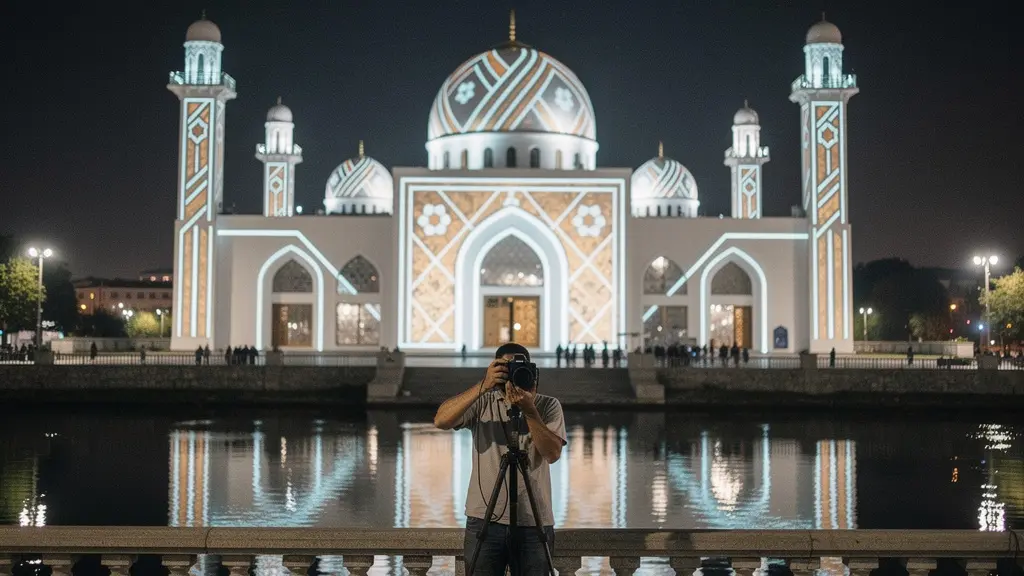
As seen in the image, a wider stance incorporates negative space, giving the light art room to breathe. But standing is not enough; you must become rigid.
Checklist for Handheld Sharpness
- Use the viewfinder (not the rear screen) to create a third point of contact and reduce sway
- Brace your body against a stable object (railing/pillar/bench) rather than balancing freely in the crowd
- Fire a short burst (3–5 frames) at your slowest usable shutter speed; pick the sharpest middle frame later
- Re-center for symmetry: move laterally until minarets frame the dome evenly to match projection artists’ intended alignment
- Underexpose slightly if needed to protect projected highlight detail, then recover shadows in post
Your body mechanics are the final barrier between a sharp image and a blurred one.
How to Photograph Glass Buildings Without Glare ruining the Shot?
Sharjah’s modern architecture creates a unique difficulty: glass. When projection mapping hits glass facades, or when you are shooting through a glass barrier (like from a nearby café), glare is the primary antagonist. A common reflex for photographers is to screw on a Circular Polarizer (CPL) to cut reflections. At night, this is a critical error.
A CPL acts like sunglasses. Technical data from manufacturers confirms that standard CPL filters typically reduce light by over -2 EV. In a handheld night situation, losing two stops of light forces you to quadruple your ISO (e.g., from ISO 1600 to ISO 6400) or slow your shutter speed dangerously. The trade-off is rarely worth it. Instead, you must manage glare through physical positioning.
Anti-Glare Plan of Action
- Don’t shoot straight-on—shift to roughly a 30–45° angle to deflect reflections away from your lens while keeping the projection readable
- Reduce stray light behind you (move position, use your body as a flag, or find a darker spot) to cut reflection intensity
- If you try a circular polarizer, test it quickly and remove it if it forces a shutter speed too slow for handheld work
- Use exposure bracketing (fast burst of multiple exposures) when highlights on glass blow out—merge later to avoid ‘white blobs’
- Keep your lens hood on and stay close to the glass (when possible) to limit off-axis flare
Physics dictates that at night, photons are more valuable than polarization; protect your light input.
Dubai Marina or Downtown: Which Skyline View Is Better for Night Photography?
While this guide focuses on Sharjah, comparing it to Dubai’s shooting environments offers valuable training context for the traveling photographer. Dubai Marina is a corridor of light. The reflections on the water are static and continuous, making it an excellent practice ground for stabilization techniques. The “canyon” effect provides ample wind protection, similar to the enclosed areas of Al Majaz.
Downtown Dubai, dominated by the Burj Khalifa, operates differently. It is a performance space. The light shows here are burst-based and rapid. Timing is everything. For instance, knowing the schedule is vital; the Dubai Fountain plays every 30 minutes from 6pm until 11pm. This predictability allows you to set your exposure settings in the “off” minutes and be ready to shoot the moment the show starts. Sharjah’s festival operates on a continuous loop, offering a more relaxed, iterative workflow compared to the high-pressure bursts of Downtown Dubai.
Use the predictable rhythm of the fountains to train your reaction times for the more complex loops in Sharjah.
Key Takeaways
- Anchor your body: Use railings and walls as physical stabilizers.
- Know the canvas: 3D mapping requires shooting from the intended viewing axis.
- Avoid Thursday nights: Heavy crowds create ground vibrations that blur shots.
Digital Art on Heritage Walls: How Does Technology Enhance Islamic Geometry?
The Sharjah Light Festival is unique because it projects digital future-tech onto deep history. When you photograph the heritage area or the mosques, you are capturing a dialogue between ancient Islamic geometry and modern photonics. The 3D mapping doesn’t just cover the walls; it deconstructs them visually, pulling apart the mathematical precision of the architecture.
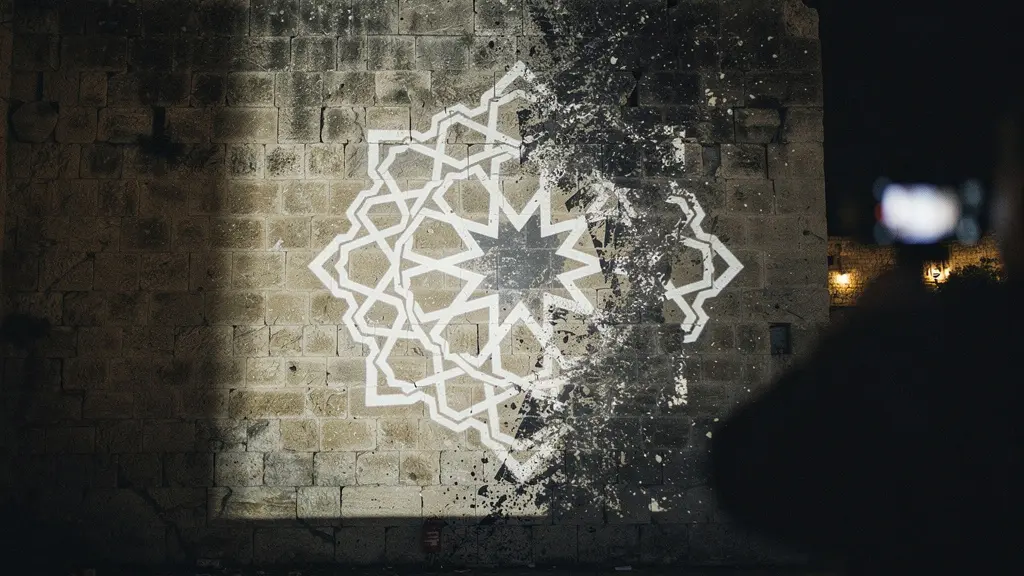
This “deconstruction” phase of the loop is often the most photogenic but the hardest to capture because it moves fast. Reports on the 2025 festival describe a mosque show that uses 3D projection technology to combine intricate geometric patterns and vibrant colors. To freeze these fleeting patterns without a tripod, switch your drive mode to “High-Speed Continuous.” Shoot in bursts of 5 or 6 images. Usually, the third or fourth image in the sequence will be the sharpest, as the initial button-press shake has subsided.
Embrace the fusion of old stone and new light, and don’t be afraid to push your ISO to capture the fleeting moments of geometric magic. Get out there, find your anchor, and let the city be your tripod.