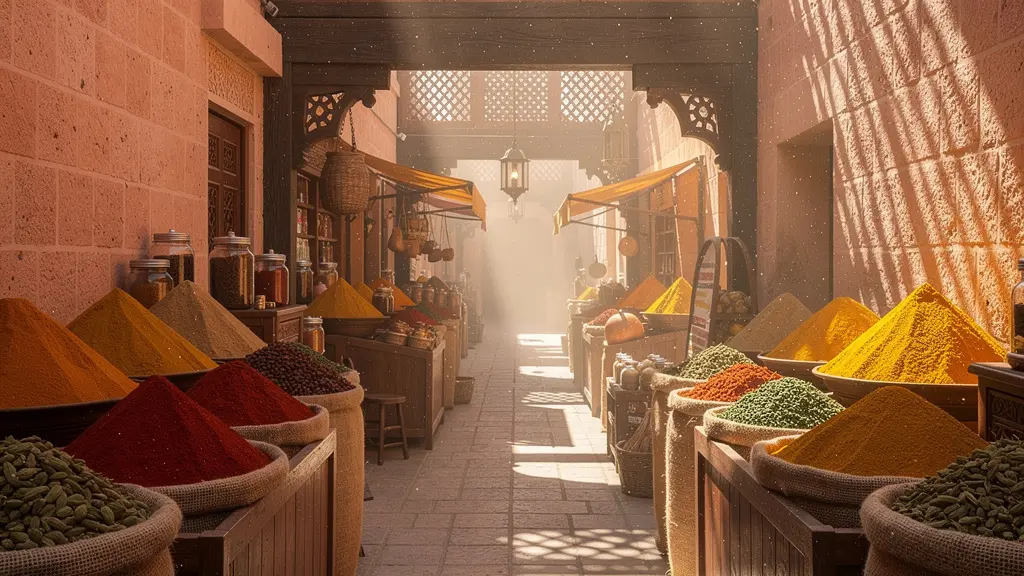
Success in the souk relies on trusting your nose over your eyes: bright colors often signal artificial dyes, while aroma indicates true potency.
- Authentic spices like turmeric should leave a yellow stain that fades, not a persistent neon mark.
- Saffron quality is determined by the trumpet shape of the threads and a delayed release of golden color in water.
Recommendation: Always conduct the “palm test” and smell test before purchasing, and prioritize vacuum sealing your haul to preserve volatile oils during travel.
Walking into the Dubai Spice Souk can feel like stepping into a sensory overload where the air is thick with cardamom, cloves, and frankincense. For a casual tourist, the vibrant pyramids of powders are merely photogenic; for a chef, they represent the soul of Middle Eastern cuisine, provided you know how to navigate the illusions. The challenge is not finding spices, but filtering out the “tourist grade” stock—often old, oxidized, or artificially colored—from the culinary-grade gems hidden in plain sight.
Many visitors rely on the visual appeal of bright colors or the loudness of a hawker’s pitch, but these are often misleading indicators of quality. To truly curate a pantry that rivals a professional kitchen, you must switch off your autopilot and engage your olfactory senses and tactile judgment. We need to look beyond the burlap sacks and understand the chemistry of freshness, the geography of trade, and the etiquette of the deal.
But if the vibrant mounds of curry powder are just for show, where is the real flavor hiding? The secret lies in understanding the difference between a spice that has been dressed up for a photo and one that has been harvested for its essential oils. This guide will dismantle the common traps and equip you with the sensory toolkit needed to distinguish colored dust from potent ingredients.
In the following sections, we will dissect the market lane by lane, from identifying genuine saffron threads to mastering the art of negotiation without causing offense.
For a visual immersion into the atmosphere of the market before we dive into the technical details, the following video offers a walking tour that captures the scale and vibrancy of the location.
To navigate this complex marketplace effectively, we have structured this analysis into specific clusters, guiding you from the macro-economics of trade to the micro-details of a saffron thread.
Table of Contents: A Chef’s Guide to the Spice Souk
- Why Do Spices from Iran and India Dominate the Dubai Markets?
- How to Negotiate Spice Prices Like a Local Without Being Rude?
- Za’atar or Ras El Hanout: Which Spice Mix Should You Buy for Souvenirs?
- The Turmeric Mistake: How to Spot Artificially Colored Spices?
- Vacuum Seal or Tins: How to Pack Spices so They Don’t Ruin Your Suitcase?
- Why Is Dubai’s Street Food Scene Dominated by Indian and Levantine Flavors?
- What Is the Best Route to Connect the Calligraphy Museum and Souq Al Arsah?
- Buying Saffron in Dubai: How to Distinguish Real Negin from Fake Threads?
Why Do Spices from Iran and India Dominate the Dubai Markets?
To understand the quality on offer, one must first appreciate the logistics. Dubai is not merely a retail point; it is a historical fulcrum of the spice trade. The spices you see in the souk are rarely grown in the UAE itself but are the result of centuries-old maritime routes that connect the sub-continent to the West. This proximity to the source is what allows for a level of freshness that is often impossible to find in European or American supermarkets.
The market is heavily skewed towards imports from specific regions due to established trade agreements and geographical proximity. For instance, recent market analysis indicates that India produces and exports 50% of the world’s spices. This massive influx flows naturally through Dubai’s ports, ensuring that the cardamom and black pepper arriving in the souk are often just weeks out of the harvest, retaining their high volatile oil content.
Dubai’s Role as Strategic Spice Trading Hub
Dubai’s location along ancient trade routes made it a spice commerce cornerstone, a legacy that continues today. Traders source spices from countries like India, Iran, and Vietnam, then sell or re-export them globally.
This “fresh off the dhow” reality means that when you buy here, you are often cutting out several middlemen. However, this abundance also means the market is flooded with varying grades of product, from premium export quality to lower grades intended for mass processing.
With the origin story clear, the next hurdle is the social contract of the purchase: the price discussion.
How to Negotiate Spice Prices Like a Local Without Being Rude?
In a professional kitchen, purchasing is a relationship; in the souk, it is a negotiation. Many tourists view haggling as a conflict, but in this culture, it is a conversation about value. The labeled price is rarely the selling price; it is an opening bid. However, aggressive low-balling is seen as disrespectful to the trader and the product.
Effective negotiation requires a shift in mindset from “how much can I save” to “what is the fair value for this quality.” It is widely understood that typical savings through negotiation range from 20-40% off the initial asking price. Achieving this without friction involves a specific set of social cues.
Protocol for Respectful Negotiation: Your 5-Step Plan
- Start with warm greeting and genuine questions about freshness and use
- Make polite counteroffer, especially when buying multiple items
- Focus on bundling – combine 2-3 products for better savings instead of haggling item by item
- State your budget and ask what quality fits it rather than disparaging products
- Thank vendor and compare prices if needed – lanes are close together
The “bundling” strategy is particularly effective because it increases the vendor’s volume while lowering your unit cost, a win-win scenario that chefs use constantly with suppliers. By grouping your saffron, sumac, and vanilla purchases, you signal serious intent.
Now that the price is right, we must decide exactly what to put in the basket, starting with the quintessential blends.
Za’atar or Ras El Hanout: Which Spice Mix Should You Buy for Souvenirs?
Two blends reign supreme in the souk, often confusing visitors: Za’atar and Ras El Hanout. From a culinary perspective, they occupy opposite ends of the spectrum. Za’atar is a daily staple, a breakfast condiment, and a finishing touch. Ras El Hanout, translating to “top of the shop,” is a complex, warming blend used for deep stews and special occasions. Choosing between them depends entirely on how you cook at home.
The following comparison breaks down their organoleptic profiles to help you decide. As shown in the comparative analysis below, their ingredients dictate their usage.
| Aspect | Za’atar | Ras El Hanout |
|---|---|---|
| Origin | Levantine (Lebanon, Syria) | North African (Morocco) |
| Main Ingredients | Thyme, sesame seeds, sumac | 20+ spices including cinnamon, cardamom, cloves |
| Flavor Profile | Herbal and tangy | Complex and warm |
| Best Use | Daily breakfast, simple dishes | Special occasion feasts |
| Price Range | 15-30 AED per 100g | 25-45 AED per 100g |
To visualize the difference in texture and composition, examine the image below. You can clearly distinguish the herbal, green granularity of the Za’atar against the fine, golden-brown complexity of the Ras El Hanout.
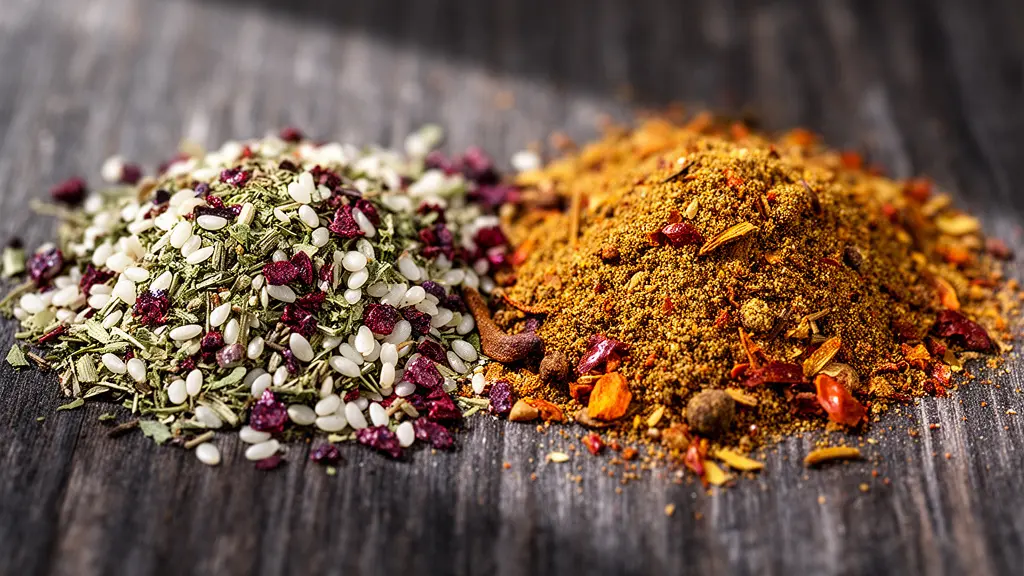
As you can see, the Za’atar (left) relies on the freshness of the thyme and the nutty crunch of sesame, while Ras El Hanout (right) is a uniform powder where individual spices merge into a single symphony. Buying fresh Za’atar means looking for a vivid green hue; if it is grey, the thyme is old.
While blends are about balance, single spices like turmeric are about purity—and this is where the most common scams occur.
The Turmeric Mistake: How to Spot Artificially Colored Spices?
One of the most counter-intuitive lessons for a chef is that “brighter isn’t always better.” In the souk, a neon-bright yellow turmeric powder often signals the presence of artificial dyes or fillers like chalk powder, rather than high curcumin content. Real turmeric has a deep, earthy, golden-orange hue, not a flat, reflective yellow.
The incentive for adulteration is high. Markets have seen a 25% price surge in turmeric recently, pushing some unscrupulous vendors to “cut” their product with cheaper materials. To ensure you are buying the root and not the dye, you must perform field tests right there at the stall.
3 Field Tests for Authentic Spices
- Palm Test: Rub spice into palm – pure turmeric leaves yellow stain that fades; artificial colors leave brighter, persistent stain and feel slick
- Color Theory Check: Real spices have deep, earthy, slightly duller hues vs artificially vibrant neon-looking fakes
- Smell Test 2.0: Rub spice between fingers to warm – real spices bloom with complex aroma; fakes smell dusty or one-dimensionally sharp
The “Smell Test 2.0” is critical because friction generates heat, which releases volatile oils. Old or fake spice will smell like dusty cardboard or purely of chemicals, whereas fresh turmeric will have a pungent, peppery, and slightly musky aroma that lingers.
Once you have secured these volatile treasures, the next challenge is getting them home without them losing their potency or destroying your luggage.
Vacuum Seal or Tins: How to Pack Spices so They Don’t Ruin Your Suitcase?
Spices are enemies of oxygen, light, and moisture. A chef’s nightmare is opening a suitcase to find that the precious cardamom has lost its aroma or, worse, that a bag of sumac has exploded over fresh clothes. The paper bags provided by vendors are temporary transport, not storage solutions.
Proper packing is also a matter of respecting the ingredient. Exposing ground spices to air accelerates the evaporation of essential oils. Therefore, your packing strategy must double as a preservation method.
Your Spice Audit Checklist: Packing Protocol
- Ask vendors to vacuum seal purchases – many now have sealers as part of service
- Use vacuum sealing for locking in aroma and preventing oxygen exposure
- Choose tins for physical protection and light-blocking properties
- Apply ‘Saffron Quarantine’ – use hard-sided container like glasses case for delicate items
- Double-bag aromatic items and check airline rules for food imports
A traveler recently shared their experience regarding the allure of the market’s goods:
I couldn’t resist buying a lama wool shawl for Mom. Apart from that, she also brought some fabrics for her suits.
– Traveler’s packing experience, Social Maharaj
While fabrics are durable, spices are fragile. The vacuum seal is the gold standard; it freezes the aging process of the spice until you break the seal in your own kitchen.
With your spices packed, it is worth pausing to understand the culinary ecosystem that created this demand in the first place.
Why Is Dubai’s Street Food Scene Dominated by Indian and Levantine Flavors?
The spice souk does not exist in a vacuum; it feeds the city. The dominant aromas of cumin, coriander, and za’atar in the air mirror the street food landscape of Dubai. This is not coincidental but a direct result of demographics shaping the palate. The demand for specific spices drives the import market, creating a feedback loop of flavor.
The sheer scale of this consumption is impressive. Reports show that the UAE spices market reached US$ 46.74 million in recent valuations, a figure driven by the daily cooking habits of the population rather than just tourism.
Cultural Diversity Driving Spice Demand
The industry is additionally influenced by the UAE’s distinctive cultural setting, shaped by a confluence of Arab, Indian and Iranian cultures. The cultural diversity has resulted in a broad spectrum of spices and herbs utilized in local cuisine, generating significant demand for both conventional and exotic variations.
This “fusion” is the authentic local cuisine. When you buy spices here, you are buying the ingredients that power the shawarma stands and the biryani houses that feed the city’s workforce.
To fully appreciate this history, one should connect the commercial souk with the cultural landmarks nearby.
What Is the Best Route to Connect the Calligraphy Museum and Souq Al Arsah?
A comprehensive sensory trip involves more than just taste; it includes the visual rhythm of the architecture. Connecting the modern appreciation of the Calligraphy Museum to the historic atmosphere of Souq Al Arsah (one of the oldest marketplaces) creates a narrative arc for your visit. Navigating this in the heat, however, requires strategic planning.
The image below captures the essence of the “Old Dubai” architecture you will encounter along these routes: narrow sikkas (alleyways) designed to channel wind and provide shade.
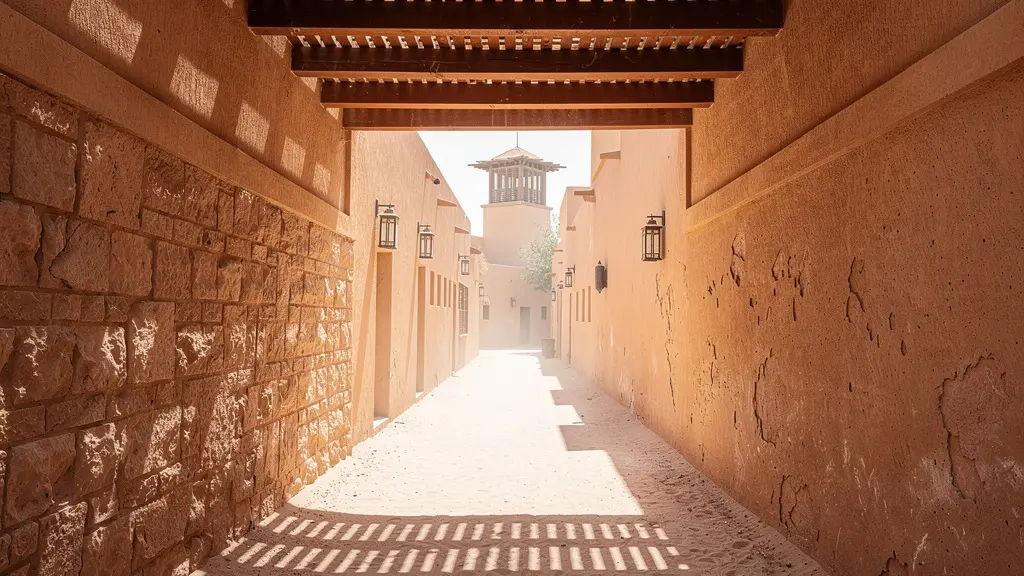
As illustrated, these high walls and wooden lattices are not just aesthetic; they are functional climate control. Sticking to these shaded paths is the “local secret” to surviving a walking tour.
Three Strategic Walking Routes
- The Scent Trail: Pass by traditional coffee roaster, oudh shop, and local bakery for sensory journey
- The Local’s Shaded Path: Use narrow covered alleyways (sikkas) and building overhangs to avoid sun
- Architectural Time-Lapse: Follow route from modern museum through traditional coral/gypsum buildings to historic Souq
- Transport option: Take 1 AED dhow ride across Creek for scenic views
- Metro access: Al Ras Station on Green Line, 3-minute walk to Spice Souk
The “Scent Trail” is particularly recommended for cooks, as the smell of roasting coffee often clears the olfactory palate between spice tastings.
Finally, we arrive at the most expensive item on your list, and the one most fraught with danger: Saffron.
Key Takeaways
- India and Iran control the supply, ensuring high freshness in Dubai.
- Neon-bright colors usually indicate artificial dyes; look for earthy tones.
- Negotiation is expected: bundle items for a 20-40% discount.
- Vacuum sealing is non-negotiable for preserving volatile oils.
Buying Saffron in Dubai: How to Distinguish Real Negin from Fake Threads?
Saffron is the ultimate test of a buyer’s knowledge. It is the most expensive spice in the world, and consequently, the most counterfeited. Unsuspecting tourists often buy dyed corn silk, safflower, or even shredded paper believing it to be “Red Gold.” In Dubai, the proximity to Iran—which statistics show provides 97% of world’s saffron supply—means high-quality Negin is available, but you must prove you know what it looks like.
Real saffron does not release its color instantly. It is a slow, magical extraction. If you drop a thread in water and it explodes into red immediately, it is dye. Real saffron releases a golden yellow hue slowly over minutes. Furthermore, the anatomy of the thread is distinct; it should flare at the top like a trumpet.
Professional Saffron Authentication Tests
- Cold Water Bleed Test: Drop one thread in cold water – real saffron slowly releases golden-yellow color; fakes immediately bleed harsh red/orange
- Anatomy Check: Real threads have distinct trumpet/bugle shape, flared at one end; fakes are uniform width or shredded
- Grade Recognition: Negin (all red, trumpet shape), Sargol (just red tip), Pushal (red stigma with yellow style)
- Visual Inspection: Deep red to crimson color with slight orange tips, dry and slightly elastic feel
- Aroma Test: Warm, honeyed scent for real saffron vs perfumy smell for fakes
Never buy saffron that is pre-ground. The powder is impossible to verify and is often mixed with turmeric or paprika. Always buy threads, and ask for “Super Negin” or “Negin” grade for the highest potency.
You have now navigated the geography, the negotiation, and the chemistry of the spice souk. The final step is to put this knowledge into practice.
Review your pantry, identify the spices that have lost their soul, and plan your next trip to the souk with the confidence of a seasoned chef.
Questions frequent on Spice Souk Shopping
How much does saffron cost in Dubai?
Prices vary by grade, but expect to pay between 10-20 AED per gram for high-quality Negin saffron. If the price is significantly lower, be wary of counterfeits.
Is it safe to buy spices in open sacks?
While picturesque, open sacks lose flavor quickly due to oxidation. It is better to ask the vendor for stock from the sealed containers behind the counter or freshly opened bags.
What is the best time to visit the spice souk?
Late afternoon or evening (after 4 PM) is ideal. The heat dissipates, the market comes alive, and the aromas are more distinct than in the scorching midday sun.
Do vendors accept credit cards?
Most established shops accept cards, but cash is king for negotiation. You will often get a better “final price” if you pay in AED cash.