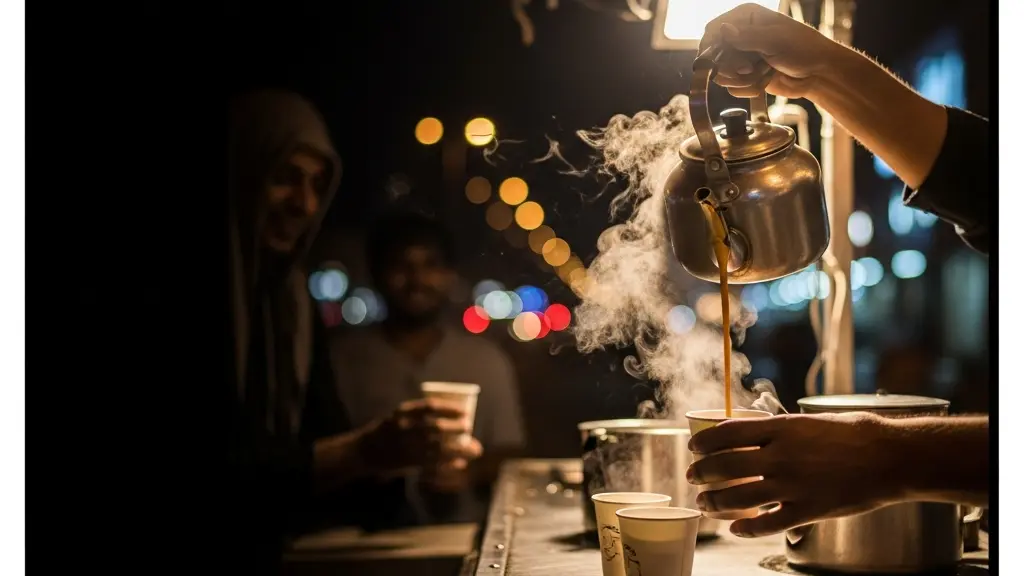
Karak is not just a drink; it is a meticulously engineered social lubricant that powers the UAE.
- The unique flavor comes from a specific chemical reaction between heat-treated milk fats and strong tea tannins.
- Ordering requires a specific vernacular and understanding of the “honking etiquette” to avoid fines.
Recommendation: Master the “Sukar Ziyada” order script and pair your cup with a Francisco sandwich for the ultimate local experience.
If you stand on any busy street corner in Dubai or Sharjah after sunset, you will witness a peculiar ritual. Luxury SUVs and modest sedans alike pull up to small, neon-lit cafeterias, windows roll down, and a frantic exchange of coins for small paper cups takes place. This is not just a caffeine fix; it is the cult of Karak.
For the uninitiated, Karak might seem like simple strong tea with milk. This is a massive understatement. It is a sugary, viscous, cardamom-spiced lifeline that transcends social classes. While tourists often look for high tea in skyscrapers, the real pulse of the country beats in these AED 1 cups. We often hear that the secret is just “lots of sugar,” but that dismisses the complex chemistry and cultural signaling at play. From the specific brand of evaporated milk to the dangerous etiquette of honking for service, the ecosystem of Karak is intricate.
But if the secret isn’t just sugar, what is it? The answer lies in a violent boiling process that would horrify a British tea sommelier, creating a molecular bond that defines the texture of the Gulf. In this guide, we won’t just tell you where to drink; we will decode the physics of the brew and the street laws of ordering it, ensuring you never look like a tourist at the cafeteria window again.
text
To navigate this landscape of steaming cups and flaky breads, we have broken down the essential elements of the UAE’s tea culture, from the science of the boil to the etiquette of the majlis.
Table of Contents: The Karak Ecosystem
- Why Is Karak Chai Boiled Longer Than Traditional English Tea?
- How to Order “Sukar Ziyada” or “Khaleek” Like a Local?
- Rainbow Milk or Fresh: Which Creates the Authentic Karak Texture?
- The Honking Mistake: When Is It Rude to Honk for Service?
- Paratha or Samosa: What Is the Classic Pairing for Your Tea?
- How to Accept Arabic Coffee (Gahwa) Without Insulting Your Host?
- How to Order a “Hassan Mathar” or “Francisco” Sandwich?
- Why Is Food Quantity So Important in Emirati Hosting Culture?
Why Is Karak Chai Boiled Longer Than Traditional English Tea?
If you treat Karak like an English Breakfast tea, you have already failed. The fundamental difference lies in the aggression of the heat. While delicate tea leaves are usually steeped gently to avoid releasing bitter tannins, Karak demands a violent, sustained boil. This isn’t carelessness; it is chemistry. The goal is to extract every ounce of flavor from the loose dust tea, creating a base so potent that it can stand up to the heavy onslaught of sugar and evaporated milk.
The visual difference in preparation is striking and tells the whole story of the final flavor profile.

As illustrated above, the vigorous boil on the right is where the magic happens. This process triggers the Maillard reaction between the milk sugars and proteins. In fact, specific research into dairy science has found that 123 lactosylated lysines are identified across milk proteins under high heat. This molecular modification is what gives Karak its distinct caramel notes and “cooked milk” flavor that you simply cannot replicate by adding cold milk to hot tea.
By stewing the mixture, the tea doesn’t just flavor the water; it fuses with the milk solids. The result is a beverage that is less of an infusion and more of a soup—rich, heavy, and infinitely comforting.
How to Order “Sukar Ziyada” or “Khaleek” Like a Local?
Walking up to a cafeteria window—or shouting from your car—requires a specific vocabulary. You are not entering a Starbucks; this is a high-speed transaction where efficiency is the highest currency. The servers are often managing dozens of orders simultaneously, so hesitation is your enemy. The default Karak comes sweet, but for the true rush, many opt to push the limits.
The language used here is a fascinating pidgin of Arabic, Urdu, and English, stripped down to its most functional components. Knowing a few key phrases signals that you belong to the street culture, not the hotel lobby.
Your Quick-Fire Ordering Script: Cafeteria Style
- Start with the item: Simply say “shay” (tea) or “Karak”.
- Add the sweetness request: Use “sukkar ziyada” (extra sugar) for the full experience.
- Keep it short: Directness is polite here; avoid long sentences.
- Repeat if needed: If the environment is loud, repeat the key phrase: “shay, sukkar ziyada.”
- Close politely: Use “Khaleek” (keep it/stay) or a simple nod to acknowledge the service.
Speed is essential because the volume of business in these tiny outlets is staggering. A Case Study from the Khaleej Times in 2023 documented a restaurant in Dubai Mall that went viral for selling Karak at just 50 fils. The result was steady, unmanageable lines, proving that in the UAE, the price and speed of tea are powerful viral drivers. When the line is that long, your script needs to be perfect.
Remember, the goal is to get your cup and keep the line moving. It is a dance of brevity and volume.
Rainbow Milk or Fresh: Which Creates the Authentic Karak Texture?
Ask a purist if they want fresh milk in their Karak, and you might be met with a confused stare. In the realm of UAE street tea, “Rainbow” milk (a brand of evaporated milk so iconic it has become the generic trademark for the product) is king. The texture of Karak depends entirely on the viscosity that only concentrated milk can provide. Fresh milk is simply too watery to achieve that signature “mouth-coating” feel.
The pour itself is often used to aerate the tea and mix the thick milk, creating a texture that is visually distinct.

This macro view emphasizes the “threading” effect of the liquid. The science supports the preference for evaporated milk. UHT treatments and concentration change the molecular structure of milk proteins, which can lead to specific sedimentation, but also creates that heavy body we crave. However, as noted in critical food science reviews, the severity of these treatments is what differentiates the product from fresh milk. The Rainbow brand has positioned itself as the default narrative for this texture, becoming inseparable from the identity of the drink itself.
Ultimately, while specialty coffee shops might boast about their organic fresh milk, the humble cafeteria knows that for a one-dirham tea, the tin can is the only way to go.
The Honking Mistake: When Is It Rude to Honk for Service?
For decades, the “honk-and-order” system was the unspoken drive-thru of the UAE. You pulled up, gave two short toots of the horn, and a server ran out to your car. It was convenient, efficient, and culturally accepted. However, as cities have grown and noise pollution has become a genuine concern, this habit has shifted from a quirk to a potential violation. The line between a polite signal and a rude disturbance is razor-thin.
Authorities have cracked down on this practice in residential and high-traffic areas. It is no longer a free-for-all. In fact, the Dubai Police have explicitly stated that continuous horn use can result in a Dh400 fine and four black points. This turns your cheap tea run into a very expensive mistake.
The New Etiquette:
- Flash, don’t honk: Many locals now flash their headlights to attract attention at night.
- Park and walk: The safest bet is to step out. It’s better for your wallet and your legs.
- Eye contact: Cafeteria servers are masters of peripheral vision; often, just rolling down your window is signal enough.
Adapting to these changing norms is part of being a respectful resident or visitor. The tea tastes better when it doesn’t come with a traffic fine.
Paratha or Samosa: What Is the Classic Pairing for Your Tea?
Karak is rarely consumed in isolation. It requires a savory counterpoint to balance the aggressive sweetness. The undisputed champion of this pairing is the Paratha (often pronounced “Porotta” locally)—a flaky, layered flatbread that is greasy, chewy, and crisp all at once. The interplay between the fats in the bread and the tannins in the tea is not just delicious; it is chemically harmonious.
Scientific analysis of food chemistry provides proof that tea polyphenols form complexes with milk proteins, which changes how we perceive bitterness and astringency. When you introduce the oil-rich paratha into this equation, you are further coating the palate, making the tea taste even smoother. It is a cycle of sip and bite that creates a perfect feedback loop of flavor.
As The National points out regarding UAE street food classics:
Placing cheese spread, hot sauce and crushed pieces of Chips Oman within a fluffy parotta is something of a UAE classic
– The National, The National
Whether you choose a plain paratha or one stuffed with Chips Oman, the rule is simple: never drink on an empty stomach.
How to Accept Arabic Coffee (Gahwa) Without Insulting Your Host?
Moving from the chaotic street corners to the quiet dignity of a Majlis, the rules change completely. Here, Karak is replaced by Gahwa (Arabic coffee), and the vibe shifts from high-speed transaction to slow, ritualistic hospitality. Gahwa is a golden, cardamom-infused brew served in tiny handleless cups called finjan. It is not just a drink; it is a test of your manners.
The setting is crucial to the experience, often characterized by minimalism and grace.

When you are served, you must use your right hand to accept the cup. Using the left is considered unclean and disrespectful. You are not expected to down a full mug; the portions are small, and the refills are frequent. The most critical non-verbal signal occurs when you have had enough. If you simply hand the cup back, it will be refilled. To stop the flow, you must gently shake the cup from side to side.
Understanding this distinction—between the chaos of the cafeteria Karak and the grace of the Majlis Gahwa—is what separates a tourist from a traveler.
How to Order a “Hassan Mathar” or “Francisco” Sandwich?
Return to the cafeteria menu, and you will find names that defy explanation. You might see a “Francisco,” a “Hassan Mathar,” or a “Burj Khalifa.” These are not standard culinary terms; they are inventions of the Kerala-dominated cafeteria industry in the UAE, becoming local legends in their own right. Ordering one is a rite of passage.
Take the Francisco, for example. It sounds Spanish, but it is pure UAE fusion.
Case Study: Decoding the Francisco
A menu listing from Twenty Four Cafeteria defines the “Francisco Paratha Sandwich” as a grilled paratha wrap built around chicken, cheese, sauce, and vegetables. It is essentially a club sandwich reimagined inside a flatbread. The name likely has no connection to San Francisco; it is just a catchy label that stuck.
Similarly, the “Hassan Mathar” is a cafeteria staple often involving chicken and cheese, praised in customer reviews as a “must-try” item alongside other cryptically named shakes like the “Abood.” These names are part of the charm. They represent a playful, creative food culture that doesn’t take itself too seriously but delivers serious flavor.
The Francisco is the perfect savory partner to your sweet Karak, grounding the sugar rush with salty, cheesy goodness.
Key Takeaways
- Karak requires a violent boil to fuse the tea and evaporated milk proteins.
- Use the “shake” gesture to stop the flow of Gahwa in a Majlis.
- The “Francisco” is a chicken-cheese paratha wrap, not a person.
Why Is Food Quantity So Important in Emirati Hosting Culture?
Whether it is the bottomless refills of Gahwa or the overflowing plates at a dinner, quantity in the UAE is a language of respect. In Emirati culture, running out of food or drink is the ultimate failure of a host. This is why you will rarely see a “single serving” of anything in a traditional context. The abundance signals that the guest is valued above the cost of the provisions.
This is codified in the serving rituals of Gahwa. The cup is never filled to the brim; that would imply the host wants you to drink up and leave. Instead, the cup is traditionally filled only a quarter full, ensuring that the server must return repeatedly to refill it. This creates multiple points of contact and interaction between host and guest. It is a cycle of service that prioritizes connection over efficiency.
The rhythm of drinking at least one cup but usually not exceeding three is a dance of politeness. You honor the host by accepting, but you show restraint by not overindulging. It is a delicate balance that mirrors the broader values of the society.
So, the next time you pay one dirham for a cup of tea, remember that you are buying into a tradition of generosity that runs much deeper than the price tag. Go find your local cafeteria, order with confidence, and drink deep.