Contrary to popular belief, guaranteeing connecting rooms isn’t about calling the hotel—it’s about engineering a booking the hotel’s reservation system cannot ignore.
- Master the critical difference between a “connecting” (guaranteed internal door) and an “adjoining” (non-guaranteed side-by-side) room to avoid the most common booking failure.
- Leverage “amenity arbitrage” to prove that two connecting rooms are often more valuable and sometimes even cheaper than a single, less-functional family suite.
Recommendation: Shift from making a weak “special request” to finding a booking path that makes connecting rooms a contractual, non-negotiable part of your reservation.
The moment of truth for any parent traveling with teenagers is at the hotel check-in desk. You hold your breath as you ask the question: “Did we get the connecting rooms we requested?” The polite but noncommittal smile you receive in return is often the prelude to disappointment—your teens are three doors down the hall, and your relaxing vacation just became a logistical challenge. The standard advice is to “call the hotel” or “book early,” but these are passive tactics, not guarantees. They leave you in the position of a hopeful requester, not a confirmed guest.
The fundamental flaw in this approach is treating a guaranteed connection as a favor. It is not. It is a specific, limited-inventory product that must be secured with logistical precision. The key isn’t to ask nicely; it’s to understand the hotel’s operational and financial systems to engineer a booking that contractually obligates them to provide the rooms you need. This guide moves beyond hopeful requests and provides a firm strategy. We will dissect room types, calculate value beyond the price tag, and master the vocabulary that separates a successful booking from a vacation-long headache.
This article provides a complete logistical framework for securing the right accommodation for your family. The following sections break down every critical decision point, from room configuration to meal plans and transport, ensuring you can book with certainty and control.
Summary: A Strategic Guide to Family Travel Logistics
- Why Are Interconnecting Rooms the First to Sell Out?
- 2-Bedroom Suite or 2 Connecting Rooms: Which Is Cheaper?
- Double Doors or Single: How Much Sound Travels Between Connected Rooms?
- The Vocabulary Mistake: The Difference Between “Connecting” and “Adjoining”
- One Bathroom or Two: Why Connecting Rooms Are Better Than Suites for Queues?
- Half-Board or All-Inclusive: Which Meal Plan Saves Money for Families?
- Why Does Booking a Stopover in Dubai Save You Up to 30% on Long-Haul Flights?
- Why Is Driving in Abu Dhabi Less Stressful Than the Traffic of Dubai?
Why Are Interconnecting Rooms the First to Sell Out?
Interconnecting rooms are the unicorns of hotel inventory. The reason they disappear so quickly is a matter of rigid supply and flexible demand. A hotel has a fixed, small number of these rooms. A standard 300-room hotel might only have 10-15 pairs. These rooms are a fixed asset; you cannot create more. Once they are booked, they are gone. Unlike standard king or twin rooms, which have some fungibility, a connecting pair is a unique product. Hotels often cannot sell one half of the pair to a solo traveler without losing the ability to sell it as a connected unit, which complicates their inventory management.
The demand, however, is extremely high and comes from multiple segments. It’s not just families with teens. It’s also multi-generational families, small business groups needing a common workspace, and friends traveling together. This creates a supply-and-demand bottleneck. Furthermore, many online travel agencies (OTAs) do not have the technical capability to guarantee connecting rooms at the time of booking. They only allow you to pass on a “request.” Because these requests are not contractually binding, savvy travelers and agents who know how to book them directly or through specialized channels snap them up first, leaving the request-based system for everyone else.
This is not a customer service failure; it is a logistical reality. The scarcity means these rooms are treated as a premium product. To secure them, you must approach the booking not as a request for an added feature, but as the deliberate purchase of a scarce and specific room category. The goal is to remove your booking from the “request” pile and place it into the “confirmed inventory” ledger.
2-Bedroom Suite or 2 Connecting Rooms: Which Is Cheaper?
The default assumption is that a two-bedroom suite is a more luxurious and therefore more expensive option. This is often incorrect. The decision between a suite and two connecting rooms should not be based on the sticker price alone, but on a logistical calculation I call “amenity arbitrage.” A large suite may offer more square footage but fail on the most critical amenities for a family with teens: doors and bathrooms. Two connecting rooms provide two distinct private spaces and, crucially, two full bathrooms—a priceless asset for getting a family of four ready in the morning.
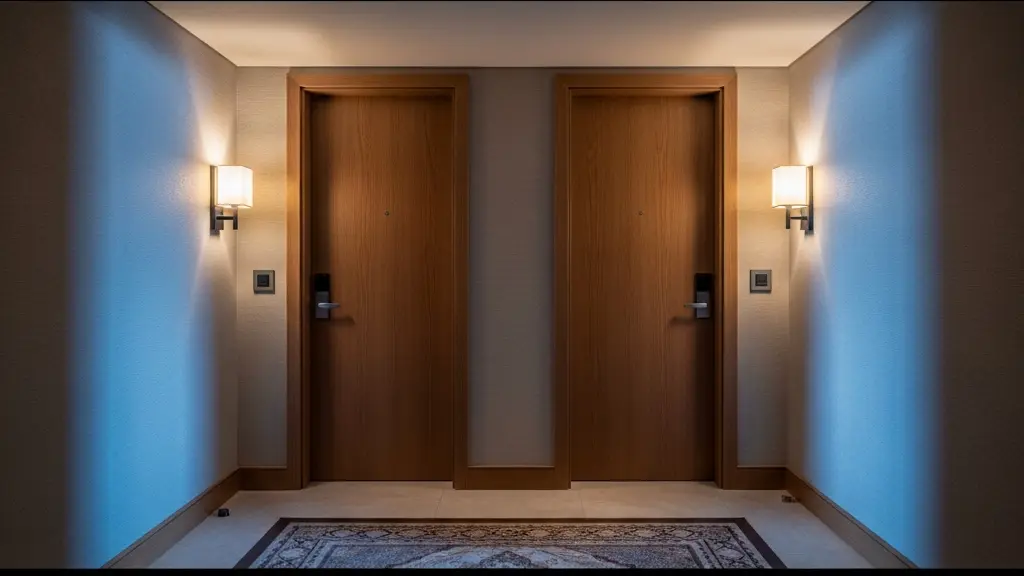
To make a purely logistical decision, you must calculate the cost-per-amenity. A $700/night two-bedroom suite with one bathroom is effectively $700 per bathroom. Two connecting rooms at $400/night each ($800 total) give you two bathrooms, bringing the cost to $400 per bathroom. Is the extra privacy and efficiency of a second bathroom worth the $100 difference? For most families with teenagers, the answer is an emphatic yes. The visual below represents this choice: the harmony of separate, peaceful spaces versus the potential friction of a single, shared area.

This calculation forces you to quantify the value of privacy and efficiency. A suite might seem like a better deal based on its total size, but when you factor in the “privacy premium” of a second closing door and the conflict-reducing benefit of a second bathroom, two connecting rooms often emerge as the superior logistical and financial choice.
Your Action Plan: The ‘Price-Per-Amenity’ Calculation
- Calculate Price Per Bathroom: Divide the total nightly cost of each option (suite vs. two rooms) by its number of full bathrooms. This reveals the true cost of convenience.
- Assess Price Per Door: Consider the value of having a door that separates the teen’s space from the parents’ space. Two connecting rooms offer two layers of privacy (the main door and the connecting door).
- Factor in the ‘Privacy Premium’: Assign a personal value to avoiding morning queues and having a separate zone for relaxation. Is that worth a small price difference?
- Check for ‘Seasonal Arbitrage’: During the off-season, hotels may discount larger suites heavily to fill them. Always compare, as the math can change depending on the time of year.
- Document for Leverage: Keep a note of your calculation. If negotiating with a hotel, being able to state “two rooms offer double the bathroom facilities for a comparable price” is a powerful, fact-based argument.
Double Doors or Single: How Much Sound Travels Between Connected Rooms?
A valid concern with connecting rooms is noise transmission. After securing privacy, the last thing you want is to hear every word of your teenager’s late-night video game session. Most connecting rooms are designed with a “back-to-back” door configuration—two separate, solid-core doors in a single frame. When both are closed, they provide a level of soundproofing comparable to a standard hotel wall. However, the weak point is almost always the gap at the bottom of the doors.
Hallway noise and sound transfer between rooms often exploit this small opening. While hotels are designed to meet certain acoustic standards, manufacturing tolerances and wear-and-tear can create gaps that compromise sound insulation. You do not have to accept this as a given. There are simple, effective, and non-damaging ways to mitigate this issue and enhance the sound barrier between the rooms, ensuring both parties enjoy their separate spaces without acoustic intrusion.
A proven method involves using an item readily available in your room, as a travel expert points out. This practical hack requires no special equipment and can be implemented in seconds.
One of the most effective strategies requires nothing more than a bathroom towel. Simply grab an extra towel from the bathroom and roll it lengthwise into a bolster. Tuck the towel in the space between the room door and the floor to ensure hallway noise is blocked.
– Travel Expert, Explore.com Travel Hacks
This simple logistical fix addresses the most common point of failure in the room’s soundproofing. By blocking the air gap, you significantly reduce the transmission of high-frequency sounds, making both rooms more private and peaceful. It’s a perfect example of applying a small, tactical solution to solve a common travel problem.
The Vocabulary Mistake: The Difference Between “Connecting” and “Adjoining”
This is the single most critical point of failure in booking rooms for a family. Using the wrong term is the fastest way to end up with a “request” that the hotel is happy to “decline due to availability.” In the hotel industry, the words “adjoining” and “connecting” have precise, non-interchangeable meanings. Confusing them is a guarantee for disappointment. Your entire booking strategy hinges on using the correct terminology with absolute precision.
An “adjoining” room is simply a room located next to or across the hall from another room. There is no internal door. To move between the rooms, you must exit into the public hallway and enter the other room. Requesting “adjoining rooms” gives the hotel tremendous flexibility; they can place you in any two rooms in proximity and claim they have fulfilled your request. This term offers zero guarantee of direct access.
A “connecting” room is what you actually want. This specifically refers to a pair of rooms with a lockable, internal door that allows movement between them without entering the hallway. This is a distinct physical feature and a specific inventory type. When you book a “connecting room,” you are booking this feature. As a travel industry glossary clarifies, connecting rooms take convenience up a notch because they are purpose-built with an internal door linking them directly. Always use the word “connecting” in all verbal and written communication with the hotel or your travel agent. Never abbreviate or use casual language. State your need clearly: “I require a confirmed pair of connecting rooms.”
One Bathroom or Two: Why Connecting Rooms Are Better Than Suites for Queues?
The debate between a suite and connecting rooms often centers on space and cost. However, for families with teenagers, the most valuable commodity is not square footage—it’s access to a bathroom. A single-bathroom suite for a family of four creates a permanent logistical bottleneck, especially during the morning rush to get out and explore. Two connecting rooms, each with its own full bathroom, eliminate this friction entirely. It’s a simple equation: double the facilities, half the conflict.
But the value of a second bathroom goes far beyond simple utility. For a teenager, it represents a crucial zone of privacy and personal space. It’s a place to decompress from the pressures of shared family travel. This isn’t just an opinion; it’s a documented psychological need.
Case Study: The Bathroom as a Private Refuge
A study on personal space highlights the bathroom’s role as a sanctuary. It revealed that a significant number of young people view the bathroom as one of the few places they can find genuine peace and quiet away from family. The data showed that 43% of young people utilize the bathroom to lock themselves away from household stress. This underscores that a second bathroom isn’t a luxury; for a teenager on a family trip, it’s a necessary decompression zone, contributing significantly to overall vacation harmony.
Therefore, when weighing your options, the “one vs. two bathrooms” question should be a primary decision factor. The ability for a teen to have their own space to get ready and retreat to is a massive, often underestimated, benefit. It transforms the accommodation from a shared bunkhouse into a functional home base with defined personal territories, directly contributing to a more peaceful and successful family vacation.
Half-Board or All-Inclusive: Which Meal Plan Saves Money for Families?
Choosing a meal plan is another logistical decision where the “easiest” option, all-inclusive, is not always the most cost-effective for families with teens. The value proposition of an all-inclusive plan is based on the assumption that guests will consume most of their meals and drinks at the resort. However, teenagers’ eating habits and desire for independence often undermine this model. They may prefer to sleep late and miss breakfast, or they might want to explore local cafes and fast-food chains rather than eat at the hotel buffet for the seventh time.
Data supports this trend. According to the CDC, a notable portion of adolescent diets comes from outside traditional meal structures, with 11.4% of daily calories for adolescents coming from fast food. Paying for an all-inclusive plan that your teen will only partially use means you are essentially paying for food they will not eat. Furthermore, many all-inclusive packages include only generic, non-branded soft drinks, a detail that can lead to additional spending if your teen insists on specific brands.
A half-board plan (breakfast and dinner) often presents a more logical and financially sound alternative. It provides two guaranteed meals, removing the stress of finding places for breakfast and dinner, while leaving lunch as a flexible option. This encourages exploring local eateries, which can be both a culturally enriching experience and a cheaper alternative to a hotel lunch. Before committing to a costly all-inclusive package, run a simple cost-benefit analysis: estimate the per-person daily cost of the all-inclusive plan and weigh it against a more realistic prediction of your family’s actual consumption.
Why Does Booking a Stopover in Dubai Save You Up to 30% on Long-Haul Flights?
The counter-intuitive idea that adding a flight can save you money is a core principle of “flight hacking,” and it works because of how airline hubs operate. Airlines like Emirates (based in Dubai) have a business model built around the hub-and-spoke system. Their goal is to funnel as much global traffic as possible through their home base, Dubai International Airport (DXB). To incentivize this, they often price long-haul flights that include a stopover in Dubai more competitively than non-stop flights on other airlines.
The saving comes from two main factors. First, you are breaking a single, expensive long-haul journey (e.g., London to Sydney) into two more moderate-haul legs (London to Dubai, then Dubai to Sydney). Often, the sum of these two parts is less than the whole, especially when booked as a single itinerary. Second, and more importantly, the UAE government and its airlines actively promote tourism through stopover programs. They offer packages that include discounted hotel stays, tours, and easier visa processes, making the stopover not just a layover but a mini-vacation. This is a strategic move to capture tourism revenue that would otherwise fly right over the country.
By booking a flight from, for example, New York to Bangkok with a two-day stopover in Dubai, you are playing directly into the airline’s preferred business model. This can result in savings of up to 30% on the total airfare compared to a direct flight on a competing carrier. You are effectively being rewarded for helping the airline maximize the efficiency of its hub. This strategy requires flexibility, but for families looking to add another city to their trip while reducing costs, it is a powerful logistical tool.
Key Takeaways
- Master the Vocabulary: “Connecting” means a guaranteed internal door; “adjoining” means side-by-side with no guarantee. Using the wrong term is the most common booking failure.
- Calculate Amenity Arbitrage: The value of two bathrooms and two private spaces in connecting rooms often outweighs the perceived luxury of a larger, single-bathroom suite.
- Engineer, Don’t Request: Shift your mindset from making a hopeful request to building a booking that contractually obligates the hotel to provide the specific room type you need.
Why Is Driving in Abu Dhabi Less Stressful Than the Traffic of Dubai?
For travelers planning a multi-city trip in the UAE, the question of transport is a major logistical consideration. While only an hour apart, the driving experiences in Dubai and Abu Dhabi are worlds apart. Driving in Abu Dhabi is significantly less stressful due to one fundamental factor: urban planning. Abu Dhabi was developed on a clear, American-style grid system. The streets are logically numbered and wide, making navigation intuitive even for a first-time visitor. Finding your way is a matter of following the grid, and traffic flows predictably with minimal bottlenecks.
Dubai, in contrast, developed organically and linearly along a central artery, Sheikh Zayed Road. This creates a spine-like layout where most major traffic is funneled onto one or two primary highways. During peak hours, these arteries become highly congested, and a single accident can cause gridlock across a large section of the city. The city’s infrastructure is a key reason why Abu Dhabi ranks #396 for traffic congestion globally, compared to Dubai’s more challenging position at #202.

This stark difference in road layout has a direct impact on the driving experience, a fact clearly illustrated by a comparison of key stress factors.
| Feature | Dubai | Abu Dhabi |
|---|---|---|
| Traffic Ranking (TomTom) | Higher Congestion (#202) | Minimal Congestion (#396) |
| Road Layout | Linear (Sheikh Zayed Rd spine) | Grid System (Numbered streets) |
| Rush Hour Impact | High (Morning & Evening peaks) | Low (Few hours lost/year) |
| Toll System | Salik (Multiple gates, 24/7) | DARB (Peak hours only) |
For families, this is a critical logistical point. Renting a car in Abu Dhabi is a viable and low-stress way to explore the emirate. In Dubai, relying on the excellent metro system and affordable taxis is often a more efficient and less stressful strategy, particularly for those unfamiliar with the city’s complex highway interchanges.
To successfully navigate the complexities of family travel, you must apply this firm, logistical mindset to every decision. Secure your accommodation, plan your meals, and choose your transport not based on assumptions, but on a clear-eyed analysis of the facts.
Frequently Asked Questions on Booking Family Rooms
What is an Adjoining Room?
Two bedrooms located side by side or nearby (sometimes across the hall), with NO shared internal door. You must use the main hallway to visit each other.
What is a Connecting Room?
Two rooms that have a direct, lockable internal door allowing guests to move between them without entering the public hallway. This is the correct term to use for guaranteed access.
Which one should families book?
Families needing direct access and supervision for children or teens should always book “Connecting” rooms. The term “Adjoining” does not guarantee direct, internal access and should be avoided if that is a requirement.