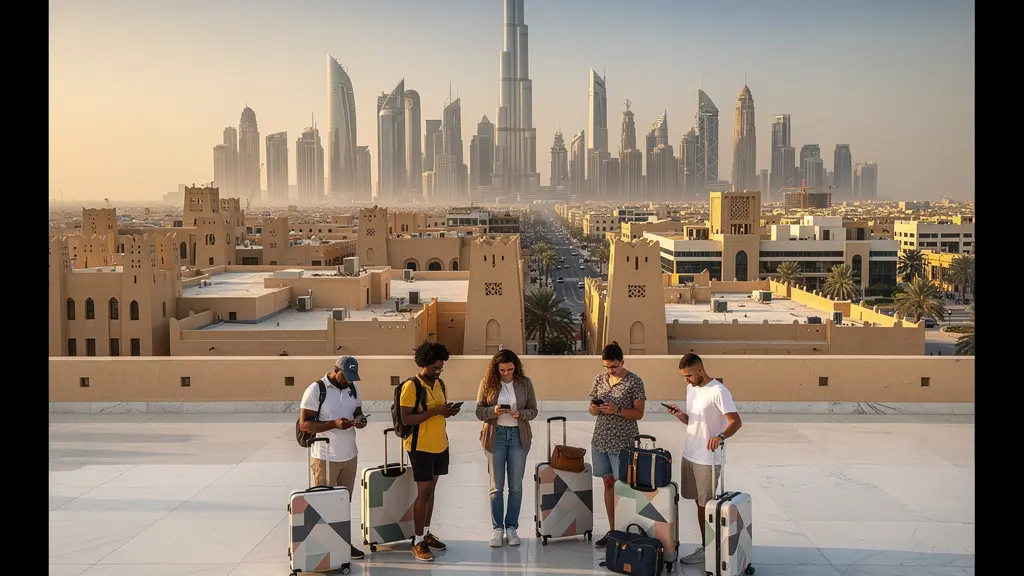
The key to mastering UAE travel isn’t just knowing holiday dates—it’s understanding the predictable logistical systems that govern them.
- Islamic holidays shift 10-11 days earlier each year, creating predictable seasonal patterns for long-term planning.
- Crowd flow and pricing follow predictable cycles, allowing strategic travelers to find value by booking against the rush.
Recommendation: Shift from reactively checking dates to proactively analyzing the calendar’s rhythm to unlock better prices, unique experiences, and smoother travel.
Planning a trip to the UAE can feel like trying to hit a moving target. You hear about incredible National Day fireworks or massive Eid sales, but the dates seem to float randomly across the year. Many travelers simply check a calendar, book their trip, and hope for the best, only to be met with unexpected “dry nights,” sold-out hotels, or flight prices that have tripled overnight. The common advice to “book in advance” is useless without knowing *what* you’re booking around.
The confusion stems from the interplay between the Gregorian calendar used for international travel and the Hijri (Islamic) lunar calendar, which dictates all religious holidays. But what if this perceived chaos is actually a highly predictable system? The secret isn’t in finding a definitive list of dates, but in decoding the underlying logic. The 10-day annual shift, the specific character of each holiday, and the resulting flow of residents and tourists all follow a predictable rhythm.
This guide moves beyond a simple holiday list. We will treat your travel planning like a logistical puzzle. You will learn to anticipate the calendar’s movement, understand the nuances between different celebrations, and identify strategic opportunities that most tourists miss. By the end, you will be equipped to navigate the UAE’s holiday landscape not as a confused visitor, but as a strategic planner, ready to capitalize on the unique rhythm of the country.
To help you master this strategic approach, we’ve broken down the key logistical challenges and opportunities into a clear roadmap. This guide will walk you through everything from the science of the shifting calendar to the art of a perfect event exit strategy.
Contents: A Logistical Guide to UAE Holiday Travel
- Why Do Holiday Dates Change by 10 Days Every Year?
- How to Know Which Days Will Be “Dry Nights” Before You Book?
- Eid Al Fitr or Eid Al Adha: Which Holiday Has Better Fireworks and Sales?
- The Booking Mistake That Triples Your Flight Cost During National Day
- 3-Day Weekend: How to Escape the City When Everyone Else Is Traveling?
- The Scheduling Mistake That Ruins 50% of Tourist Trips During Ramadan
- Coca-Cola Arena vs Etihad Park: How to Plan Your Exit Strategy?
- DSF Sales Strategy: How to Find Real Discounts vs Marketing Hype?
Why Do Holiday Dates Change by 10 Days Every Year?
The core of all holiday planning confusion in the UAE lies in a simple mathematical difference: the Islamic (Hijri) calendar is a lunar calendar of about 354 or 355 days, while the Gregorian calendar is a solar calendar of 365 days. This discrepancy is not random; it’s a predictable system. Every year, Islamic holidays like Ramadan, Eid Al Fitr, and Eid Al Adha shift backwards by approximately 10 to 11 days against the Gregorian calendar. This is the fundamental rule of predictive logistics for long-term UAE travel planning.
Understanding this “Rule of 10” transforms you from a reactive tourist into a proactive planner. You can forecast, with reasonable accuracy, which season a holiday will fall in two or three years from now. For example, a holiday occurring in the pleasant winter of one year will eventually cycle into the heat of summer. According to official guidelines, this systematic shift means that Islamic dates shift approximately 10-11 days earlier each year. This knowledge is crucial for planning weather-dependent activities like beach days or desert safaris far in advance.
For holidays dependent on the sighting of a new moon (like Eid), there’s often a one-day window of uncertainty. The expert strategy is to book flexible accommodation and, when booking flights, target the second of the two potential dates, as it has a higher probability of being the confirmed holiday. This simple tactic leverages the system’s slight ambiguity to your advantage, minimizing the risk of mistimed travel.
How to Know Which Days Will Be “Dry Nights” Before You Book?
A “dry night” in the UAE is a period, typically lasting 24 hours, when the sale of alcohol is prohibited in hotels, restaurants, and bars. These are declared for solemn religious occasions and can come as a major surprise to unprepared tourists envisioning a lively nightlife. However, like the calendar itself, the occurrence of dry nights follows a predictable pattern based on the nature of the holiday. They are not random. The system distinguishes between solemn observances and joyous celebrations.
Holidays marking somber events in Islamic history, such as the Prophet’s Ascension (Isra’a Wal Mi’raj) or Commemoration Day, will almost certainly include a dry night. In contrast, celebratory holidays like Eid Al Fitr, Eid Al Adha, and UAE National Day are periods of festivity where alcohol service is generally uninterrupted. The most significant period of restriction is the entire month of Ramadan, where alcohol is not served from sunrise to sunset, and entertainment is significantly toned down. This clear categorization allows for strategic scheduling to align your travel with your desired atmosphere.
The following table provides a clear probability index for planning purposes, turning a potential trip-ruining surprise into a manageable logistical factor.
| Holiday Type | Dry Night Probability | Restriction Timing | Alternative Activities |
|---|---|---|---|
| Religious Solemnity (Prophet’s Ascension, Commemoration) | 100% | Sunset day before to sunset day of | Cultural performances, shisha lounges |
| Celebratory Religious (Eid holidays) | 0% | No restrictions | Full entertainment options |
| National Celebrations (National Day) | 0% | No restrictions | Fireworks, concerts, full dining |
| Ramadan Period | 100% (entire month) | Dawn to sunset daily | Iftar experiences, late-night shopping |
Case Study: Ramadan 2026 Entertainment Adaptation Strategy
During the predicted Ramadan period of 2026 (February 18 – March 19/20), the hospitality sector won’t simply shut down; it will adapt. This adaptation is a core part of the system dynamics. High-end Dubai hotels will pivot to featuring special non-alcoholic mixology menus, transforming a restriction into a culinary showcase. Live music will be replaced by traditional Oud players and cultural performances. Shisha lounges will see their hours extended late into the night, and lavish Iftar buffets will become the primary evening social event. This strategic shift demonstrates how restrictions are systematically converted into opportunities for unique and memorable cultural experiences unavailable at other times of the year.
Eid Al Fitr or Eid Al Adha: Which Holiday Has Better Fireworks and Sales?
While both Eid holidays are major public celebrations, they offer distinctly different experiences for a traveler. Choosing between them depends entirely on your priorities: a high-energy, retail-focused trip or a more subdued, family-oriented cultural immersion. Eid Al Fitr, which marks the end of Ramadan, is a massive, energetic release. It’s characterized by a city-wide festive buzz, spectacular public firework displays, and the peak of fashion and gift-related retail sales.
In contrast, Eid Al Adha, the “Festival of Sacrifice,” is traditionally more family-centric and spiritual. While it still features celebrations and sales, the overall atmosphere is calmer. The shopping promotions often lean towards home goods and electronics rather than fashion. Fireworks are more localized and family-oriented. This distinction is a crucial piece of strategic scheduling; aligning your visit with the correct Eid is essential for matching your expectations.
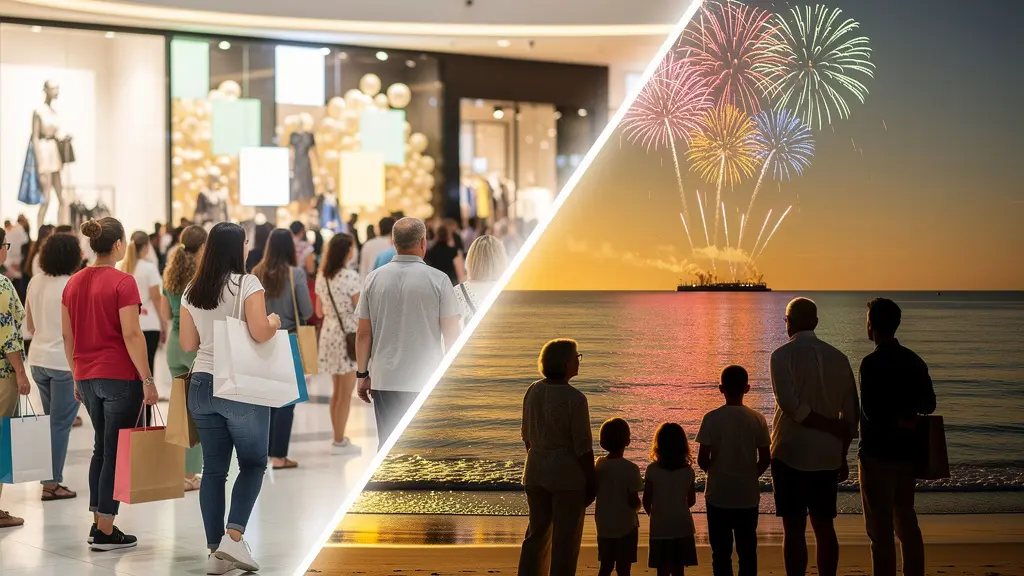
The choice also has logistical implications for travel. Eid Al Fitr sees a surge in regional travel as people visit family and friends across the GCC, impacting flight availability and prices. Eid Al Adha’s timing is linked to the Hajj pilgrimage, which can cause significant pricing and availability shifts on specific flight routes to and from Saudi Arabia. The following comparison breaks down the system dynamics of each holiday.
| Aspect | Eid Al Fitr (March 20-22, 2026) | Eid Al Adha (May 27-29, 2026) |
|---|---|---|
| Atmosphere | High-energy post-Ramadan celebration | Family-centric, more subdued |
| Shopping Focus | Fashion, gifts, mall events (50-70% discounts) | Home goods, electronics, staycation deals (40-60% discounts) |
| Fireworks Vibe | Massive public energy release at JBR, Dubai Festival City | Family-oriented displays, calmer crowds |
| Flight Impact | Regional travel surge | Linked to Hajj – affects specific routes to/from Saudi Arabia |
| Best For | Shoppers, party atmosphere seekers | Families, cultural immersion travelers |
The Booking Mistake That Triples Your Flight Cost During National Day
UAE National Day (December 2-3) is a fixed holiday, removing the guesswork of the lunar calendar. However, this predictability creates a different logistical challenge: a massive, synchronized rush of travelers. The single most common and costly mistake tourists and residents make is booking their return flight on the last official day of the holiday break. On this day, you are competing with virtually the entire population of the UAE and a significant portion of the GCC, all trying to fly home simultaneously. This predictable demand spike is a classic logistical bottleneck that airlines exploit with surge pricing, often tripling the cost of a standard fare.
The expert solution is a simple principle of crowd and cost arbitrage known as the “Shoulder Day Strategy.” By shifting your travel just one day off-peak, you can achieve dramatic savings. Flying back on the Saturday before the main rush or extending your trip to return on Monday morning can reduce your flight cost by 40-60%. This strategy involves a small trade-off in time for a massive financial benefit.
Another common error is arriving right before the holiday begins. The 1-2 days leading up to the break are the most expensive arrival window. A smarter approach is to book a mid-holiday arrival, landing when the initial travel frenzy has subsided. Because National Day’s dates are fixed, you have the advantage of being able to set fare alerts months in advance, allowing you to watch these price dynamics play out and book at the optimal moment.
3-Day Weekend: How to Escape the City When Everyone Else Is Traveling?
During any long weekend in the UAE, a predictable mass exodus occurs. The highways leading from major cities like Dubai and Abu Dhabi to popular escape destinations such as Hatta, Jebel Jais, and the Fujairah coast become heavily congested. This creates hours of traffic, crowded attractions, and a stressful start to what should be a relaxing break. The common approach is to join the herd, but the strategic traveler does the exact opposite.
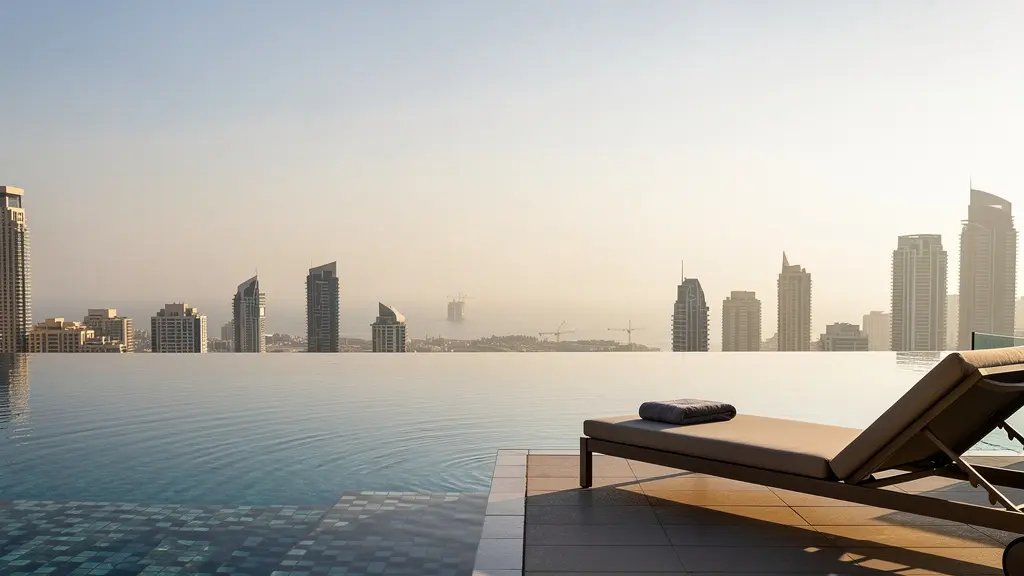
The most effective strategy is the “Reverse Commute,” a prime example of crowd and cost arbitrage. Instead of fleeing the city, you lean into the exodus. As residents leave, luxury city hotels drop their rates by as much as 40-60% to attract guests. This is your opportunity to enjoy a five-star staycation for a fraction of the price. You get to experience the city’s best attractions—malls, restaurants, beaches—in a uniquely tranquil state, free from the usual crowds. Reservations become easier to secure, and the city feels like your own private resort.
If you are set on leaving the city, avoid the main arteries and A-list destinations. Instead, target “second-tier” escapes. While everyone heads for the mountains, explore the serene mangroves of Umm Al Quwain, the fascinating Mleiha archaeological sites in inland Sharjah, or the quiet beaches of Ajman. These destinations see up to 70% less holiday traffic. Combine this with a strategic departure time—leaving Thursday noon by taking a half-day off, or waiting until the rush subsides on Friday morning—to completely bypass the logistical nightmare of holiday traffic.
The Scheduling Mistake That Ruins 50% of Tourist Trips During Ramadan
Visiting the UAE during the holy month of Ramadan offers a deeply unique cultural experience, but it requires a complete reversal of a typical tourist schedule. The most common mistake is planning a trip as you would any other time of year: active sightseeing in the afternoon followed by dinner and evening entertainment. During Ramadan, this approach is doomed to failure. Due to fasting from sunrise to sunset, the city’s energy and activity levels operate on an inverted schedule. Public life slows dramatically in the afternoon, with many shops and attractions operating on reduced hours.
Failing to account for this system dynamic is what ruins many trips. Tourists find themselves wandering through quiet streets in the afternoon heat with little to do, feeling the city is “closed.” Data shows that city-wide city activity levels during Ramadan show a 50% energy drop between 2-5pm. The key is to embrace the “Ramadan Reverse Schedule.” You must front-load your day, scheduling all high-energy activities like desert safaris, beach time, or walking tours for the early morning (7 am to 11 am), when the weather is cool and energy levels are highest.
The afternoon is for rest, pool time at your hotel, or visiting air-conditioned museums. After sunset, the city comes alive in its “second life.” This is the time for vibrant Iftar buffet experiences, late-night shopping (malls are often open until 1 or 2 am), and exploring the special cultural events set up for the month. Mastering this strategic scheduling is the single most important factor for a successful Ramadan visit.
Your Ramadan Strategic Scheduling Checklist
- Morning (7am-11am): Schedule all high-energy activities – desert safaris, walking tours, outdoor attractions.
- Afternoon (12pm-5pm): Plan for rest at the hotel, pool time, or indoor museums when city energy is lowest.
- Post-sunset (7pm onwards): Dedicate this time to experiencing the vibrant ‘second life’ with Iftars, late shopping, and cultural events.
- Pre-book Iftar Experiences: Major hotel Iftars are major social events and book out 3-5 days in advance; never expect walk-in availability.
- Avoid Taxi Dependency (6-7:30pm): This is the critical window when drivers are breaking their fast. Use the Metro or plan to arrive at your Iftar location well before 5:30pm.
Key Takeaways
- The “Rule of 10” is your fundamental tool: Islamic holidays move 10-11 days earlier each year, allowing for long-term seasonal prediction.
- Master crowd and cost arbitrage by traveling on “shoulder days” and considering “reverse commute” staycations to save significantly and avoid stress.
- Adapt your schedule to the specific holiday’s “personality”—a high-energy Eid, a solemn Ramadan, or a patriotic National Day—to match your travel expectations.
Coca-Cola Arena vs Etihad Park: How to Plan Your Exit Strategy?
Attending a major concert or event during a UAE holiday is a fantastic experience, but it comes with a significant logistical challenge: the mass exit. Thousands of people leaving a single venue at the same time creates a predictable bottleneck for taxis, ride-sharing services, and public transport. Planning your exit is as important as planning your arrival, and your strategy should be tailored to the venue’s specific infrastructure. The difference between a smooth departure and a 90-minute wait in a chaotic crowd comes down to understanding the venue’s logistical ecosystem.
Dubai’s Coca-Cola Arena and Abu Dhabi’s Etihad Park (on Yas Island) present two very different scenarios. The Coca-Cola Arena has a massive advantage with direct access to the Dubai Metro system. The fatal flaw is trying to get on the Metro or hail a taxi immediately after the event ends, along with 17,000 other people. The expert move is to wait. Spend 30-45 minutes at a nearby café in City Walk and let the initial surge dissipate before strolling to the Metro.
Etihad Park, by contrast, has no Metro access, making it entirely dependent on road transport. Here, waiting is the wrong strategy. You must be proactive. The optimal plan is to pre-book your ride-share service before the final song begins. As you walk towards the designated pickup area (often a short walk towards Yas Marina Circuit), your car will be en route, bypassing the long queues that form moments after the show ends. This concept of event exit velocity is about making a calculated move based on the venue’s unique constraints.
| Aspect | Coca-Cola Arena (Dubai) | Etihad Park (Abu Dhabi) |
|---|---|---|
| Public Transport | Direct Metro access (Burj Khalifa/Dubai Mall station) | No metro – taxi/ride-share only |
| Best Exit Strategy | Wait 30-45 min at nearby cafe, then take Metro | Pre-book ride before final song ends |
| Walk & Hail Zone | 15 min walk to Sheikh Zayed Road | Walk to Yas Marina Circuit entrance |
| Nearby Hotels (Walking) | Rove City Walk, Vida Downtown | W Abu Dhabi, Yas Hotel |
| Surge Pricing Window | 45-60 minutes post-event | 60-90 minutes post-event, as per observations from past events |
DSF Sales Strategy: How to Find Real Discounts vs Marketing Hype?
The Dubai Shopping Festival (DSF) is a world-renowned retail event, but for the strategic shopper, it’s a month-long exercise in separating genuine bargains from pure marketing hype. Not all discounts are created equal. The festival operates in predictable phases, and knowing this cycle is key to maximizing your savings. Simply showing up and expecting deals everywhere is a recipe for disappointment; you need a targeted approach.
The system dynamics of DSF can be broken into three phases. Phase 1 (the first week) is for new collection launches with moderate 25-30% discounts. This is the time to grab popular items before they sell out. Phase 2 (mid-festival) is often more about marketing than markdowns—focusing on raffles, brand activations, and entertainment. This is the period to skip for serious bargain hunting. Phase 3 (the final 10 days) is the main event for bargain hunters. This is when stores are desperate to clear stock, offering real 50-75% discounts, though sizes and availability will be limited. It has been reported that the DSF’s 30th anniversary mega sale offered up to 90% off on select items during flash sales.
To identify real deals, check the manufacturing dates on clothing tags. Genuine discounts are applied to current-season stock, whereas “hype” deals often involve old stock brought in specifically for the sale. Furthermore, downloading mall-specific apps like U by Emaar or Share can grant you access to exclusive flash sales, often providing an extra 10-20% on top of the already discounted prices. For the ultimate bargain, visit the outlet malls the week *after* DSF ends; this is where much of the unsold festival stock goes for a final, aggressive markdown.
By shifting your perspective from a passive tourist to a logistics-minded planner, you can navigate the UAE’s holiday calendar with confidence. Use these systemic insights to anticipate challenges, identify opportunities, and build a truly optimized and memorable travel experience.