
The immense prestige and cost of falconry in the UAE stem not just from tradition, but from treating it as a modern, high-stakes professional sport for elite avian athletes.
- A falcon’s value is determined by its performance lineage and the deep psychological bond of trust it forms with its handler, a process that can take weeks.
- A vast cultural infrastructure, including the world’s largest falcon hospital, supports these birds with cutting-edge medical care and technology.
Recommendation: To grasp the true essence of falconry, look beyond tourist shows and towards the events and institutions that reveal its modern sporting soul.
When an observer sees a falcon in the United Arab Emirates—perched majestically on a gloved fist or even traveling in a business class cabin—the first question is often about cost. Whispers of birds valued at hundreds of thousands of dollars circulate, immediately followed by the acknowledgment of its deep roots in Bedouin heritage. But to truly understand the sport of falconry, the national sport of the UAE, one must look past the simple equation of “tradition equals value.” The reverence for this bird of prey is not a relic of the past; it is a living, breathing testament to a culture that blends profound respect for history with a relentless drive for modern excellence.
The common understanding is that falconry is a preserved piece of history, a link to a time when Bedouins relied on these raptors for hunting in the harsh desert. While true, this only scratches the surface. The modern falcon is less a hunting tool and more a high-performance avian athlete. Its price tag is not arbitrary; it is a reflection of its pedigree, its training, and its potential to win in fiercely competitive, high-stakes races. The prestige associated with falconry today is built upon an entire ecosystem of specialized science, technology, and a unique “trust economy” between man and bird.
This guide delves into the “why” behind the prestige. We will explore the intricate process of building trust, the state-of-the-art infrastructure that keeps these athletes in peak condition, and the modern face of competition. By understanding these components, you will see falconry not as a static tradition, but as a dynamic and sophisticated national passion.
To fully appreciate the layers of this cultural phenomenon, this article explores the complete world of Emirati falconry, from the foundational bond with the bird to the authentic ways you can witness its legacy. The following sections break down each crucial aspect.
Summary: Understanding Falconry: Why Is It So Expensive and Prestigious in the UAE?
- Why Does It Take Weeks to Train a Falcon to Trust Its Handler?
- How to Tour the Abu Dhabi Falcon Hospital and What Will You Learn?
- Drone Training or Live Prey: Which Method Is Used for Modern Falcon Races?
- The Legal Mistake of Trying to Buy Falcon Paraphernalia to Take Home
- When Does the President’s Cup for Falconry Take Place?
- Why Has the Arabian Oryx Population Bounced Back from Extinction?
- Private Farm Visit or Mega-Camp: Which Offers Real Insight into Bedouin History?
- How to Experience Authentic Bedouin Life Without Falling for Tourist Traps?
Why Does It Take Weeks to Train a Falcon to Trust Its Handler?
The foundation of a falcon’s immense value is not its speed or strength alone, but the intangible bond it shares with its falconer. This is not a simple master-pet dynamic; it is a profound partnership built on a “trust economy” where patience and respect are the core currency. A wild falcon is an independent predator. To convince it to willingly return to a handler’s glove requires a delicate psychological process of habituation and positive reinforcement that cannot be rushed. The initial phase is known as ‘manning,’ where the falconer keeps the bird with them constantly, getting it accustomed to human presence, sounds, and movements.
This period is critical for breaking down the bird’s natural fear. The falcon is often hooded with a ‘burqa’ to keep it calm, and the handler speaks to it softly, stroking its chest until it accepts their touch. Only then does training to the lure (a tool used to recall the bird) begin. This intensive process creates a cooperative athlete, not a captive. According to one championship falconer, Rashid Al Ketbi, building this fundamental relationship is paramount. In an interview, he explained the non-negotiable nature of this bond.
If you don’t establish a bond with your bird, it will not succeed, it took me a week to teach him to respond when I call him, it takes some people up to three weeks
– Rashid Al Ketbi, Khaleej Times interview with championship falconer
This statement highlights the variability and personal nature of the training. An analysis of falconry championships confirms that for some, it takes up to three weeks just to teach a falcon to respond when called. This initial investment in trust is what transforms a wild bird into a champion capable of competing at the highest level, forming the very bedrock of its prestige and monetary value.
How to Tour the Abu Dhabi Falcon Hospital and What Will You Learn?
The concept of the “avian athlete” is nowhere more evident than at the Abu Dhabi Falcon Hospital (ADFH). This world-renowned institution is a cornerstone of the modern cultural infrastructure supporting falconry in the UAE. It’s not just a veterinary clinic; it’s a state-of-the-art facility dedicated to the health, welfare, and performance of these prized birds. A visit here offers unparalleled insight into the seriousness with which falconry is treated. The sheer scale of the operation is staggering; as the world’s largest and leading falcon hospital, it provides care for thousands of birds annually.
A guided tour of the ADFH is a must for anyone curious about the sport. It demystifies the world of falconry and showcases the fusion of tradition and technology. As you walk through the pristine facilities, you witness the incredible level of care these birds receive. The facility sees about 6,000 birds passing through its doors each year for everything from routine check-ups to complex surgeries.
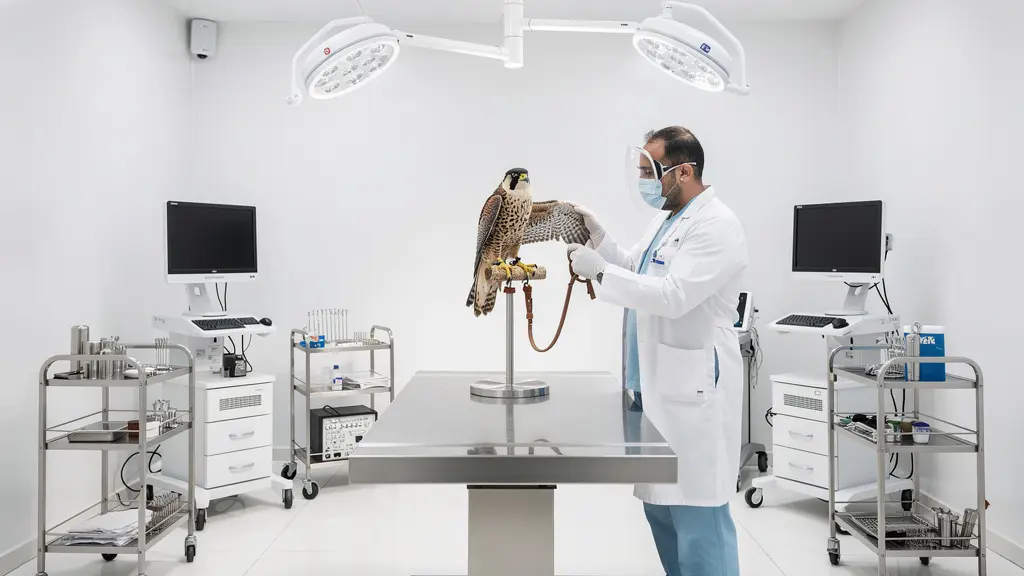
The tour experience is highly structured to be educational. It typically includes a visit to the on-site museum, which details the history of falconry, and an observation of routine medical procedures like a pedicure or feather repair in the examination room. You may also see the large, free-flight aviary where falcons are rehabilitated. One of the highlights for many visitors is the opportunity to handle a falcon, feeling its light weight and powerful grip on your gloved arm under the careful supervision of staff. This tangible connection makes the abstract concept of the falcon’s value deeply personal.
Drone Training or Live Prey: Which Method Is Used for Modern Falcon Races?
The evolution of falconry in the UAE perfectly encapsulates the nation’s identity: a deep respect for the past combined with an ambitious embrace of the future. This “hybrid tradition” is most visible in modern training methods. Historically, falcons were trained using live prey, like the Houbara bustard. However, due to conservation efforts and the standardization required for modern racing, training techniques have dramatically shifted. Today, technology plays a leading role in honing a falcon’s skills.
The primary tool for training is no longer live prey but sophisticated, remote-controlled devices. Falconers now use specially designed drones and model airplanes that mimic the erratic flight patterns of prey. This method offers several advantages: it is consistent, controllable, and allows falconers to precisely measure a bird’s speed, altitude, and response time. It turns training into a data-driven science, allowing for the fine-tuning of an avian athlete’s performance. Championship falconer Rashid Al Ketbi notes this shift, stating, “Now we use drones or plane dummies to mimic a flying prey to train our falcons to chase it.”
However, tradition is not entirely abandoned. While drones are used for daily conditioning and building speed, actual competitions often employ a different method to ensure fairness and excitement. Events like the Al Dhafra Festival use a lure called a ’tilwa’—often a bundle of feathers or a taxidermied pigeon wing—swung on a rope and pulled at high speed across the racecourse. This creates a standardized target for all competitors, ensuring the race is a true test of the falcons’ speed and training over a set 400-meter distance, rather than their hunting instinct. This blend of high-tech preparation and traditional competition format is the hallmark of modern Emirati falconry.
The Legal Mistake of Trying to Buy Falcon Paraphernalia to Take Home
As a visitor captivated by the majesty of falconry, it’s natural to want to bring a piece of this culture home. Souks and heritage villages are filled with beautiful, handcrafted falconry equipment, from leather hoods (burqas) to ornate jesses (tethers). However, purchasing these items without understanding the law can lead to a serious and costly mistake. Many falcon-related items fall under international and local regulations designed to protect endangered species and preserve cultural heritage.
The key regulation to be aware of is CITES (the Convention on International Trade in Endangered Species of Wild Fauna and Flora). Many falcon species are listed under CITES, which means that any part of the bird—including feathers—is strictly controlled. An authentic feather found in a souk could be from a protected species, making its export illegal without complex permits. Furthermore, distinguishing between a mass-produced tourist souvenir and an authentic, handmade artifact used by a real falconer can be difficult. The latter may be considered a restricted cultural artifact.
To avoid any issues with customs, it is crucial to be a discerning and informed buyer. Opt for souvenirs that are clearly reproductions or artistic interpretations rather than functional equipment. Photography books, high-quality art prints depicting falcons, or even traditional spices and perfumes from the region are wonderful, legal alternatives that still evoke the spirit of the desert. If you are ever in doubt, the safest course of action is to inquire with the official UAE customs authorities before making a purchase. Keeping receipts is also a good practice to prove an item is a modern reproduction.
Your Checklist for Buying Falcon-Themed Souvenirs Legally
- Understand CITES regulations: Be aware that feathers and items from certain species are internationally regulated.
- Distinguish authentic from tourist items: Recognize that handmade traditional items could be restricted cultural artifacts.
- Choose legal alternatives: Opt for photography books, locally made art depicting falcons, or other traditional goods.
- Verify with authorities: When in doubt, always check with UAE customs before purchasing any questionable item.
- Document purchases: Keep all receipts for falcon-themed items to prove they are reproductions if questioned.
When Does the President’s Cup for Falconry Take Place?
The culmination of a year’s worth of dedicated training, investment, and passion is showcased at the President’s Cup for Falconry. This is not just a competition; it is the premier event on the UAE’s sporting calendar, a spectacle of speed, skill, and national pride. Established in 2013, this prestigious event typically runs from December through January, drawing thousands of competitors and spectators to the Al Falah racecourse in Abu Dhabi. It represents the pinnacle of the sport, where the country’s best avian athletes and their handlers vie for multi-million dirham prizes and, more importantly, immense prestige.
The competition is a highly organized affair, featuring multiple categories of races based on the falcon’s species (like the Peregrine and Saker) and ownership. Falcons compete individually, chasing a lure over a 400-meter track at breathtaking speeds, often exceeding 100 km/h. Their times are measured with high-tech laser systems, leaving no room for error. The atmosphere is electric, blending the quiet intensity of the falconers with the roar of the crowd.
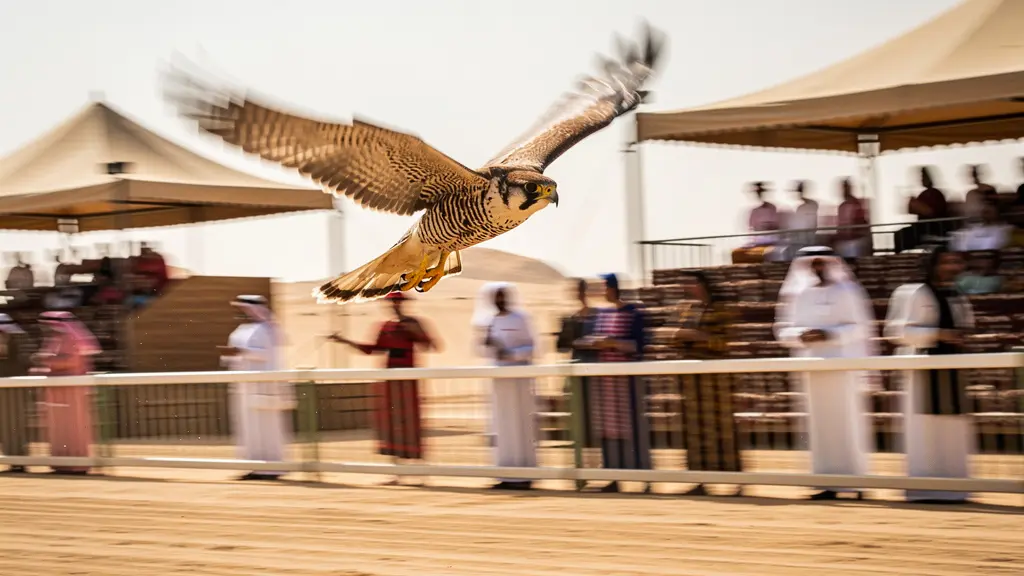
What makes the President’s Cup particularly significant is its role in evolving the tradition. In a historic move, the 2024 competition reserved a specific afternoon of races exclusively for female falconers, signaling the opening of this traditionally male-dominated sport to a new generation of enthusiasts. This inclusivity, combined with the technological precision of the races and the massive prize pools, solidifies the President’s Cup as a world-class sporting event and a vibrant expression of modern Emirati identity. Witnessing it is to understand the very heart of why falconry is held in such high esteem.
Why Has the Arabian Oryx Population Bounced Back from Extinction?
The deep-seated passion for preserving the falcon is not an isolated phenomenon. It is part of a much broader and deeply ingrained national ethos of conservation in the UAE. The most powerful symbol of this commitment is the remarkable comeback of the Arabian Oryx. This elegant white antelope, with its long, straight horns, was once widespread across the Arabian Peninsula but was hunted to the brink of extinction. By 1972, the Arabian Oryx was declared Extinct in the Wild.
The species’ survival is a direct result of the foresight and dedication of the UAE’s late founder, Sheikh Zayed bin Sultan Al Nahyan. In the 1960s, he initiated a captive-breeding program, gathering the few remaining individuals to protect them on Sir Bani Yas Island. This program became one of the world’s most successful conservation stories. Through careful management, genetic diversification, and eventual reintroduction programs, the population grew steadily. The success was so profound that it achieved a global milestone.
As The National News reported, the conservation efforts led to a historic reclassification. This achievement is a source of immense national pride and serves as a powerful context for understanding the cultural value placed on native species.
The Arabian oryx became the first animal to revert to vulnerable status after previously being listed as extinct in the wild
– The National News, UAE Conservation Success Story Report
This success story with the Oryx demonstrates that the reverence for the falcon is part of a holistic vision to protect and celebrate the nation’s natural heritage. Both animals are powerful symbols of the desert’s soul, and the effort to preserve them is a core tenet of modern Emirati identity, connecting the past with a sustainable future.
Private Farm Visit or Mega-Camp: Which Offers Real Insight into Bedouin History?
For tourists eager to experience falconry, the UAE offers a spectrum of options, ranging from massive desert safari camps to intimate, private encounters. Choosing the right one is crucial for gaining genuine insight versus merely consuming a scripted performance. The mega-camps, often catering to hundreds of tourists a night, provide a polished, theme-park version of Bedouin culture. Here, the falconry “experience” is typically a brief, five-minute photo opportunity with a bird handled by a resort employee.
While entertaining, these mega-camps lack the depth and authenticity of a private visit. True insight into Bedouin history and the soul of falconry is found in smaller, more personal settings. Seeking out experiences run by actual Emirati families who are passionate practitioners of the sport offers a completely different perspective. These visits often take place on a private farm or in a traditional ‘majlis’ setting, where culture is shared through conversation, not performance. Here, you can have a genuine discussion with a falconer, hear personal stories passed down through generations, and observe the quiet, daily rituals of caring for a bird.
The difference lies in authenticity and human connection. A private visit allows you to witness the passion firsthand, while the mega-camp offers a standardized product. The following table breaks down the key differences, drawing from a comparative analysis of cultural tourism experiences.
| Aspect | Private Farm | Mega-Camp |
|---|---|---|
| Falconry Experience | Genuine conversation with passionate falconers | 5-minute photo opportunity |
| Cultural Authenticity | Personal stories and demonstrations | Scripted performances |
| Group Size | Intimate, small groups | Hundreds of tourists |
| Host Background | Actual Emirati falconers/families | Resort employees |
| Cultural Exchange | Arabic coffee ritual and majlis discussions | Scheduled entertainment |
For a visitor seeking to understand the prestige of falconry, the choice is clear. The mega-camp shows you a bird, but the private farm introduces you to the falconer and their world, offering a far more memorable and meaningful connection to the heritage.
Key Takeaways
- Falconry’s prestige comes from its status as a modern, high-stakes sport for elite “avian athletes,” not just its history.
- The value of a falcon is forged through a deep, trust-based psychological bond with its handler and supported by a vast, high-tech “cultural infrastructure.”
- Authentic cultural insight is found in intimate encounters with practicing falconers, not in large-scale tourist performances.
How to Experience Authentic Bedouin Life Without Falling for Tourist Traps?
Experiencing authentic Bedouin culture, with falconry at its heart, requires looking beyond the polished veneer of mass tourism. The key is to seek out experiences centered on genuine connection rather than passive entertainment. Instead of looking for the most “Instagrammable” desert safari, focus on opportunities that connect you with the people who are the living custodians of this heritage. This means prioritizing experiences run by Emirati families who are actual practitioners of falconry or camel breeding, as their passion and knowledge are the real attraction.
An invitation to a ‘majlis’—a traditional space for community gathering and conversation—is a sign of a truly authentic experience. It is here, over cups of Arabic coffee, that culture is shared through storytelling, not scripted performances. Focus on the “un-Instagrammable” moments: watching a falconer meticulously tend to his bird’s feathers, listening to stories of a prized camel’s lineage, or learning about the symbiotic relationship between the three core elements of Bedouin life: the camel (for transport), the falcon (for hunting), and the Saluki dog (for companionship).
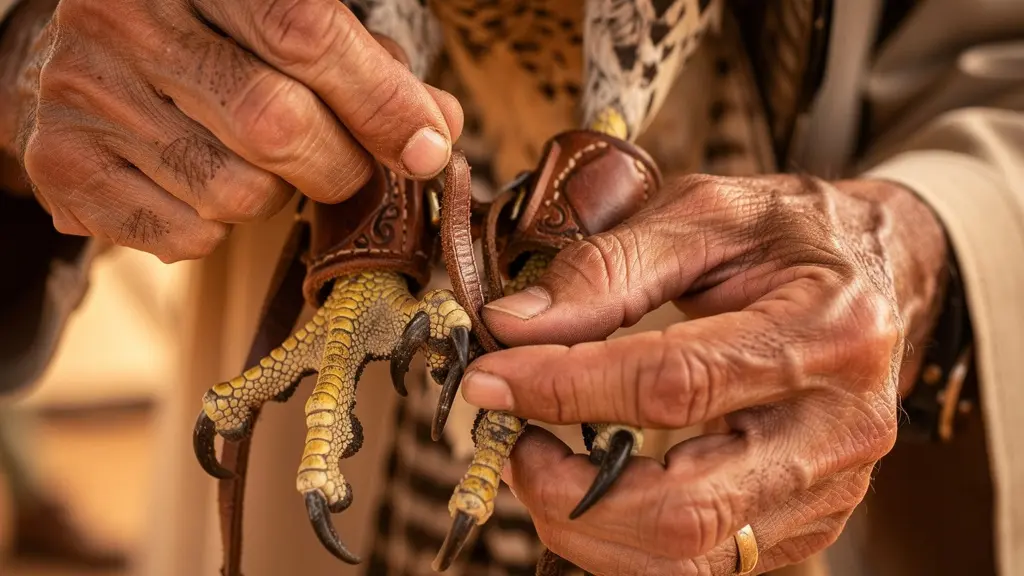
Even larger resorts can offer pockets of authenticity. For example, some high-end desert resorts like Qasr Al Sarab collaborate with local experts to provide genuine falconry demonstrations that go beyond a simple photo op. The ultimate goal is to shift your mindset from being a spectator to being a respectful guest. By doing so, you move past the tourist traps and get a glimpse into the true soul of the desert, where the bond between humans and animals tells a story far richer than any scripted show ever could.
Ultimately, to appreciate the prestige of falconry is to appreciate the modern UAE itself. By seeking out these authentic connections, you not only gain a deeper understanding of a sport but also of a nation that holds its heritage in one hand and its future in the other.
Frequently Asked Questions about Falconry in the UAE
What is the national bird of the UAE?
The Falcon is the national bird of the United Arab Emirates. It is a potent symbol of courage, heritage, and the nation’s Bedouin roots, which is why it is featured on the country’s emblem and currency.
How much does a falcon cost in the UAE?
The price of a falcon can vary dramatically, from a few thousand dollars to well over a hundred thousand, and sometimes into the millions for a proven champion. The cost depends on its species (Saker and Peregrine are highly valued), its “performance lineage” or pedigree, its age, and the level of its training.
Can tourists participate in falconry in the UAE?
While tourists cannot own or train falcons, many operators offer “falconry experiences.” For a genuine insight, it is best to choose experiences run by Emirati families or specialized centers that focus on education and conversation, rather than large desert safari camps where it is often just a quick photo opportunity.