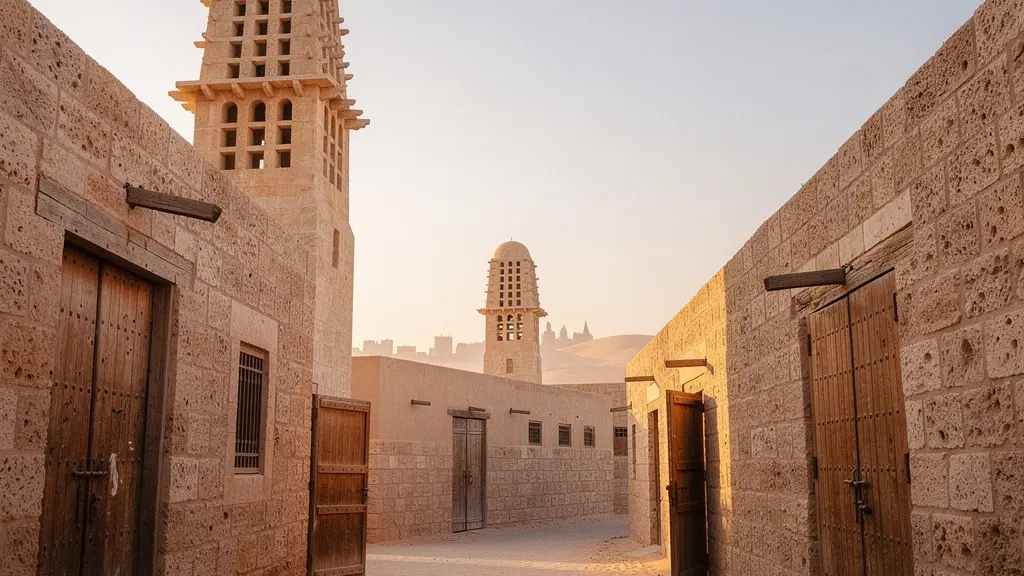
The true value of Sharjah’s Heritage Area lies not in its “authenticity,” but in its status as a meticulously curated, state-funded preservation project—an intellectual counterpoint to Dubai’s commercialized history.
- Sharjah’s restoration is academically driven, using original materials and archaeological methods, unlike the more organic, commercially-focused evolution of districts like Al Fahidi.
- A successful visit requires a narrative approach, understanding the story behind each museum and the deliberate contrasts in engineering and architecture across the Emirates.
Recommendation: Approach your day trip not as a tourist ticking off sights, but as a curator, decoding the philosophy of cultural preservation that earned Sharjah its esteemed title.
For the discerning traveler, the glittering skylines of the UAE can sometimes feel like a façade, a dazzling display of modernity that overshadows a deeper, more complex history. Many visitors, particularly those with a passion for culture, leave Dubai with a sense of having seen much but understood little. The common advice is to seek “authenticity” in neighboring Sharjah, but this recommendation often lacks a crucial framework. A trip to Sharjah is not merely about seeing older buildings; it is about engaging with a fundamentally different philosophy of culture and heritage. It’s an opportunity to witness the result of a conscious, decades-long effort to preserve, catalog, and present a national identity with academic rigor.
While other heritage sites in the region have evolved into bustling commercial hubs, Sharjah has pursued a path of deliberate cultural curation. This guide moves beyond the simple lists of museums and souqs. It offers an intellectual framework for your visit, treating the Heritage Area as a living exhibit of preservation strategy. We will explore the very reason for its UNESCO designation, provide a narrative-driven itinerary to maximize your time, and draw critical comparisons with other historical sites like Dubai’s Al Fahidi and the forts of Al Ain. By understanding the *why* behind Sharjah’s restoration, you transform a simple day trip into a profound cultural pilgrimage, appreciating not just the artifacts on display, but the very act of their conservation as a statement of national pride.
This article provides a structured approach to understanding the depth of Sharjah’s cultural project. We will delve into the strategic decisions that shaped the emirate, the practicalities of a meaningful visit, and the crucial contrasts that highlight its unique position in the UAE.
Summary: Decoding Sharjah’s Legacy as the Cultural Heart of the Emirates
- Why Has Sharjah Been Named the Cultural Capital of the Arab World?
- How to Visit 5 Sharjah Museums in One Day Using the Joint Ticket?
- Heart of Sharjah or Al Fahidi: Which Heritage District Feels More Authentic?
- The Scheduling Error That Leaves Tourists Stranded in Sharjah on Friday Mornings
- What Is the Best Route to Connect the Calligraphy Museum and Souq Al Arsah?
- How to Trace the Falaj Water Channels Through the Al Ain Oasis?
- Shindagha Museum or Sharjah Maritime: Which Tells the Better Sea Story?
- Exploring Al Ain Forts: Which Citadels Are Worth the Drive from Dubai?
Why Has Sharjah Been Named the Cultural Capital of the Arab World?
The title “Cultural Capital of the Arab World,” bestowed by UNESCO in 1998, is not a mere honorific; it is the recognition of a deliberate and long-term state policy. Unlike the organic, often commercially-driven development seen elsewhere, Sharjah’s cultural identity is the result of a top-down, academically-grounded vision. This strategy is manifest in the sheer density and quality of its institutions. Since the designation, the emirate has grown to include a network where UNESCO recognized Sharjah as the Cultural Capital of the Arab World, with over 21 museums now operating. This commitment goes beyond numbers, focusing on a meticulous preservation philosophy.
The most powerful testament to this is the Heart of Sharjah project. This initiative is not a simple renovation but the largest heritage restoration in the entire Gulf region, spanning 35,000 square meters. The goal is to return the old town to its 1950s appearance by 2025, using original materials like coral stone and gypsum. Archaeological discoveries made during the work are not paved over but integrated into the final presentation, turning the entire district into a living museum. As Khalid Jasim Al Midfa, Chairman of Sharjah’s Commerce and Tourism Development Authority, stated, this reflects a clear strategy:
We have a lot of strategic objectives to promote Sharjah as a cultural destination suited to all age groups
– Khalid Jasim Al Midfa, Chairman of Sharjah’s Commerce and Tourism Development Authority
This approach—valuing archaeological accuracy and educational depth over commercial appeal—is the core reason for Sharjah’s celebrated status. The capital is not just a place with culture; it is a place that has actively curated and defended its heritage as a matter of public policy.
How to Visit 5 Sharjah Museums in One Day Using the Joint Ticket?
To truly appreciate the interconnected narrative of Sharjah’s heritage, a scattergun approach is inefficient. A curated itinerary allows the story of the emirate to unfold chronologically and thematically. The most effective tool for this is the Heritage Joint Ticket, which for a modest AED 20 for adults offers access to five key institutions within the Heart of Sharjah. This isn’t just a cost-saving measure; it is an invitation to follow a specific historical path. By structuring your day correctly, you can trace the evolution of Sharjah from a coastal settlement to a center of political and artistic power.
Rather than simply wandering between locations, consider this narrative-driven approach:
- 8:00 AM – Sharjah Maritime Museum: Begin at the coast to understand the foundation of Sharjah’s existence—the sea. Explore the pearling and dhow culture that shaped its economy and worldview.
- 9:45 AM – Souq Al Arsah: After understanding the goods (pearls, fish), experience the place of trade. This short walk through one of the oldest souqs connects the maritime story to the commercial one.
- 10:30 AM – Sharjah Heritage Museum: With the context of sea and trade established, delve into the daily life of the Emirati people. This museum provides a comprehensive overview of customs, rituals, and social structures.
- 1:30 PM – Al Hisn Fort: From the people, turn to their rulers. The fort represents the center of defense and political power, showing how the community was governed and protected.
- 2:30 PM – Calligraphy Museum: Conclude your journey by exploring the soul of the culture—its art and intellect. This museum showcases the highest form of Islamic artistic expression, representing the pinnacle of the civilization you’ve just explored.
This path transforms a museum crawl into a coherent story, where each stop builds upon the last. The arrangement of the museums is no accident; they are designed to be experienced as a unified cultural tapestry.

This symbolic representation of interconnected keys reflects the unity of the museum experience. Each institution is a key that unlocks a different chapter of Sharjah’s history, but only together do they reveal the full picture. This approach ensures you leave with a deep, layered understanding rather than a fragmented collection of facts.
Heart of Sharjah or Al Fahidi: Which Heritage District Feels More Authentic?
The term “authentic” is often used to describe both Sharjah’s Heart and Dubai’s Al Fahidi Historical Neighbourhood, but it means very different things in each context. To the history buff, authenticity is found in methodological rigor and historical accuracy. In this regard, Sharjah’s approach is fundamentally different and, for the purist, more deeply satisfying. While Al Fahidi has evolved into a vibrant, charming district of cafes, art galleries, and boutique hotels, its restoration has been more organic and commercially influenced. Heart of Sharjah, by contrast, is a state-funded archaeological preservation project.
The restoration of Al Hisn Fort, which began in 1996, set the precedent. Sheikh Sultan bin Muhammad Al Qasimi personally oversaw the project, ensuring that the original foundations were used and that traditional coral stone construction methods were faithfully replicated. This academic, museum-quality approach to reconstruction defines the entire district. It is less a tourist-centric space and more a life-sized, historically accurate diorama of 1950s life. The atmosphere is therefore more contemplative and educational, as opposed to the bustling, social ambiance of Al Fahidi.
The following comparison clarifies the distinct philosophies and experiences offered by each district, as detailed in an analysis of the restoration project.
| Aspect | Heart of Sharjah | Al Fahidi (Dubai) |
|---|---|---|
| Restoration Philosophy | State-funded archaeological preservation | Organic commercial evolution |
| Size | 35,000 square meters | Approx 15,000 square meters |
| Primary Focus | Museum-quality preservation | Active cafes and galleries |
| Visitor Atmosphere | Contemplative, educational | Bustling, tourist-heavy |
| Architectural Authenticity | Original materials (coral stone, gypsum) | Mixed restoration approaches |
| Best For | History buffs seeking depth | Casual cultural exploration |
Ultimately, the choice depends on the visitor’s goal. For a pleasant afternoon of cultural browsing and coffee, Al Fahidi is excellent. But for the traveler seeking to understand the deep-seated principles of historical preservation and see architectural honesty in practice, the Heart of Sharjah offers an unparalleled and more intellectually rigorous experience.
The Scheduling Error That Leaves Tourists Stranded in Sharjah on Friday Mornings
One of the most common and frustrating mistakes for visitors is arriving in the Sharjah Heritage Area on a Friday morning, expecting to tour the museums. Due to Jumu’ah (Friday prayer), a central observance in Islamic life, the cultural institutions operate on a different schedule. In Sharjah, Sharjah museums observe special Friday hours, with doors only opening from 4:00 PM to 8:00 PM. Unaware tourists often find themselves stranded in a beautiful but largely closed district, wasting precious hours of their day trip.
However, for the prepared traveler, this “problem” can be transformed into a unique opportunity to witness a side of local life that most tourists miss. Instead of seeing the morning as a write-off, it can be repurposed into an alternative heritage walk that focuses on atmosphere, architecture, and authentic daily routines. The quiet streets offer a chance for undisturbed photography, and the public spaces reveal a different rhythm of life. This requires a shift in mindset from a consumer of museum exhibits to an observer of living culture.
A well-planned Friday morning can still be deeply rewarding. The key is to embrace the closures and build an itinerary around them, culminating in the museum visits once they open in the afternoon.
Your Action Plan: The Friday Morning Alternative Itinerary
- Experience Local Commerce: Start at 9:00 AM by visiting the Souq Al Jubail fish market. Witnessing the vibrant, authentic trade offers a powerful slice of local life that no museum can replicate.
- Conduct an Architectural Tour: Use the quiet morning (10:00 AM) for an exterior photography tour. Focus on the intricate details of the closed museums, such as the iconic wind towers and the texture of the coral stone walls, without crowds.
- Explore Public Spaces: At 11:00 AM, wander through the open courtyards and public squares within the Heritage Area, observing the quiet flow of life before the midday prayer.
- Observe Cultural Rhythms: Around noon, find a respectful distance from a local mosque to experience the unique atmosphere of the call to Jumu’ah prayer, a profoundly important moment in the weekly cycle.
- Begin Your Museum Tour: Have a traditional lunch and be ready for when the museums reopen at 4:00 PM, allowing you a full evening of exploration until 8:00 PM.
By following this plan, you turn a potential scheduling disaster into a deeper, more observational cultural experience, gaining insights that are unavailable during regular opening hours.
What Is the Best Route to Connect the Calligraphy Museum and Souq Al Arsah?
The journey between the Sharjah Calligraphy Museum and the historic Souq Al Arsah is more than just a short walk; it is a sensory immersion into the very fabric of the Heritage Area. The “best” route is not necessarily the fastest, but the one that allows you to fully appreciate the architectural and atmospheric details that define this district. This path, a mere few hundred meters, is a perfect microcosm of the entire preservation project. The alleyways are intentionally narrow, the walls are built from textured coral stone, and the play of light and shadow creates a contemplative mood that feels worlds away from the urban sprawl nearby.
To truly experience it, one must walk slowly. Starting from the Calligraphy Museum, instead of heading directly to the main thoroughfare, seek out the smaller, shaded sikkas (alleyways). Here, the experience becomes tactile and auditory. You can run your hand along the rough, fossil-studded coral walls, materials wrested from the sea itself. The sound of your footsteps on the sandy ground is often the only sound, creating a silence that is profound. This walkability is a core design feature of the district, encouraging personal discovery.
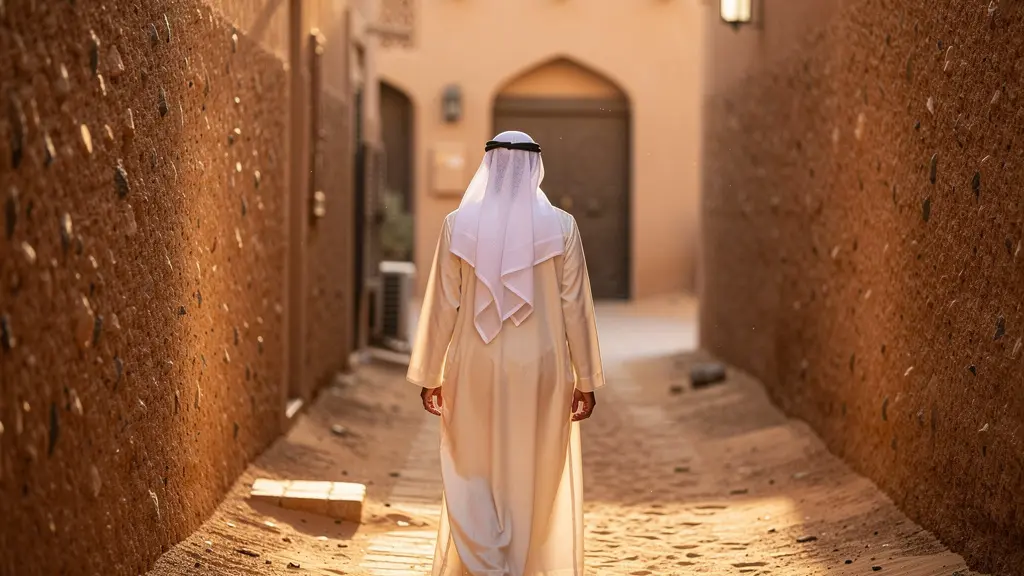
As you approach Souq Al Arsah, the sensory landscape changes. The silence gives way to the distant murmur of commerce, and the faint scent of frankincense and spices from the shops begins to permeate the air. This gradual transition from the quiet artistic contemplation of the Calligraphy Museum to the gentle bustle of a traditional market is a beautifully orchestrated experience. The route is the destination. It’s a moment to disconnect from the map on your phone and connect with the physicality of history, following the path as it was intended to be walked for generations.
How to Trace the Falaj Water Channels Through the Al Ain Oasis?
To fully grasp the ingenuity of Emirati heritage, it is essential to look beyond Sharjah’s coastal environment and understand the challenges of the interior. A visit to the Al Ain Oasis offers a perfect counterpoint, revealing a different but equally brilliant system of survival: the falaj. This ancient irrigation network, a UNESCO World Heritage site in its own right, represents 3,000 years of continuous use and demonstrates a profound understanding of hydraulic engineering. Unlike Sharjah’s reliance on wells to tap into the water table, the falaj system uses gravity-fed channels to bring water from distant mountains, a marvel of ancient engineering.
Tracing these water channels is an exercise in historical detective work. The system, which irrigates over 3,000 acres of date palm groves, was built with precise slope calculations of 0.5-2%, achieved without any modern instruments. By walking through the oasis, you can identify the key components of this system:
- Main Aflaj Channels: Look for the primary, concrete-lined channels, typically 50-80cm wide, that serve as the main arteries of the oasis.
- Distribution Points: Spot the critical Y-shaped junctions where water is diverted from the main channel into smaller streams to feed different family-owned palm groves.
- Ancient Markers: Notice the traditional stone markers used to indicate water rights and time-based allocation, a sophisticated system of resource management.
- Architectural Contrast: Most importantly, actively compare this open-channel, gravity-fed system with the well-and-bucket methods that would have been used in coastal Sharjah, understanding how geography dictated technology.
This exploration provides a crucial piece of context. It shows that there was no single “Emirati” way of life, but a series of brilliant, environment-specific adaptations. Understanding Al Ain’s falaj system enriches your appreciation for Sharjah’s coastal heritage by highlighting the different problems each community had to solve.
Shindagha Museum or Sharjah Maritime: Which Tells the Better Sea Story?
Both Sharjah and Dubai tell the story of the sea, but they do so in vastly different languages. The Sharjah Maritime Museum and Dubai’s Shindagha Museum (specifically, its “Perfume House” and “Crossroads of Civilization” sections) offer contrasting narrative philosophies that reflect the broader identities of their respective emirates. For the history buff seeking a tangible connection to the past, Sharjah offers a more direct and unmediated experience.
The Sharjah Maritime Museum focuses on the local, Al Qasimi-led traditions of pearling and fishing. Its strength lies in its collection of physical artifacts and, most importantly, its connection to the adjacent dhow harbor. Here, you can see working wooden boats, smell the tar and salt, and witness a living tradition. The experience is hands-on and grounded in the material culture of the profession. In contrast, Shindagha Museum employs a high-tech, multimedia approach. It tells a grander, more global story of Dubai’s role in international trade routes, using immersive digital displays and interactive exhibits. It is a sleek, impressive, and highly produced experience.
A cultural observer, in an analysis for Wonderful Museums, noted that “Sharjah chose a path of deep cultural investment rather than tourism-driven mega-projects,” a sentiment perfectly captured by this comparison.

This table summarizes the core differences for a history-focused visitor:
| Aspect | Sharjah Maritime Museum | Shindagha Museum (Dubai) |
|---|---|---|
| Narrative Focus | Al Qasimi pearling & fishing traditions | Global trade routes & perfume trade |
| Display Style | Traditional artifacts & physical dhows | High-tech multimedia experiences |
| Unique Feature | Working dhows moored in adjacent creek | Interactive Crossroads of Civilization |
| Best For | Hands-on maritime heritage | Tech-savvy historical exploration |
| Time Needed | 60-90 minutes | 2-3 hours |
| Authenticity Factor | Direct connection to working boats | Immersive digital reconstructions |
The choice is one of narrative scale and sensory preference. Shindagha tells a polished, global story through a digital lens. Sharjah tells a local, textural story through physical artifacts and a living connection to the sea itself.
Key Takeaways
- Philosophy Over Polish: Sharjah’s heritage is defined by a state-funded, academic preservation philosophy, prioritizing archaeological accuracy over commercial appeal.
- Material Honesty: The use of original materials like coral stone in Sharjah, versus mudbrick in inland Al Ain, reveals how geography and climate dictated architecture and survival strategies.
- Curated vs. Commercial: Unlike Dubai’s more tourist-oriented heritage sites, Sharjah’s Heart is a contemplative, educational space best approached with a narrative itinerary.
Exploring Al Ain Forts: Which Citadels Are Worth the Drive from Dubai?
Just as the falaj system provides a counterpoint to Sharjah’s water technology, the forts of Al Ain offer a crucial lesson in architectural contrast. A drive from Dubai to explore these inland citadels is not a diversion from the story of Sharjah, but a vital chapter in understanding the diverse environmental challenges that shaped the Emirates. The key difference lies in the building materials: Al Ain’s forts are masterpieces of mudbrick construction, a technique perfectly suited to the arid desert climate.
The thick mudbrick walls provided immense thermal mass, keeping the interiors cool during the scorching desert days and releasing heat slowly during the cold nights. This stands in stark contrast to Sharjah’s coastal Al Hisn Fort, which employed coral stone construction. Coral stone, being porous and harvested from the sea, was naturally resistant to the high humidity and salt-laden air of the coast, environments where mudbrick would quickly degrade. This architectural divergence is a physical manifestation of how geography dictated not only lifestyle but also defensive strategies across the region.
For a history buff, pairing visits to these forts can tell a powerful story:
- For Architectural Comparison: The most valuable exercise is to mentally (or physically) contrast Al Ain’s mudbrick forts like Al Jahili with Sharjah’s coral stone Al Hisn. This highlights the brilliant, location-specific engineering solutions.
- For a Political Narrative: To understand the rise of Sheikh Zayed, pair a visit to his former royal residence at Al Jahili Fort with the Al Ain Palace Museum.
- For Defense Strategy: Compare Mezyad Fort, a remote watchtower, with Al Murabba Fort, a later police outpost, to see the evolution of security in the oasis.
Visiting Al Ain’s forts with Sharjah’s architecture in mind transforms the experience. You are no longer just looking at old forts; you are reading a story written in mud and coral, a tale of human ingenuity in two vastly different, yet neighboring, landscapes.
Your journey through Sharjah’s Heritage Area, framed by these contrasts and informed by its preservation philosophy, becomes an act of historical interpretation. The ultimate step is to apply this intellectual framework in person, to walk the alleyways and tour the museums not just as a visitor, but as an engaged student of cultural history, appreciating the profound statement that Sharjah continues to make.