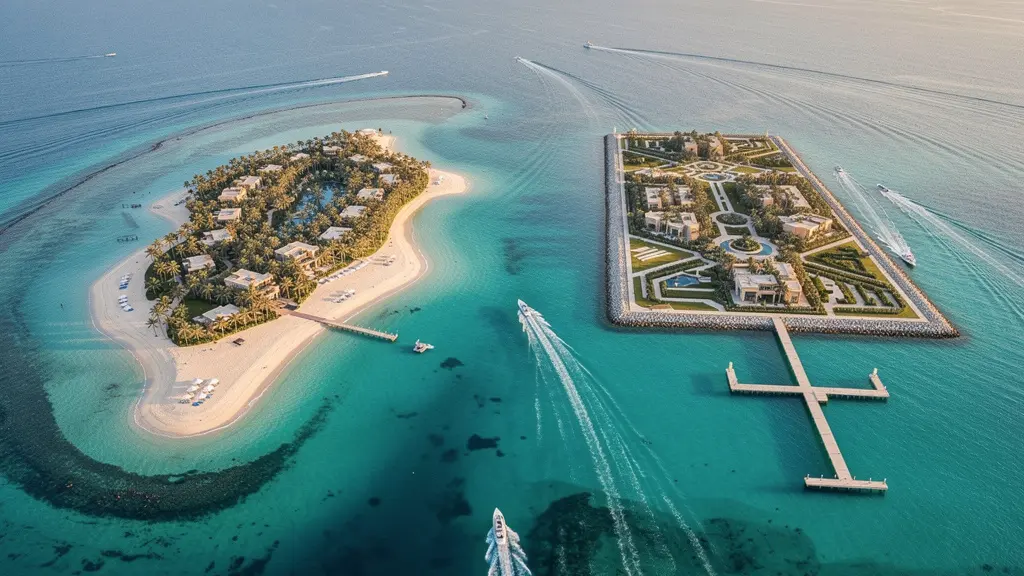
The choice between Zaya Nurai and Anantara World Islands hinges on your definition of luxury: natural, bohemian freedom versus structured, man-made perfection.
- Zaya Nurai offers greater flexibility and a more authentic, Maldives-like beach experience, but this comes with higher ambient costs.
- Anantara World Islands provides unparalleled privacy and manufactured calm, but its rigid logistics can define—and sometimes limit—your stay.
Recommendation: Choose Zaya Nurai for spontaneous, day-to-night escapes. Choose Anantara World Islands for a planned, truly secluded overnight retreat where the island itself is the destination.
For the discerning traveler in the UAE, the siren call of a Maldives-style escape without the air miles is a potent fantasy. The options crystallize into two titans of indulgence: Zaya Nurai Island, Abu Dhabi’s established bohemian paradise, and Anantara World Islands, the ambitious newcomer offering a new form of seclusion off Dubai’s coast. The brochures promise sun-drenched privacy and turquoise waters, but the reality of a perfect island getaway is written in the fine print of boat schedules, the grain of the sand, and the unspoken rules of room service.
Many comparisons focus on price or amenities, but they miss the point. The true currency of a luxury escape is seamlessness, and the ultimate luxury is choice. But what if the very structure of the resort dictates every choice you make? This isn’t just about comparing villas or restaurants. It’s about understanding the fundamental character of each island. We’ll move beyond the polished images to dissect the experiential friction points that can make or break your stay, from logistical constraints to the very real question of authenticity. The ultimate decision isn’t about which island is better, but which island’s philosophy of luxury aligns with your own.
This deep-dive comparison will guide you through the critical, often overlooked, factors that define these exclusive experiences. By understanding the nuances of access, privacy, and even the texture of the sand beneath your feet, you can make an informed choice that ensures your private island retreat is genuinely worth the boat ride.
Summary: Zaya Nurai or The World Islands: A Luxury Showdown
- Why Does the Boat Transfer Schedule Dictate Your Entire Stay?
- How to Ensure Your Island Villa Is Not Visible to Neighbors?
- Natural Sand or Dredged: Does the Beach Feel Artificial on World Islands?
- The Room Service Mistake of Ordering Off-Menu on an Island
- Day Pass vs Overnight: When Is It Cheaper to Just Visit for the Day?
- Dibba or Fujairah City: Which Area Offers Better Seclusion?
- Calm Lagoon or Open Waves: Which Water Is Safer for Non-Swimmers?
- Hotel Pool Cabanas: Are They Worth the Minimum Spend Requirement?
Why Does the Boat Transfer Schedule Dictate Your Entire Stay?
An island’s exclusivity is defined by its access, and the boat transfer is the first and last chapter of your story. It’s not merely transport; it’s the rhythm to which your entire stay must dance. The difference in philosophy between Zaya Nurai and Anantara World Islands is immediately apparent here. Zaya Nurai operates like a sophisticated water taxi service, with boats running hourly, granting you a liberating sense of freedom. As one detailed account shows, guests can enjoy a full day, shower, change, and head back to the mainland for an evening of shopping before catching a late-night flight. This flexibility transforms the island from a destination resort into a seamless part of a larger UAE itinerary.
Anantara World Islands, by contrast, operates on a more structured, scheduled basis. While this ensures a tranquil and orderly arrival, it introduces a layer of experiential friction. Your spontaneity is tethered to their timetable. Furthermore, private transfers, while available, come at a significant premium; private boat transfers can cost AED 3,800 for a round trip, a cost that firmly anchors you to the resort’s schedule. This logistical rigidity means you don’t just visit the island; you commit to its tempo.
The choice between these two approaches comes down to control. Do you prefer the freedom to come and go as you please, or the structured serenity of a meticulously planned escape? The following table breaks down the practical differences.
| Resort | First Boat | Last Boat | Frequency | Journey Time |
|---|---|---|---|---|
| Zaya Nurai Island | 7:30 AM | 12:30 AM | Every hour | 12 minutes |
| Anantara World Islands | Variable | Variable | Scheduled times | 20 minutes |
How to Ensure Your Island Villa Is Not Visible to Neighbors?
The promise of a private villa is the promise of seclusion—a sanctuary where the outside world ceases to exist. Both resorts sell this dream, but deliver it in fundamentally different ways. At Anantara World Islands, privacy is an architectural mandate. As a purpose-built luxury destination on a man-made island, it was designed from the ground up with seclusion in mind. The very layout of its 70 rooms, suites, and thatched-roof villas is a testament to this, engineered to minimize sightlines and maximize personal space. This is a place built for high-profile guests who demand absolute discretion.
This emphasis on security and exclusivity is a core part of its identity. As CNN Travel notes, the island’s access protocol is rigorous, creating a veritable fortress of solitude. This creates a powerful, if somewhat sterile, sense of security.
Nobody can get onto the island without registering their passport, making sure that those who come, including royalty, are guaranteed the utmost privacy and security
– CNN Travel, Dubai’s luxury island where every room opens onto a private beach
Zaya Nurai, with its more organic, sprawling layout, presents a different kind of privacy. The lush vegetation and clever positioning of villas create a feeling of being lost in a tropical jungle. However, this natural seclusion can be more variable. Some villas offer impeccable privacy, while others might offer a glimpse of a neighboring roof or a path used by other guests. The privacy illusion is at play here: what feels secluded may not be completely isolated. The key is due diligence. When booking, it’s essential to consult resort maps and guest reviews, or even call the resort directly to request a villa known for its superior isolation. The trade-off is clear: engineered, guaranteed privacy at Anantara versus natural, more variable seclusion at Nurai.
Natural Sand or Dredged: Does the Beach Feel Artificial on World Islands?
A private island fantasy is incomplete without the feel of soft, powdery sand between your toes. This tactile experience is a crucial, though often subconscious, measure of authenticity. Here, the origins of the two islands create a stark contrast. Zaya Nurai Island is surrounded by what guests consistently describe as “powder-white soft sand,” a natural beach environment that evokes the very essence of the Maldives. It’s breathtakingly beautiful, an organic paradise that feels timeless and real.
The World Islands, on the other hand, face a unique challenge: the authenticity deficit. The archipelago is an engineering marvel, but one built from specific materials. The islands are composed mainly of sand dredged from Dubai’s shallow coastal waters. While pristine and beautiful, this sand has a different character. Natural beach sand has been tumbled by waves for millennia, its grains rounded and smooth. Dredged sand can be more angular and coarse. This is not a matter of quality, but of texture and feel. To the casual beachgoer, the difference may be negligible. But for the connoisseur of coastal luxury, it can be the subtle dissonance that whispers “man-made” in an otherwise perfect paradise.
This macro-level difference in sand composition speaks to the core identity of each island, a tactile detail that can be surprisingly significant.

The visual distinction, as seen in a close-up comparison, is subtle but real. One represents a naturally occurring luxury, the other a perfectly engineered one. There is no right or wrong, only preference. Do you want the authentic, slightly imperfect feel of a natural ecosystem, or the guaranteed, uniform perfection of a meticulously constructed one? The answer reveals much about what you truly seek in an island escape.
The Room Service Mistake of Ordering Off-Menu on an Island
On a private island, room service is not a convenience; it’s a lifeline. However, this captive market environment comes with its own set of rules and pitfalls. The single biggest mistake a guest can make is assuming the kitchen’s capabilities are as boundless as the ocean view. Ordering off-menu, a request that might be effortlessly accommodated in a city hotel, introduces significant experiential friction on an island. Logistics are everything. Ingredients are limited, supply chains are complex, and kitchen staff are trained for efficiency on a specific menu. An off-piste request can lead to delays, disappointment, and a dish that is a pale imitation of your craving.
Furthermore, pricing operates in its own stratosphere. As frequent guests have noted, on-island costs can be eye-watering, with some reports citing that alcohol can be triple mainland prices. This isn’t just about a luxury markup; it’s the economics of isolation. Every bottle, every ingredient, has undertaken a journey to get to your plate. To navigate this successfully, a strategic approach to ordering is not just wise; it’s essential for a seamless experience. Rather than fighting the system, the savvy guest learns to work within it, ensuring both satisfaction and value.
Action Plan: Smart Ordering on an Island Resort
- Review the fresh seafood display at restaurants like Hooked to see what’s actually available that day.
- Ask about frequently requested ‘guest favorites’ that kitchen staff are practiced at making.
- For dietary restrictions, communicate needs at check-in rather than at meal time.
- Take advantage of included breakfast buffets before they end to reduce lunch costs.
- Consider the day pass food credit (AED 420 at Nurai) to test dining options before committing to overnight stays.
Day Pass vs Overnight: When Is It Cheaper to Just Visit for the Day?
The ultimate question for many is one of value. When does the indulgence of an overnight stay justify its considerable cost over the fleeting pleasure of a day pass? The answer lies in calculating a metric that brochures ignore: the value-per-hour. A simple cost analysis reveals that, on a purely financial basis, the day pass offers a more accessible entry point to paradise. At Zaya Nurai, for example, the cost per hour for a day guest is significantly lower than for an overnight guest.
However, this calculation is deceptively simple. It doesn’t account for the intangible, yet priceless, benefits of an overnight stay. The true luxury is not just accessing the facilities; it’s possessing the island when the day-trippers have departed. It’s the silent, golden hour of sunrise on a completely empty beach, a privilege reserved exclusively for those who stay. This is the experience that the UAE’s affluent population, part of a luxury tourism market valued at nearly USD 20 billion, is increasingly willing to pay a premium for. The day pass buys you access; the overnight stay buys you ownership, however temporary.
The day pass is a test drive. The overnight stay is the full experience. The table below quantifies the cost, but the true value is a personal calculation of what you cherish more: accessible luxury or exclusive serenity.
| Option | Cost | Duration | Inclusions | Cost per Hour |
|---|---|---|---|---|
| Zaya Nurai Day Pass | AED 480 | ~10 hours | AED 420 F&B credit, beach/pool access, boat transfer | AED 48/hour |
| Zaya Nurai Overnight | ~USD 1,000 (AED 3,670) | 24 hours | Villa, private pool, beach access, boat transfer | AED 153/hour |
| Anantara Day Visit | AED 150 boat + dining | ~8 hours | Restaurant access, boat transfer | Variable |

Dibba or Fujairah City: Which Area Offers Better Seclusion?
While the private islands off Abu Dhabi and Dubai’s coasts offer one model of seclusion, the east coast of the UAE presents another. Areas like Dibba and Fujairah City provide a different flavor of escape, one defined by rugged mountains and a more traditional coastal feel. However, when comparing this to the hyper-exclusive model of The World Islands, the definition of “seclusion” itself must be re-examined. Seclusion on the east coast is about distance from the urban core. Seclusion at Anantara World Islands is about creating a separate, curated universe.
Anantara World Islands isn’t just off the coast; it’s a destination within a destination, located on the “South American continent” of the man-made archipelago. This isn’t just geographical marketing; it’s a statement of intent. The resort is part of a larger project, a revival of The World Islands that has seen AED 1.8 billion in transactions in 2024, targeting Ultra High-Net-Worth Individuals with a promise of a private-island lifestyle just minutes from the mainland. The seclusion here is not about being far away; it’s about being in an inaccessible, highly controlled bubble. It’s a seclusion spectrum where privacy is manufactured and guaranteed, rather than found in nature.
In contrast, the seclusion of Dibba or Fujairah is more organic. You might share a beach with local fishermen or find a quiet cove, but it is part of a larger, accessible world. The World Islands offers a more absolute, if artificial, form of isolation. For the guest who wants to be completely removed from the world, while remaining geographically close to its center, the appeal is undeniable. It’s the ultimate paradox: a remote hideaway floating in plain sight.
Calm Lagoon or Open Waves: Which Water Is Safer for Non-Swimmers?
The allure of turquoise water is universal, but for families with young children or less confident swimmers, the nature of that water is a critical safety consideration. The open, natural coastline of an island like Zaya Nurai offers the authentic ebb and flow of the sea. While beautiful, this can mean variable currents, occasional waves, and a seabed that changes with the tides. It’s a wilder, more natural beauty that requires constant supervision.
The World Islands, by its very design, offers a different proposition. The entire archipelago is sheltered by a massive, 27-kilometer-long breakwater. This engineering feat transforms the surrounding sea into a vast, placid lagoon. The result is consistently calm, predictable water, free from strong currents or surprising waves. This makes it an exceptionally safe environment for water activities, particularly for non-swimmers and children. The resort capitalizes on this, offering activities like paddleboarding and kayaking in waters that are as serene as a swimming pool.
This manufactured calm provides peace of mind that is hard to quantify but invaluable for families seeking a stress-free beach holiday. The choice is between the invigorating unpredictability of the open ocean and the tranquil certainty of a protected lagoon.
Checklist: Water Safety Features for Families
- Calm waters suitable for paddleboarding and kayaking at World Islands.
- Soft sands extending around the island perimeter for safe beach access.
- Supervised water sports with professional instructors at both resorts.
- Kids’ club activities including supervised banana boat rides.
- Shallow entry areas designated for children and non-swimmers.
Key takeaways
- The boat schedule is not a minor detail; it defines the freedom and flexibility of your entire stay.
- True villa privacy is a function of design and vegetation, not just marketing claims; scrutinize resort maps.
- The feel of the sand—natural versus dredged—is a subtle but powerful indicator of an island’s authenticity.
Hotel Pool Cabanas: Are They Worth the Minimum Spend Requirement?
In the world of luxury resorts, the pool cabana has evolved from a simple shaded recliner to a private micro-club, complete with its own economy of minimum spends and exclusive amenities. The question is no longer just about comfort, but about calculated value. Are they worth it? The answer depends entirely on the experience they curate. At Zaya Nurai’s famed Smokin’ Pineapple beach club, the cabanas are part of a meticulously crafted “Instagram-worthy” ecosystem. The experience is a blend of bohemian chic, with hammocks, tipis, and the iconic water swings, all designed to create a vibrant, photogenic atmosphere that feels exclusive and desirable.
In this context, the minimum spend is not just a fee; it’s an access pass to a specific lifestyle. You are not just paying for a seat; you are investing in an afternoon of curated cool, a backdrop for social media, and a sense of belonging to an in-the-know tribe. This trend is a microcosm of a larger movement in UAE’s luxury sector. The incredible growth of the yacht charter market, projected to reach USD 330.9 million by 2030, is driving demand for similar high-end, experience-focused shore-side amenities. Guests accustomed to the bespoke service of a private yacht expect an equivalent level of exclusivity on land.
So, is the cabana worth it? If you plan to spend the entire day indulging in food and drinks, the minimum spend can often be met organically, making the cabana effectively “free”. It becomes a strategic choice for a group wanting a dedicated base. However, for a couple just seeking shade for an hour, it’s an unjustifiable extravagance. The cabana’s worth is a direct function of your intended length of stay and your desire to participate in the resort’s curated social scene.
Ultimately, choosing the right island escape is an exercise in self-awareness. By looking past the brochure and decoding the subtle cues—the logistics, the textures, the unspoken rules—you can align your desires with the reality of the destination, ensuring your investment of time and money yields the most precious commodity of all: a perfect memory.